

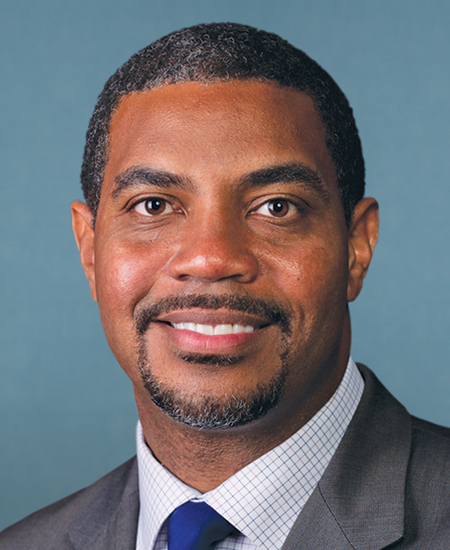
Photo of Steven Horsford
D United States House · District 4 · Nevada On the 2026 ballot

Rep. Steven Horsford

Compare
Total votes
2,837
all sessions
Attendance
98%
58 missed
Near the chamber average
With party
95%
of cast votes
Lower than 83% of chamber peers
Bipartisan score
2%
crosses aisle rarely
Higher than 82% of chamber peers
Sponsored
1,245
bills & resolutions
Near the chamber average
Committees
3
assignments
1,245 bills and resolutions

Sponsored bills

Total
1,245
Primary
82
Co-sponsor
1,163
This page
1,245
matching current filters
Co-sponsor HR 2586
In committee · United States House · Co-sponsor
Reentry Act of 2025

Maddy summaryHR 2586, the Reentry Act of 2025, amends Medicaid rules to allow incarcerated individuals to receive Medicaid coverage during the 30 days immediately before their release from prison or jail. This directly affects people leaving correctional facilities, ensuring they can access health care as they transition back into communities. The bill requires a report within 18 months analyzing current health care standards in prisons, the number of people who would gain coverage, and current discharge practices to improve Medicaid enrollment for newly released individuals. The report will also assess how to better connect people with community health services and addiction treatment after release.

In committee Apr 1, 2025 1 co-sponsor
Primary HR 2554
In committee · United States House · Lead sponsor
Lower Drug Costs for Families Act

Maddy summaryHR 2554, the Lower Drug Costs for Families Act, modifies how Medicare calculates rebates for prescription drugs under Parts B and D. It changes the base year for rebate calculations from 2021 to 2016, which would increase rebates to Medicare by accounting for higher drug price growth since 2016. The bill also adjusts how "commercial market" drug units are counted for rebates, excluding units paid for through Medicaid or other programs. These changes apply to Medicare Part B drugs starting in 2026 and Part D drugs starting in 2025, directly affecting drug manufacturers and Medicare's rebate payments.

In committee Apr 1, 2025 0 co-sponsors
Primary HR 2553
In committee · United States House · Lead sponsor
Capping Prescription Costs Act of 2025

Maddy summaryHR 2553, the Capping Prescription Costs Act of 2025, limits out-of-pocket costs for prescription drugs under health insurance. It sets a $2,000 annual cap per individual or $4,000 per family for covered prescriptions starting in 2026, with annual adjustments based on the medical care CPI. The bill applies directly to people with employer-sponsored group health plans, individual health insurance plans, and plans covered under the Affordable Care Act. It requires insurers and plan sponsors to ensure cost-sharing for prescriptions does not exceed these limits, effective for plan years beginning January 1, 2026.

In committee Apr 1, 2025 0 co-sponsors
Co-sponsor HR 2509
In committee · United States House · Co-sponsor
COMPLETE Care Act

Maddy summaryHR 2509, the COMPLETE Care Act, creates Medicare payment incentives for primary care providers who integrate specific behavioral health services into their practice. It directly affects Medicare providers offering services identified by HCPCS codes 99484, 99492, 99493, 99494, G2214, and G0323 (covering models like Collaborative Care and Primary Care Behavioral Health) during 2027-2029. The bill increases Medicare payments for these services to 125-175% of standard rates (phasing down from 175% in 2027 to 125% in 2029) and waives budget neutrality rules to fund these higher payments. Additionally, it requires the HHS Secretary to provide technical assistance to primary care practices adopting these models by 2026, with dedicated funding for 2025-2029.

In committee Mar 31, 2025 1 co-sponsor
Co-sponsor HR 1661
In committee · United States House · Co-sponsor
SAFE Act of 2025

Save America's Forgotten Equines Act of 2025 or the SAFE Act of 2025 This bill permanently prohibits the slaughter of equines (e.g., horses and mules) for human consumption. (Current law prohibits the slaughter of dogs and cats for human consumption. This bill extends the prohibition to equines.) Specifically, this bill prohibits a person from knowingly (1) slaughtering an equine for human consumption; or (2) shipping, transporting, possessing, purchasing, selling, or donating an equine to be slaughtered for human consumption or equine parts for human consumption. The bill subjects a violator to a fine. The bill applies to conduct in or affecting interstate or foreign commerce or within the special maritime and territorial jurisdiction of the United States. However, it does not apply to an activity carried out by an Indian for a religious ceremony. As background, in recent years, the appropriations acts have prohibited the Department of Agriculture (USDA) from using federal funds to inspect horses before they are slaughtered for human consumption. Therefore, there are currently no USDA-inspected horse slaughter facilities in the United States.

In committee Mar 28, 2025 1 co-sponsor
Co-sponsor HR 2464
In committee · United States House · Co-sponsor
Repealing Outdated and Unilateral Tariff Authorities Act

Maddy summaryThis bill repeals Section 338 of the Tariff Act of 1930 (19 U.S.C. 1338), which granted the President unilateral authority to impose tariffs without Congressional approval. It directly affects the President's ability to use this specific provision for tariff actions. The key mechanism is the removal of this legal authority from U.S. trade law. The bill makes no other changes to tariff policy or procedures.

In committee Mar 27, 2025 1 co-sponsor
Co-sponsor HR 2410
In committee · United States House · Co-sponsor
Revitalizing Downtowns and Main Streets Act

Maddy summaryHR 2410 creates a 20% federal tax credit for developers converting older non-residential buildings (at least 20 years old) into affordable housing. The credit applies to qualified conversion costs, requiring that 20% of units be rent-restricted for residents earning 80% or less of the area median income for 30 years. It establishes a $12 billion national credit limit, with $3 billion reserved for conversions in economically distressed areas, and mandates state-level allocation plans prioritizing projects near transit and employment. The bill directly affects developers seeking tax incentives for downtown revitalization, not tenants or local governments.

In committee Mar 27, 2025 1 co-sponsor
Co-sponsor HR 2459
In committee · United States House · Co-sponsor
Reclaim Trade Powers Act

Reclaim Trade Powers Act This bill repeals the statute that directs the President to take certain actions, such as imposing a tariff of up to 15% for up to 150 days on articles imported into the United States, when necessary to address large and serious U.S. balance-of-payments deficits or certain other situations that present fundamental international payments problems.

In committee Mar 27, 2025 1 co-sponsor
Co-sponsor HR 1725
In committee · United States House · Co-sponsor
Sgt. Isaac Woodard, Jr. and Sgt. Joseph H. Maddox GI Bill Restoration Act of 2025

Maddy summaryThis bill provides housing loans and education assistance to Black World War II veterans who were denied GI Bill benefits due to racial discrimination, or to their surviving spouses, children, or direct descendants. To qualify, applicants must certify they were denied benefits on racial grounds under the original 1944 GI Bill and apply within five years of the law's enactment. The Department of Veterans Affairs must implement these provisions within 90 days and report to Congress on participation and program costs. It specifically addresses documented historical discrimination where Black veterans were steered toward vocational training instead of college, with only 6% earning degrees compared to 19% of White veterans.

In committee Mar 27, 2025 1 co-sponsor
Co-sponsor HR 1733
In committee · United States House · Co-sponsor
Rural Veterans Transportation to Care Act

Maddy summaryThis bill expands transportation assistance for rural veterans by updating a Department of Veterans Affairs grant program. It allows grants to be awarded to county veterans service organizations and tribal organizations, in addition to existing recipients, and increases the maximum grant amount to $80,000 for organizations needing to purchase ADA-compliant vehicles. The bill defines "rural" using the USDA's Rural-Urban Commuting Areas (RUCA) system and removes fixed annual funding limits, allowing for flexible budgeting. It directly affects rural veterans who need transportation to healthcare facilities and the organizations that provide this service.

In committee Mar 27, 2025 1 co-sponsor
Showing 341 to 350 of 1,245 bills
Previous 1 … 34 35 36 … 125 Next