

Teacher and Educator Access to Crucial Health and Wellness Act of 2022 or the TEACH Act of 2022 This bill directs the Department of Education to award grants to state educational agencies and, through them, subgrants to local educational agencies to implement or improve health and wellness programs for education professionals. It also requires the National Institutes of Health to study the impact of COVID-19 on the mental health of education professionals.
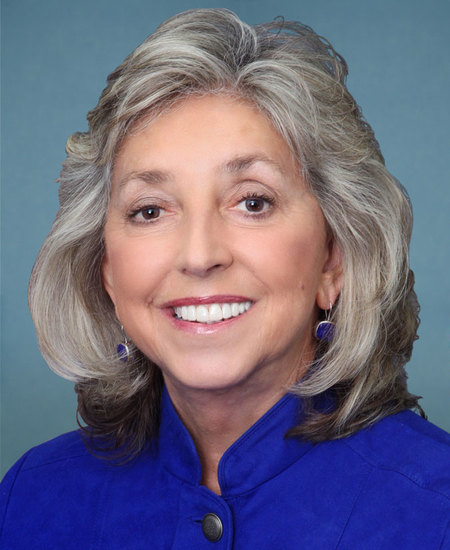
Rep. Dina Titus
Sponsored bills
Planning for Animal Wellness Act or the PAW Act This bill directs the Federal Emergency Management Agency (FEMA) to establish a working group relating to best practices and federal guidance for animals in emergencies and disasters. Specifically, the working group shall (1) encourage and foster collaborative efforts among individuals and entities working to address the needs of household pets, service and assistance animals, and captive animals in emergency and disaster preparedness, response, and recovery; and (2) review best practices and federal guidance on sheltering and evacuation planning relating to the needs of such pets and animals.
Bulb Replacement Improving Government with High-efficiency Technology Act or the BRIGHT Act This bill expands requirements relating to the procurement and use of energy-efficient lighting in federal buildings. Under current law, public buildings that are constructed or managed by the General Services Administration (GSA) must be equipped with energy-efficient light bulbs and fixtures. Under the bill, buildings must be equipped with the most life-cycle cost effective and energy-efficient lighting systems available, including with respect to sensors, fixture distribution, and other elements. The bill also specifically establishes requirements relating to the procurement of such lighting systems and modifies other requirements accordingly. The bill also requires the GSA to provide information to federal, state, local, and tribal entities about procuring and using such lighting systems in furtherance of governmental efficiency.
This resolution recognizes the anniversaries of the International Day of Peace, Human Solidarity Day, the International Day of Living Together in Peace, and other specified international days. The resolution also expresses that Congress commits to (1) encouraging the people of the United States to continue commemorating international days of peace, coexistence, and cooperation; and (2) supporting activities on such days that promote thoughtful, deliberative, and cooperative actions to achieve peace.
This concurrent resolution commends the bravery, courage, and resolve of the women and men of Iran who are (1) participating in the current protests to defend their fundamental human rights, and (2) risking their safety to speak out against the human rights abuses committed by the Iranian regime. The resolution condemns (1) the brutal beating and death of Mahsa Amini; and (2) the violent suppression by the Iranian regime of women and men participating in the current demonstrations, including children, and calls for transparent accountability for all killings of protesters by Iranian security forces. Finally, the resolution encourages continued efforts by the Biden Administration to respond to the protests, including the recent sanctioning of the Iranian morality police.
Veteran Service Recognition Act of 2022 This bill addresses immigration-related issues pertaining to noncitizen (or non-U.S. national) military veterans, including by authorizing the Department of Homeland Security (DHS) to provide lawful permanent resident status to a veteran subject to removal. If a noncitizen veteran appears to be eligible for lawful permanent resident status under this bill, that veteran must receive a reasonable opportunity to apply for such status and may not be removed until there is a final administrative decision on the veteran's eligibility. For the purposes of providing such status under this bill, DHS may waive any applicable grounds of inadmissibility, except for certain crime- or security-related grounds. The bill also extends certain deadlines relating to obtaining citizenship after serving in the Armed Forces. DHS must create a system for identifying noncitizens who are or may be veterans. Before initiating removal proceedings against a noncitizen, DHS must attempt to determine whether the noncitizen is a veteran. DHS must ensure that veteran status is considered in immigration proceedings. The bill also requires U.S. Citizenship and Immigration Services (USCIS) and the Department of Defense to take certain actions to facilitate opportunities for military recruits and veterans to obtain U.S. citizenship, such as by training Judge Advocate General Corps members to act as liaisons between the Armed Forces and USCIS on servicemember citizenship applications. The bill also establishes the Military Family Immigration Advisory Committee to provide recommendations on cases involving the removal of a servicemember, veteran, or certain family members of a servicemember or veteran. Such an individual may not be removed until the committee has provided a recommendation to DHS about the individual's case, unless the individual is inadmissible due to a conviction for an aggravated felony. The bill also waives certain grounds of inadmissibility (e.g., being unlawfully present in the United States) for certain noncitizens applying for lawful permanent resident status as an immediate relative of a U.S. citizen who has served at least two years in the Armed Forces.
READ Act Reauthorization Act of 2022 This bill reauthorizes a law that requires the implementation of a strategy to promote quality basic education in partner countries by (1) expanding access to basic education for all children, particularly marginalized children and vulnerable groups; and (2) improving the quality of basic education and learning outcomes.
Safe Connections Act of 2022 This act establishes requirements concerning access to communication services for survivors of domestic violence, human trafficking, and related harms. At a survivor's request, a mobile service provider must separate from a shared mobile service contract the survivor's line (and the line of any individual in the survivor's care) from the abuser's line unless separation is operationally or technologically infeasible. A survivor requesting this must (1) verify through appropriate documentation that an individual under the contract committed or allegedly committed an act of domestic violence, trafficking, or a related criminal act against the survivor; and (2) assume financial responsibility for services after a line separation. A provider may not charge fees or impose other requirements on such requests. Additionally, a provider must separate the line within two business days of receiving a request; allow requests to be made remotely (if feasible); meet conditions related to confidentiality of, disposal of, and other matters concerning communications about requests; and make information about the process for requests available through consumer-facing communications (e.g., websites). The act (1) provides liability protection for providers' acts or omissions undertaken to comply with such requests, and (2) requires the Federal Communications Commission (FCC) to adopt rules for these requests. Additionally, the FCC must (1) expand access to federally subsidized communication services for survivors facing financial hardship, and (2) evaluate this expanded access. The FCC must also consider rules requiring communication service providers to omit from consumer-facing logs calls and texts to hotlines for domestic violence and similar issues while retaining internal records.
Truth and Healing Commission on Indian Boarding School Policies Act This bill establishes the Truth and Healing Commission on Indian Boarding School Policies in the United States and sets forth its powers, duties, and membership. Among other duties, the commission must investigate the impacts and ongoing effects of the Indian Boarding School Policies (federal policies under which American Indian, Alaska Native, and Native Hawaiian children were forcibly removed from their family homes and placed in boarding schools). Further, the commission must develop recommendations on ways to (1) protect unmarked graves and accompanying land protections; (2) support repatriation and identify the tribal nations from which children were taken; and (3) discontinue the removal of American Indian, Alaska Native, and Native Hawaiian children from their families and tribal communities by state social service departments, foster care agencies, and adoption agencies.
The Jackie Walorski Maternal and Child Home Visiting Reauthorization Act of 2022 This bill reauthorizes through FY2027, increases funding for, and modifies the Maternal, Infant, and Early Childhood Home Visiting Program. This program supports home visits for expectant and new parents who live in communities that are at-risk for poor maternal and child health outcomes. Changes to the program include setting out requirements for allocating program funds; increasing the percentage of funds reserved for tribal entities; establishing a publicly available dashboard that reports program outcomes; requiring activities to reduce unnecessary data collection, reporting, and other administrative requirements of the program; and allowing for virtual home visits (provided certain conditions are met). The bill also reduces funding for the Medicare Improvement Fund.