

Puppies Assisting Wounded Servicemembers Act of 2021 or the PAWS Act of 2021 This bill requires the Department of Veterans Affairs (VA) to implement a grant program for the purpose of pairing service dogs with eligible veterans. Organizations that receive grants must provide veterinary health insurance coverage, hardware, and travel expenses for each service dog and veteran participating in the program. Eligible veterans are those who (1) are enrolled in the VA health care system, (2) have been evaluated and treated for post-traumatic stress disorder (PTSD) but remain diagnosed with PTSD, (3) may benefit from a service dog, and (4) agree to successfully complete training provided by an eligible organization. Veterans are required to see a VA health care provider at least once every six months to determine whether the veteran continues to benefit from a service dog. Eligible organizations are nonprofit organizations that provide service dogs to veterans with PTSD, meet publicly available standards set forth by the Association of Service Dog Providers for Military Veterans, have expertise in the needs of veterans with PTSD, agree to cover all costs in excess of the grant amount to guarantee the benefits of the program, agree to reaccept or replace a service dog provided to a veteran, and submit an application to the VA. Any improvement in PTSD symptoms as a result of the provision of a service dog shall not affect the veteran's eligibility for any other VA benefits. The Government Accountability Office must report on the grant program.
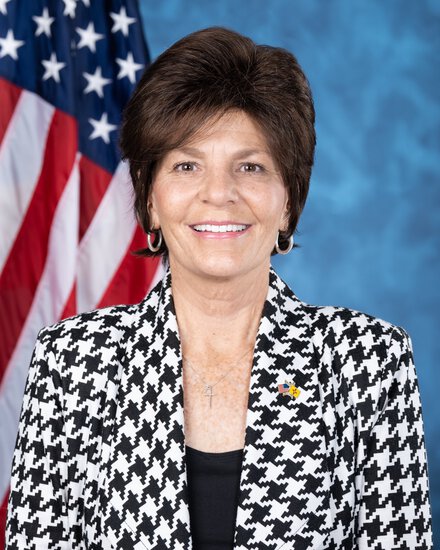
Rep. Yvette Herrell
Sponsored bills
Protecting Religion from Government Act of 2021 This bill prohibits a state or local government from imposing any law or regulation limiting the ability of a house of worship to hold any religious service or celebrate any religious ceremony in person. It creates a federal cause of action allowing a person to challenge a state or local regulation limiting the ability of the individual or religious institution to hold in-person services.
Border Crisis Prevention Act of 2021 This bill imposes additional requirements on asylum seekers, increases certain time limits related to detained aliens, and addresses other immigration-related issues. The Department of Homeland Security (DHS) must detain certain aliens, such as an alien convicted of an aggravated felony or believed to be a trafficker of controlled substances, beyond certain time limits for detaining an alien. The bill also provides for additional instances when DHS may extend the 90-day removal period (generally the window in which DHS has to remove an alien after a final order of removal). An alien choosing to appeal mandatory detention or detention as part of a removal period extension may do so only by filing for a writ of habeas corpus. DHS shall establish a process to determine whether an alien not subject to mandatory detention and who has tried to comply with a removal order should be detained or released with conditions. Furthermore, under this bill, an alien's credible fear of persecution must be more probable than not in order to be eligible for asylum. DHS may also deny asylum to an applying alien and remove the alien to a country that is not the alien's country of nationality, if the alien would be safe and would be able to apply for asylum from that country. (Currently, an asylum applicant may be removed to a third country only if that country is party to an agreement allowing for such removal.) The Department of Justice may appoint 100 additional immigration judges.
Heartbeat Protection Act of 2021 This bill makes it a crime for a physician to knowingly perform an abortion (1) without determining whether the fetus has a detectable heartbeat, (2) without informing the mother of the results, or (3) after determining that a fetus has a detectable heartbeat. It provides an exception for an abortion that is necessary to save the life of a mother whose life is endangered by a physical (but not psychological or emotional) disorder, illness, or condition. A physician who performs a prohibited abortion is subject to criminal penalties—a fine, up to five years in prison, or both. A woman who undergoes a prohibited abortion may not be prosecuted for violating or conspiring to violate the provisions of this bill.
Teleabortion Prevention Act of 2021 This bill restricts the use of telehealth for chemical abortions (also known as medication abortions). Specifically, it requires a provider who dispenses or prescribes medication for a chemical abortion to physically examine the patient, be physically present at the location of the chemical abortion, and schedule a follow-up visit. The bill provides an exception for a chemical abortion that is necessary to save the life of a mother whose life is endangered by a physical disorder, illness, injury, or condition. The bill establishes criminal penalties—a fine, a prison term of up to two years, or both—for a provider who does not comply with the requirements. A patient who undergoes a chemical abortion may not be prosecuted.
Born-Alive Abortion Survivors Protection Act This bill establishes requirements for the degree of care a health care practitioner must provide in the case of a child born alive following an abortion or attempted abortion. Specifically, a health care practitioner who is present must (1) exercise the same degree of care as would reasonably be provided to any other child born alive at the same gestational age, and (2) ensure the child is immediately admitted to a hospital. Additionally, a health care practitioner or other employee who has knowledge of a failure to comply with the degree-of-care requirements must immediately report such failure to law enforcement. A health care practitioner who fails to provide the required degree of care, or a health care practitioner or other employee who fails to report such failure, is subject to criminal penalties—a fine, up to five years in prison, or both. An individual who intentionally kills or attempts to kill a child born alive is subject to prosecution for murder. The bill bars the criminal prosecution of a mother of a child born alive under this bill and allows her to bring a civil action against a health care practitioner or other employee for violations.
Let States Cut Taxes Act This bill removes a prohibition on states and territories using COVID-19 (i.e., coronavirus disease 2019) relief funding under the American Rescue Plan Act of 2021 to offset a reduction in revenue resulting from a reduction in taxes or a delay in the imposition of a tax or tax increase.
Unauthorized Spending Accountability Act of 2021 This bill establishes a three-year budgetary level reduction schedule for unauthorized programs funded through the annual appropriations process. Under the bill, a budgetary level is an allocation provided to the congressional appropriations committees under Section 302(a) of the Congressional Budget Act of 1974 by a congressional budget resolution or a deeming resolution. The schedule applies to programs included in the Congressional Budget Office's annual report listing programs that are funded through the appropriations process and have an authorization of appropriations that has either expired or will expire during the year. For the first year after a program's authorization has expired, the bill requires the budgetary level to be reduced by 10% of the funds appropriated for the program in the expiring fiscal year. The bill then requires reductions of 15% in the second and third years before terminating the program at the end of the third unauthorized year. Programs that are reauthorized during the three-year period are exempt from the budgetary level reductions if the reauthorization contains a sunset provision limiting the authorization of appropriations period to no more than three years. The bill establishes the Spending and Accountability Commission to review all mandatory spending programs and submit to Congress a legislative proposal to establish an authorization cycle for discretionary spending programs. The commission may recommend legislation to replace the budgetary level reductions required by this bill with reductions in mandatory spending. The commission's reauthorization schedule must limit reauthorizations to three years, include the budgetary level reductions established by this bill, and establish a mechanism for replacing the budgetary level reductions with reductions to mandatory spending programs. The House of Representatives must consider the commission's proposal using specified expedited legislative procedures.
Working Families Flexibility Act of 2021 This bill revises requirements for the receipt of compensatory time off for private sector employees. Specifically, the bill authorizes private employers to provide compensatory time off to their employees at a rate of one and one-half hours for each hour of employment for which overtime compensation otherwise is required; employees may accrue a maximum of 160 hours of compensatory time. Employers are prohibited from interfering with an employee's right to or not request compensatory time off in lieu of payment of overtime compensation or from requiring an employee to use such compensatory time, and must give their employees 30-days notice before discontinuing a compensatory time policy. Employers are liable to employees for damages from violations of these requirements.
Global War on Terrorism Memorial Location Act This bill authorizes the establishment of a National Global War on Terrorism Memorial in the area of the National Mall.