

Protecting American Voters Act This bill requires the Department of Homeland Security (DHS) and the Social Security Administration (SSA) to provide certain information to a state election official, upon the official's request, to verify citizenship status for the purpose of voting in federal elections. Specifically, the agencies must provide the state election official with such information necessary to verify that an applicant for voter registration or a registrant on the official list of eligible voters is a U.S. citizen. DHS may respond to a request by using the Systematic Alien Verification for Entitlements program, which is used to verify immigration status. DHS may not charge a fee for this information. DHS must comply with any safeguards that the SSA determines are necessary to protect the confidentiality of an individual's Social Security number. Finally, the bill requires states to remove the names of noncitizens from their official lists of eligible voters.
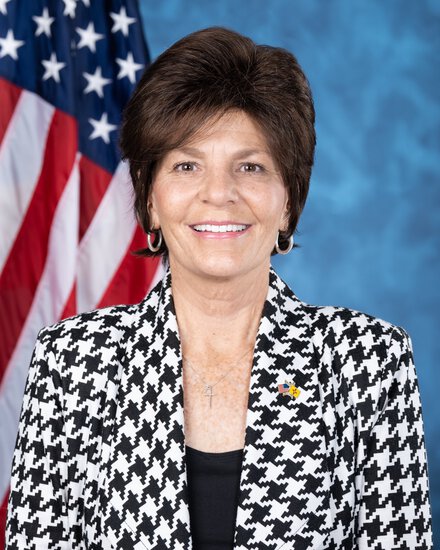
Rep. Yvette Herrell
Sponsored bills
This resolution commits to the use of competitive free market and free trade policies to combat national security threats caused by China and its attacks on the U.S. pharmaceutical manufacturing base. The resolution urges the United States to (1) remove tax, regulatory, and debt burdens and barriers that have weakened this base; (2) empower the U.S. Trade Representative to take specified actions to counter harmful and unfair trade practices by China; (3) address shortcomings in Food and Drug Administration data collection related to foreign-sourced pharmaceutical ingredients; and (4) identify and streamline regulatory hurdles that have impeded the U.S. pharmaceutical manufacturing base.
This resolution requires the chair of a House committee to administer a specific oath to any witness appearing before the committee. Currently, a committee chair is only authorized to administer an oath.
Protecting Higher Education from Foreign Threats Act This bill prohibits an institution of higher education (IHE) from receiving federal funds for an award year in which the IHE employs an instructor who, while employed at the IHE and providing direct instruction to students, received funds from the Chinese Community Party. An IHE may regain eligibility for federal funds by demonstrating to the Department of Education that it no longer employs such instructor.
Davis-Bacon Repeal Act This bill repeals the Davis-Bacon Act, which requires that the locally prevailing wage rate be paid to various classes of laborers and mechanics working under federally-financed or federally-assisted contracts for construction, alteration, and repair of public buildings or public works. References in any law to a requirement under the Davis-Bacon Act shall be null and void.
State Tax Freedom Act This bill removes a prohibition on states and territories using COVID-19 relief funding under the American Rescue Plan Act of 2021 to offset a reduction in revenue resulting from a reduction in taxes or a delay in the imposition of a tax or tax increase. Additionally, the bill requires the Department of the Treasury to refund the state, territory, or tribal government any money that was repaid to the federal government since enactment of the American Rescue Plan Act of 2021 due to the state cutting taxes.
Reopening America by Supporting Workers and Businesses Act of 2021 This bill permits states to provide a one-time lump sum payment, through July 1, 2021, to individuals who (1) were eligible for COVID-19 pandemic unemployment compensation during any week after enactment of this bill, and (2) are no longer eligible as a result of becoming thereafter reemployed. Payments of $1,200 shall be paid to individuals who work at least 30 hours and $600 to individuals who work at least 20 hours but less than 30. The payments are available for claimants (1) who are not employed by a government entity, (2) who return to work for at least four consecutive weeks, and (3) whose annual salary does not exceed $75,000. Before receipt of a payment, the individuals' employers must verify their hours and earnings. Additionally, the bill (1) accelerates a scheduled increase in funding for reemployment services and eligibility assessments (RESEA), (2) allows states to use RESEA funds to serve all workers receiving unemployment benefits, and not just those most likely to exhaust their benefits; and (3) allows states to provide reemployment services to individuals receiving pandemic unemployment assistance and pandemic emergency unemployment compensation. Finally, the bill reinstates the requirement that unemployment claimants certify they are able, available, and actively seeking work.
Federal Agency Sunset Commission Act of 2021 This bill provides for the establishment of the Federal Agency Sunset Commission to submit to Congress a schedule for review and abolishment of each agency, including each advisory committee. The schedule for review shall be in the form of a joint resolution. Each agency shall be abolished unless reauthorized by Congress. For each agency, the commission must schedule a date of abolishment to occur at least once every 12 years. The commission must (1) review and evaluate the efficiency and public need for each agency using specified criteria; (2) analyze the authority claimed by the executive branch but not specifically authorized by statute; (3) recommend whether each agency should be abolished, reorganized, or continued; and (4) report to Congress on introduced legislation that would establish a new agency or a new program. The Government Accountability Office and the Congressional Budget Office, in cooperation with the Congressional Research Service, shall prepare an inventory of federal programs to assist Congress and the commission in carrying out this bill. The bill provides for expedited consideration of the schedule for review and abolishment.
Forest Information Reform Act or the FIR Act This bill specifies that neither the Department of Agriculture nor the Department of the Interior may be required to reinitiate consultation on a land management plan when a species is listed as threatened or endangered, critical habitat is designated, or new information concerning a listed species or critical habitat becomes available.
Redirecting Resources to the Border Act This bill addresses the relocation of personnel and fencing deployed in the National Capital Region in response to the January 6, 2021, attacks on the U.S. Capitol building and grounds. Specifically, the bill requires all fencing installed in response to the attacks to be relocated to the southern land border of the United States. The Department of Defense must reassign National Guard members who were deployed in response to the attacks to the National Capital Region on or after January 6, 2021, to the southern land border of the United States to assist U.S. Customs and Border patrol.