Increasing Health Coverage through HRAs Act of 2021 This bill provides statutory authority for the Department of the Treasury, the Department of Labor, and the Department of Health and Human Services rule dated June 20, 2019, which provides for the integration of health reimbursement arrangements and other account-based health plans with individual health insurance coverage or Medicare.
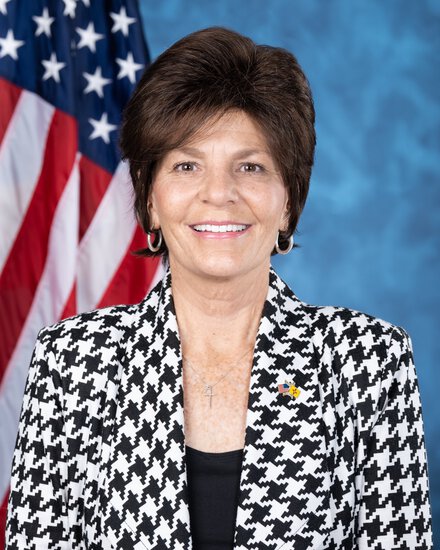
Rep. Yvette Herrell
Sponsored bills
This resolution requires an analytical statement to be included in committee reports on whether, and the extent to which, the increased budget authority, outlays, or revenue produced by the enactment of a bill or joint resolution may have an inflationary impact on prices and costs in the operation of the national economy and the purchasing power of low- and middle-income families.
Vote Outcome Transparency in Elections Act or the VOTE Act This bill establishes certain requirements for counting ballots in federal elections. Specifically, the bill requires the appropriate state or local election official, within one hour after the closure of a polling place on election day, to submit a report to the chief state election official. The report must document (1) the total number of voted ballots in the possession of the state or local official, and (2) the total number of voted ballots that have been tabulated for the election. Within one hour after the closure of polling places on election day, the chief state election official must (1) submit a final report to the chief executive of the state, and (2) make the final report publicly available on a government website. The bill also requires each state and local jurisdiction to ensure that voted ballots delivered by postal mail are postmarked, signed, or otherwise indicated as delivered by the U.S. Postal Service.
This bill requires the Department of Veterans Affairs to ensure that, if it creates a presumption of service-connection between the occurrence of a disease and exposure to an herbicide agent while serving in the Armed Forces between January 9, 1962, and June 30, 1976, at a military base in Thailand, such presumption must also apply to exposure at any military base in Thailand, regardless of where on the base the veteran was located or what military job specialty the veteran performed.
National Strategic and Critical Minerals Production Act of 2021 This bill sets forth environmental review requirements for the mine permitting process and limits the review to 30 months. Under the bill, projects that provide minerals vital to job creation, energy infrastructure, coastal resilience and restoration, economic competitiveness, and national security must be considered to be infrastructure projects as described in Executive Order 13807, titled Establishing Discipline and Accountability in the Environmental Review and Permitting Process for Infrastructure Projects and dated August 15, 2017.This order directed agencies to ensure that the environmental review and permitting process for infrastructure is coordinated, predictable, and transparent. The Bureau of Land Management (BLM)or the Forest Service must appoint a project lead for the mine permitting process to coordinate with other agencies to ensure that the agencies minimize delays, set and adhere to timelines for completion of the permitting process, set clear permitting goals, and track progress against goals. The project lead must also determine the amount of financial assurance required for reclamation of a mineral exploration or mining site. The bill considers the requirements of the National Environmental Policy Act of 1969to be satisfied if the BLM or the Forest Service determines that the agency issuing the permit will address specified factors, such as environmental impacts of the permit or alternatives to issuance of the permit. Additionally, the bill exempts projects on National Forest System land from regulations that prohibit timber tree cutting and road construction in areas without roads.
Trillion Trees Act This bills establishes a variety of requirements and incentives to plant trees and conduct other land management practices for the purposes of capturing and storing carbon in domestic and international trees and forests. Additionally, the bill provides incentives to research or develop other carbon sequestration tools. Specifically, the bill directs the Department of Agriculture (USDA) to set targets to increase forest carbon stock through January 1, 2100, for the purposes of sequestering and storing carbon in U.S. forests. It also establishes and provides funding for the Trillion Trees Challenge Fund to provide grants to nonfederal entities for activities related to reforestation efforts on public or private lands. In addition, it raises the cap on the Reforestation Trust Fund to enhance forest health in the National Forest System and requires the USDA to establish a Tree City USA Grant Program. The bill also allows the U.S. Agency for International Development to enter into an agreement with a nonprofit organization to establish an International Forest Foundation to promote reforestation and prevent deforestation. Additionally, it establishes requirements and incentives to address seedling shortages and support nurseries. Finally, the bill provides market incentives to research or develop other carbon sequestration tools relating to biochar, sustainable building practices, biochemical and bioplastic products, and biomass energy.
Biochar Innovations and Opportunities for Conservation, Health, and Advancements in Research Act of 2021 or the BIOCHAR Act of 2021 This bill establishes two temporary programs to encourage research, development, and commercialization of biochar. This is carbonized biomass produced by converting plant matter through reductive thermal processing for nonfuel uses. First, the Department of Agriculture (USDA) and the Department of Energy (DOE) must fund biochar demonstration projects through state, tribal, or local governments; land-grant colleges or universities; or private, nonprofit, or cooperative entities. In selecting projects, the departments must prioritize, for example, projects that (1) have the greatest potential for carbon sequestration; and (2) create new jobs and economic benefits, particularly in rural areas. Projects may use funds for various activities, including developing commercially and technologically viable biochar production units and demonstrating cost-effective market opportunities for biochar and biochar-based products. At least 50% of the plant matter used in a project must come from forest thinning and management activities on National Forest System land. In addition, USDA and DOE must conduct research related to the biochar produced from the projects. Second, USDA must establish a grant program for land-grant colleges and universities to conduct applied research on environmental and economic benefits of biochar. For the duration of the two programs, USDA and DOE must periodically report to Congress about issues related to commercialization of biochar and the status of the programs. The programs terminate after 10 years.

Flexible Financing for Rural America Act This bill allows rural utility service providers to submit to the Department of Agriculture (USDA) a request to adjust the interest rate or modify the terms of certain loans. The request shall include a report summarizing how the adjustment or modification will assist the borrower in providing critical utility services to a rural community. Specifically, on receipt of a request, USDA or the Department of the Treasury (in the case of a loan owned by the Federal Financing Bank) must adjust the interest rate on the loan to match certain interest rates for obligations of comparable maturity to the term remaining on the loan (or a higher rate requested by the borrower), and make modifications to the loan terms as necessary to address changes in the financial position of the borrower due to the COVID-19 public health emergency and to promote the financial sustainability of the borrower. In carrying out the adjustments or modifications, USDA or Treasury shall not impose or collect any fee from, or impose any penalty on, a borrower. The bill also provides funding to implement the adjustments and modifications and for the liquidation of residual intragovernmental amounts owed by the Federal Financing Bank in connection with certain loans.
This resolution requires an analytical statement to be included in committee reports on whether, and the extent to which, the increased budget authority, outlays, or revenue produced by the enactment of a bill or joint resolution may have an inflationary impact on prices and costs in the operation of the national economy and the purchasing power of low- and middle-income families.
Accessing America's Critical Minerals Act of 2021 This bill establishes deadlines to complete the environmental review of critical mineral projects on federal land and sets forth related requirements to expedite the review of such projects under the National Environmental Policy Act of 1969 (NEPA). If an environmental assessment or environmental impact statement is required for such project, then all necessary federal review and permit considerations must be completed within 18 or 24 months, respectively. However, the review may exceed the time limit if the project sponsor agrees. The lead agency of the environmental review of such project must allow a state or local government, an Indian tribe, a project sponsor, or another appropriate entity to assume certain federal responsibilities regarding the environmental review of the project upon the request of such entity. Further, the bill authorizes a lead agency to determine that the requirements of NEPA have been satisfied if a state or federal agency acting under state or federal law has addressed specified factors, such as the environmental impact of the action to be conducted under the permit. If the lead agency does not make such a determination, then the agency must enter into an agreement with the project sponsor to set time limits for each part of the permitting process.