

Wildfire Prevention and Drought Mitigation Act of 2021 This bill categorically excludes forest management activities carried out on specified public lands from requirements to conduct environmental assessments and environmental impact statements. In order to be excluded from environmental review, the primary purposes of such activities must be to protect a municipal or tribal water source from damage caused by wildfire; improve watershed or habitat conditions; improve, maintain, or restore water yield or quality; improve, maintain, or restore snowpack; or adapt the forest landscape to an increased threat of drought. The bill limits the categorical exclusion to activities that manage up to 10,000 acres of land. However, activities that manage up to 30,000 acres of land may be categorically excluded from environmental review if the activities are located in areas that (1) are in a severe, extreme, or exceptional drought; or (2) have been in such droughts in the previous five years.
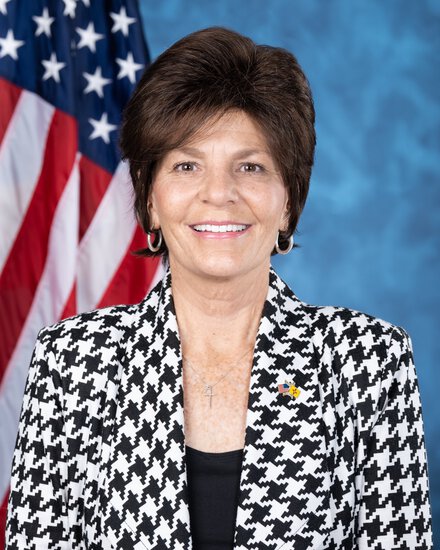
Rep. Yvette Herrell
Sponsored bills
Veterans Health Care Freedom Act This bill requires the Center for Innovation for Care and Payment within the Department of Veterans Affairs (VA) to implement a three-year pilot program to improve the ability of veterans who are enrolled in the VA health care system to access hospital care, medical services, and extended care services through the covered care system by providing such veterans with the ability to choose health care providers. Under the bill, the covered care system includes VA medical facilities, health care providers participating in the Veterans Community Care Program (VCCP), and eligible entities or providers that have entered into a Veterans Care Agreement. A veteran participating in the program may elect to receive care at any provider in the covered care system. The pilot program removes certain requirements (e.g., location of the veteran) to access care at VA and non-VA facilities. After four years, the bill permanently phases out the requirements for accessing care under the VCCP and Veterans Care Agreements and requires the VA to provide such care under the same conditions of the pilot program. Additionally, after four years, veterans may receive care at a VA medical facility regardless of whether the facility is in the same Veterans Integrated Service Network as the veteran.
This resolution expresses the sense of the House of Representatives that the Department of Homeland Security (DHS) provides essential protection for our country from foreign and domestic threats and that defunding DHS would be detrimental to our national security.
This resolution recognizes and expresses support for the efforts of democracy and human rights activists in Cuba.
Preserving Rules Ordered for The Entities Covered Through 340B Act of 2021 or the PROTECT 340B Act of 2021 This bill prohibits pharmacy benefit managers (PBMs) and health insurance plans from discriminating against health providers participating in the 340B drug pricing program, including pharmacies contracted with such providers to dispense 340B drugs. The 340B program allows certain providers to receive covered outpatient drugs at reduced prices from manufacturers. Specifically, PBMs and insurance plans may not reimburse 340B participants at a lower rate than other entities not participating in the program; impose differing terms (such as fees, charge-backs, or audits) on 340B participants; interfere with an individual's choice to receive drugs from a 340B participant; require 340B participants to identify which drugs fall within the program; or refuse to contract with a 340B participant on the basis that they utilize the program. Violations of this bill are subject to a civil penalty of not more than $5,000 per violation per day. These prohibitions also apply to prescription drug (Part D) sponsors under Medicare. The bill also provides for a process to prevent duplicate 340B drug discounts to states under Medicaid.
Broadband for Rural America Act This bill modifies and consolidates Department of Agriculture (USDA) programs for expanding broadband internet in rural areas. Specifically, the bill modifies a program that provides grants, loans, and loan guarantees to support broadband expansion in rural areas. Modifications include revising the criteria used to prioritize applications and projects and changing the name of the program to the ReConnect Rural Broadband Program. Additionally, the bill terminates on June 30, 2022, a Department of Agriculture (USDA) COVID-19 response program that supports broadband expansion in rural areas for distance learning and telemedicine. Any remaining program funds available after the termination date shall be used for the ReConnect Rural Broadband Program. The bill also expands coordination requirements that apply to the Department of Commerce, USDA, the Federal Communications Commission (FCC), and the National Telecommunications and Information Administration. This includes requiring the use of specified FCC maps when assessing a community's access to broadband.
Freedom to Fly Act This bill prohibits regulations or policies that allow employees of the Transportation Security Administration to ask passengers flying domestically about vaccinations.
Law Enforcement Officer Recreation Pass Act This bill directs the Department of Agriculture and the Department of the Interior to make the National Parks and Federal Recreational Lands Pass available, without charge and for the lifetime of the passholder, to law enforcement officers.
This resolution honors the suppliers of the National Aeronautics and Space Administration (NASA) for the work they are doing on the Artemis missions.
Essential Caregivers Act of 2021 This bill requires skilled nursing facilities, nursing facilities, intermediate care facilities for the intellectually disabled, and nearby inpatient rehabilitation facilities to establish an essential caregivers program during a public health emergency. Under the program, facilities must allow each resident to select up to two essential caregivers to provide daily living assistance, emotional support, or companionship during the emergency. Facilities must afford such caregivers 12 hours of access to residents each day (or unlimited access for end-of-life care), and caregivers must agree to follow facility protocols for staff safety. Facilities may deny access to caregivers who violate protocols, subject to certain notification requirements; the Centers for Medicare & Medicaid Services must establish an appeals process relating to such decisions and may take specified enforcement actions against facilities that violate the bill's requirements.