

Maddy summaryThe Healthy H2O Act establishes a federal grant program to help rural households and facilities improve drinking water quality by covering costs for point-of-use or point-of-entry water treatment systems, filter replacements, and related services. It directly assists eligible end users in rural areas - including homeowners, renters, child-care facilities, and small residential property owners - who have tested water containing health contaminants like lead, arsenic, or PFAS, while prioritizing private well users and limiting assistance to households with income below 150% of the median nonmetropolitan household income. Grants can fund certified treatment systems, installation by qualified professionals, maintenance, and water quality testing, administered by the Department of Agriculture with $10 million annually from 2024-2028. The program requires annual reports to Congress on progress, barriers to safe water access, and trends in treatment technology use to inform future improvements.
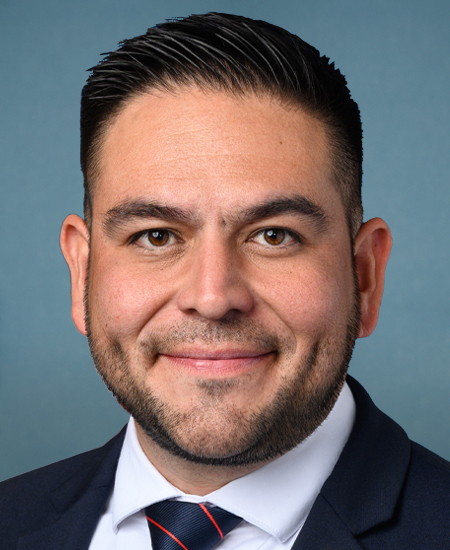
Rep. Gabe Vasquez
Sponsored bills
Maddy summaryHR 2802, the Improving Mental Health Access for Students Act, requires colleges and universities to include suicide prevention contact information on student identification cards. Specifically, institutions must list the National Suicide Prevention Lifeline, Crisis Text Line, and their campus mental health center on new ID cards. Schools that don't issue ID cards must post this information on their websites instead. The requirement takes effect one year after the bill's enactment.
U.S. Customs and Border Protection Rural and Remote Hiring and Retention Strategy Act of 2023 This bill requires the Office of the Chief Human Capital Officer of the Department of Homeland Security (DHS) and U.S. Customs and Border Protection (CBP) to issue a strategy and implementation plan to improve CBP's hiring and retention of individuals in rural or remote areas. Until the strategy and implementation plan are issued, DHS must periodically brief Congress and the Government Accountability Office (GAO) on its progress. After receiving each DHS report, the GAO must submit to Congress an assessment of the effectiveness of the actions described in the DHS report.
Maddy summaryThis bill reauthorizes annual funding for teaching health centers that train doctors through graduate medical education programs. It sets specific funding levels from 2011 through 2034, gradually increasing over time (e.g., $582.7 million annually for 2033), with future years adjusted for inflation based on medical care costs. The funding directly supports community-based teaching hospitals and clinics that provide both patient care and physician training. Key provisions include fixed annual amounts for specific fiscal years and an inflation adjustment mechanism starting in 2034. This is a procedural funding measure affecting healthcare training institutions, not a new policy.
Maddy summaryThis bill reauthorizes $150 million annually in federal funding for diabetes prevention and treatment programs serving American Indian and Alaska Native communities, extending the existing program through fiscal year 2028. It directly affects tribal health programs and Native American communities by ensuring continued access to critical diabetes care services. The key provision adds a new funding allocation of $150 million per year for 2024-2028 to the Public Health Service Act, with funds remaining available until fully spent. This maintains current program levels without altering eligibility or service requirements.
Providing Resources and Occupational Training for Emotional Crisis and Trauma in 911 Act or the PROTECT 911 Act This bill establishes a grant program, and requires the Department of Health and Human Services (HHS) to develop resources, for addressing mental health conditions among public safety telecommunicators. These include 9-1-1 operators and other public safety personnel who are responsible for responding to requests for emergency assistance. Specifically, HHS must award grants to state, local, and regional emergency communications centers or nonprofits for behavioral health and wellness programs to prevent and mitigate job-related mental health issues among public safety telecommunicators. Additionally, HHS must develop and disseminate (1) best practices for identifying, preventing, and treating post-traumatic stress disorder among public safety telecommunicators; and (2) resources for educating mental health professionals about the workplace culture of, stressors and challenges experienced by, and therapies for treating mental health issues common to public safety telecommunicators.
National Taxpayer Advocate Enhancement Act of 2023 This bill grants the National Taxpayer Advocate the authority to appoint counsel in the Office of the Taxpayer Advocate to report directly to the National Taxpayer Advocate.
American Innovation and R&D Competitiveness Act of 2023 This bill eliminates the five-year amortization requirement for research and experimental expenditures, thus allowing continued expensing of such expenditures in the taxable years in which they are incurred.
Maddy summaryHR 2728, the Young Farmer Success Act, expands student loan forgiveness eligibility under the Higher Education Act to include full-time farm and ranch workers. It directly affects young agricultural workers employed as employees or managers at farms meeting specific revenue thresholds. The key provision adds "full-time job engaged in farm work" as a qualifying employment type for loan forgiveness, requiring farms to earn at least $35,000 in gross revenue from agricultural sales in 2023 (with annual inflation adjustments based on the Consumer Price Index). This amendment modifies existing loan forgiveness rules without creating new programs, applying to workers meeting the farm revenue criteria.
Maddy summaryHR 2725, the "Do No Harm Act," amends the Religious Freedom Restoration Act (RFRA) to clarify that RFRA does not apply when federal laws protect against discrimination or promote equal opportunity. It specifically exempts protections under the Civil Rights Act, Americans with Disabilities Act, workplace benefits like leave, child labor safeguards, and healthcare access from RFRA challenges. The bill also clarifies that RFRA does not block private lawsuits between individuals, applying only to cases involving government entities. This amendment ensures that existing federal civil rights and workplace protections remain enforceable under RFRA.