

Maddy summaryThis bill amends the Higher Education Act to require all U.S. colleges and universities receiving federal financial aid to create detailed anti-harassment policies covering physical, online, and institution-sponsored settings. It mandates policies prohibiting harassment based on race, sex (including sexual orientation and gender identity), disability, religion, and other protected characteristics, including harassment via institutional email, computers, or electronic messaging. The bill also establishes a $50 million annual grant program to fund colleges developing prevention programs, victim support services, and training for students and staff on recognizing and addressing harassment. These policies and grants must comply with existing civil rights laws like Title IX but add specific requirements for reporting and prevention.
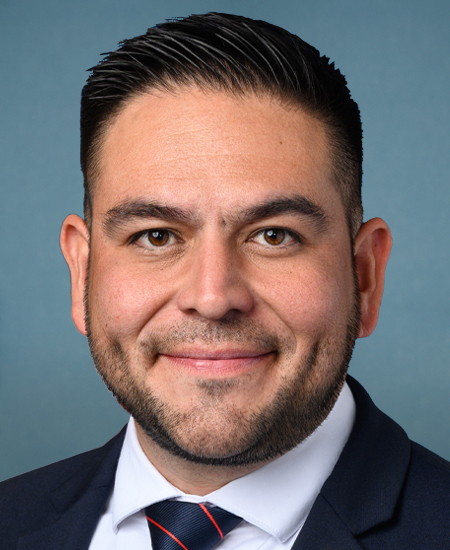
Rep. Gabe Vasquez
Sponsored bills
Maddy summaryHRES 714 is a formal recognition resolution celebrating Hispanic Restaurant Week (September 22-October 3, 2023) and acknowledging the economic contributions of Hispanic restaurant owners and employees to the U.S. restaurant industry. It highlights statistics showing Hispanic individuals own a significant share of restaurants and workforce participation in the sector, but does not create new policies, funding, or regulations. This resolution is purely ceremonial, expressing congressional appreciation without any legislative impact.
Maddy summaryThis bill provides federal retirement benefits to educators at tribal schools. It makes employees of tribally controlled schools eligible for the same federal retirement pension (FERS) and Thrift Savings Plan (TSP) as other federal employees. The Bureau of Indian Affairs will pay the government's share of these contributions. This directly affects educators working at tribal schools operating under specific federal contracts or grants, such as those under the Indian Self-Determination Act or Tribally Controlled Schools Act.
Maddy summaryHR 5354, the Small Farm Conservation Act, creates a dedicated subprogram within the Environmental Quality Incentives Program (EQIP) to provide targeted conservation support for small-scale farms. It allocates $100 million annually (2024-2028) specifically for farms under 50 acres or meeting median state farm size limits, with 35% of funds for tailored technical assistance (including hiring specialized staff) and 65% for direct financial payments. Key provisions include a minimum $2,500 payment per producer, a 50% payment increase for soil health systems, and a streamlined, continuous enrollment process to reduce administrative barriers. The bill prioritizes historically underserved farmers - such as veterans, beginning farmers, and those in high-poverty areas - while requiring annual reporting on program outcomes.
Maddy summaryHR 4455, the Community Facilities Program for Rural Clean School Bus Infrastructure Act, amends the Consolidated Farm and Rural Development Act to allow rural communities using its essential community facilities program funds to cover clean school bus infrastructure. Specifically, it permits recipients of these loans or grants to use funds for purchasing charging infrastructure, labor costs for installation/maintenance, and planning activities supporting clean school bus adoption. The bill defines "clean school bus" using the Energy Policy Act of 2005 and authorizes necessary funding for these purposes. It directly affects rural communities receiving essential community facilities program funds, enabling them to modernize school bus infrastructure with clean energy solutions.
Maddy summaryThe World LEAP Act creates a federal grant program to support world language and dual language education in K-12 schools, directly affecting local school districts and their students. It authorizes $15 million annually to fund competitive grants for school districts to establish or improve language programs, requiring grantees to reserve 20% of funds for teacher certification pathways and professional development, and 5% for program evaluation. The program prioritizes applications that partner with community heritage language schools, serve diverse students including English learners and heritage learners, and include sustainability plans beyond the grant period. Grantees must report annually on student enrollment, certified teacher numbers, and community support to measure program impact.
Maddy summaryThe Better CARE for Animals Act of 2023 amends the Animal Welfare Act to strengthen enforcement of animal welfare standards. It gives the Attorney General authority to bring civil cases for violations, including seeking penalties up to $10,000 per day per violation and injunctions to remove or relocate animals. The bill also requires the Secretary of Agriculture and Attorney General to coordinate through a new Memorandum of Understanding, focusing on repeat violators. These changes directly affect dealers, exhibitors, and enforcement agencies by expanding civil enforcement tools and clarifying jurisdiction over rule violations.
Maddy summaryHR 4838 extends and enhances federal block grants for specialty crop producers (like fruits, vegetables, and nuts) through 2028, directly affecting state agricultural agencies and farmers. The bill requires states to consult with producers and groups when designing grant programs and outlines how funds must be used to boost competitiveness. It sets annual funding at $100 million starting in fiscal year 2024, replacing previous funding levels that expired in 2023. The law aims to support state-level initiatives through structured planning and stakeholder input.
Maddy summaryThe John R. Lewis Voting Rights Advancement Act of 2023 would strengthen the Voting Rights Act of 1965 by updating the criteria for which states and localities must obtain federal preclearance before changing voting practices. It would establish new standards for proving vote dilution and vote denial by requiring courts to consider historical discrimination, racial polarization in voting, and whether voting practices disproportionately burden minority voters. The bill would also require states and localities to provide public notice of voting changes and share demographic data about polling locations. These changes would primarily affect jurisdictions with a history of voting rights violations, aiming to prevent discriminatory voting practices before they take effect.
Maddy summaryThis bill amends existing law to allow Indian tribes, alongside counties and state governors, to retain and use funds from timber sales under "good neighbor agreements" for forest restoration projects. It directly affects tribes, counties, and state agencies participating in these agreements, which involve collaborative forest management on federal lands. The key change lets tribes keep timber sale revenue to fund restoration work under their agreements, just as counties and governors can. The bill does not create new programs but adjusts who can access these funds. It applies to projects initiated after 2018 or on or after the bill's enactment date.