

Retirement Investment in Small Employers Act This bill allows an increased start-up tax credit (from $500 to $2,500) for micro-businesses (not more than 10 employees) for the costs of setting up a defined contribution pension plan.
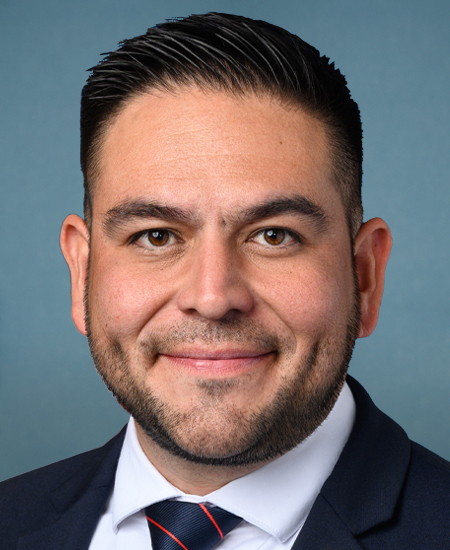
Rep. Gabe Vasquez
Sponsored bills
Maddy summaryHR 1809 requires the U.S. Commerce Secretary to develop a strategy preventing U.S. exports of specific microelectronics (like microcontrollers, GPS modules, and circuit boards) to Iran for use in drone production. It also directs the State Department to coordinate with European and Asian allies to block similar technology transfers to Iran. The bill targets dual-use components that have been found in Iranian drones used by Russia in Ukraine, aiming to stop these technologies from supporting Iran's drone industry. This policy directly affects U.S. manufacturers of these components, their distributors, and international partners involved in exporting such technology to Iran.
Maddy summaryHR 2577 establishes the DHS Suicide Prevention and Resiliency for Law Enforcement Act, requiring all Department of Homeland Security (DHS) law enforcement components - including U.S. Customs and Border Protection, Immigration and Customs Enforcement, the Secret Service, TSA, and others - to implement new mental health programs. The law creates a central "Law Enforcement Mental Health and Wellness Program" under the Chief Medical Officer to coordinate suicide prevention, reduce stigma, and provide confidential support, including peer-to-peer networks, annual training for officers, and resources for families. Key mechanisms include mandatory annual confidential surveys of personnel, data collection on suicides (while protecting privacy), and requiring DHS components to improve mental health programs by removing barriers to seeking help and ensuring no adverse actions for officers who access counseling. The bill mandates annual congressional briefings on implementation through 2027.
Maddy summaryThe Savings for Servicemembers Act (HR 5844) lowers the required travel distance for tax deductions for reserve component members of the Armed Forces. It changes the Internal Revenue Code to reduce the minimum distance from home (100 miles to 50 miles) for qualifying travel expenses related to military duties. This adjustment directly affects reserve service members who travel for training or duty, allowing them to deduct more travel costs. The change applies to tax returns filed for 2023 and later years.
Maddy summaryHR 5667, the Pay Our Military Act, ensures continued pay and allowances for active-duty military members, reservists, Department of Defense civilians, and qualifying contractors during any government funding gap in fiscal year 2024. It appropriates funds from the Treasury to cover these payments if regular appropriations bills aren't passed before the end of the fiscal year. The funding automatically terminates once regular appropriations are enacted or by January 1, 2025, whichever comes first.
Maddy summaryThis bill requires the Department of Veterans Affairs (VA) to review all veteran suicides occurring between 2018-2023 (the five years before enactment) for veterans who received VA care. The review must analyze demographics, medications (including those with strong safety warnings like "black box" labels), prescribing patterns, mental health diagnoses, and facility-level data. The VA must complete the review within 18 months and publicly submit a detailed report to Congress and the public within 30 days of completion. This law directly affects veterans' families, VA healthcare providers, and policymakers by mandating transparency around suicide risk factors and prescribing practices.
Maddy summaryThe Veteran Medical Exams for Distant Areas Act (HR 5470) amends the 2020 Veterans Health Care and Benefits Improvement Act to adjust two specific deadlines for Department of Veterans Affairs (VA) medical disability examination procedures. It postpones one deadline from three years after the 2020 Act's enactment to September 1, 2028, and changes another deadline from the day before the 2020 Act's enactment to January 4, 2021. These are administrative timing adjustments affecting how VA schedules examinations for veterans, particularly those in remote areas as referenced in the bill's title. The bill does not alter the substance of medical exam requirements but modifies implementation timelines.
Maddy summaryThe CONNECT Act of 2023 streamlines support for rural broadband providers by creating an Office of Technical Assistance ($10 million annually) to help small providers (serving ≤20,000 subscribers) navigate applications and permitting. It adds a mini-grant program ($20,000 max per provider) to prepare applications, prioritizes cooperative and nonprofit projects with 20 extra evaluation points, and requires USDA to review broadband permit applications within 180 days. The bill also sets eligibility for funding in areas with no existing fixed-wireline service or stalled broadband projects (after 3 years without significant construction). These changes directly affect rural communities and small broadband providers seeking federal funding to expand internet access.
Maddy summaryThe Voluntary Public Access Improvement Act of 2023 increases annual funding for the Voluntary Public Access and Habitat Incentive Program to $150 million per year from fiscal years 2024 through 2028. This program provides financial incentives to private landowners who allow public access to their land for recreational activities like hunting and fishing, while also supporting habitat conservation efforts. The bill amends the Food Security Act of 1985 to establish this new funding level, replacing previous annual amounts. It directly affects participating landowners who enroll in the program and the public seeking expanded recreational access to private lands. The change is a specific funding adjustment without altering the program's existing structure or eligibility rules.
Maddy summaryThis bill establishes special pay rates for wildland firefighters employed by the Forest Service or Department of the Interior. It creates a percentage increase over standard General Schedule base rates (ranging from 1.5% for GS-15 to 42% for GS-1), provides 450% premium pay for days deployed to qualifying wildfire incidents, and requires rest and recuperation leave following incident deployment. These changes apply specifically to firefighters whose duties primarily relate to wildland fires, not structural fires. The bill takes effect on October 1, 2023, and replaces standard pay rates for affected firefighters. Premium pay is not considered part of basic pay for various compensation calculations.