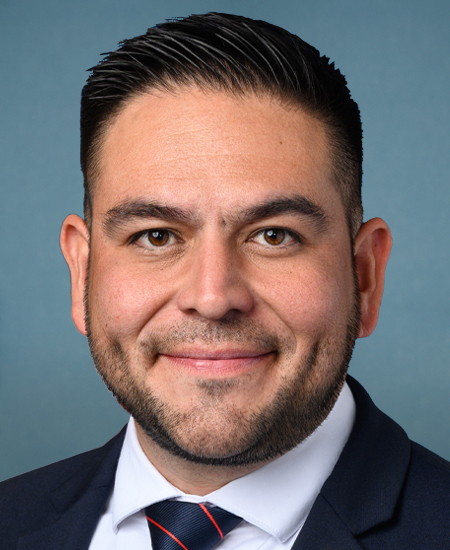
Photo of Gabe Vasquez
D United States House · District 2 · New Mexico On the 2026 ballot

Rep. Gabe Vasquez

Compare
Total votes
1,879
all sessions
Attendance
100%
9 missed
Higher than 78% of chamber peers
With party
92%
of cast votes
Lower than 90% of chamber peers
Bipartisan score
4%
crosses aisle rarely
Higher than 89% of chamber peers
Sponsored
690
bills & resolutions
Near the chamber average
Committees
6
assignments
690 bills and resolutions

Sponsored bills

Total
690
Primary
63
Co-sponsor
627
This page
690
matching current filters
Co-sponsor HRES 993
In committee · United States House · Co-sponsor
Recognizing and expressing support for the Iranian people protesting for a free and democratic Iran.

Maddy summaryThis symbolic House resolution expresses U.S. congressional support for Iranian protesters demanding democracy and human rights. It condemns the Iranian regime's violent suppression of protests, including killings, mass arrests, and internet restrictions, while urging the regime to release political prisoners and restore communication access. The resolution reaffirms the Iranian people's right to self-determination through free elections and echoes a 2023 resolution (HCR 7) that similarly praised protesters. As a non-binding expression of support, it does not impose new policies or alter U.S. government actions.

In committee Jan 13, 2026 1 co-sponsor
Co-sponsor HR 6998
In committee · United States House · Co-sponsor
Renewed Hope Act

Maddy summaryThe Renewed Hope Act (HR 6998) requires the Department of Homeland Security to hire 200 new staff, including 40 forensics analysts and 30 child exploitation investigators for the Victim Identification Laboratory, plus 130 additional personnel for the Child Exploitation Investigations Unit, to improve identification and rescue efforts for victims of child sexual exploitation. It establishes a mandatory training program for law enforcement and related organizations to use updated victim identification techniques and mandates coordination between DHS and the National Center for Missing and Exploited Children to streamline investigations. The bill also includes strict privacy rules to secure victim information and allows temporary hiring of experts for forensic analysis at specified rates.

In committee Jan 13, 2026 1 co-sponsor
Co-sponsor HR 6088
In committee · United States House · Co-sponsor
Restoring Food Security for American Families and Farmers Act of 2025

Maddy summaryHR 6088, the *Restoring Food Security for American Families and Farmers Act of 2025*, repeals specific sections (10101-10108) from a prior reconciliation law. This action revives previous provisions related to food security programs that were modified by those repealed sections. The bill directly affects federal food assistance and agricultural support programs by restoring their prior legal framework. It does not create new policies but reverses recent changes to existing food security measures.

In committee Jan 13, 2026 1 co-sponsor
Co-sponsor HR 5168
In committee · United States House · Co-sponsor
Puerto Rico Nutrition Assistance Fairness Act

Maddy summaryThis bill updates federal nutrition law to include Puerto Rico in the Supplemental Nutrition Assistance Program (SNAP), allowing it to transition from its current funding method to the same SNAP benefits available to U.S. states. Puerto Rico must submit a 180-day plan to the USDA detailing its transition to SNAP, with approval required within another 180 days. The transition period lasts up to 5 years from the bill's effective date, during which Puerto Rico would continue receiving block grants while preparing for full SNAP participation. This change directly affects Puerto Rico's 1.4 million residents who currently receive nutrition assistance under a separate funding structure.

In committee Jan 13, 2026 1 co-sponsor
Co-sponsor HR 5037
In committee · United States House · Co-sponsor
Middle Mile for Rural America Act

Maddy summaryThe Middle Mile for Rural America Act extends the deadline for funding rural broadband infrastructure projects under the Rural Electrification Act from 2023 to 2031. This directly affects rural communities by providing more time to build the backbone internet networks that connect local areas to broader high-speed services. The key mechanism is amending Section 602(g) of the Rural Electrification Act to update the program's timeframe, allowing eligible projects to qualify for support through 2031. The bill focuses on concrete policy changes to support existing infrastructure funding, without adding new programs or resources.

In committee Jan 13, 2026 1 co-sponsor
Co-sponsor HR 4782
In committee · United States House · Co-sponsor
Local Farmers Feeding our Communities Act

Maddy summaryHR 4782, the Local Farmers Feeding our Communities Act, establishes a USDA program to connect local farmers with food distribution networks. It requires eligible entities (like state agriculture agencies) to use funds to purchase unprocessed or minimally processed local foods from covered producers - including at least 25% from small-size, mid-size, beginning, or veteran farmers - while providing technical assistance for food safety and supply chains. The bill allocates $200 million annually (2026-2030) from the Commodity Credit Corporation, mandating 10% for Tribal governments and 1% per state before distributing remaining funds. This directly supports regional food security by boosting economic opportunities for local farmers and improving access to fresh, nutritious food through established distribution channels.

In committee Jan 13, 2026 1 co-sponsor
Co-sponsor HR 909
Passed · United States House · Co-sponsor
Crime Victims Fund Stabilization Act of 2025

Maddy summaryHR 909, the Crime Victims Fund Stabilization Act of 2025, modifies how funds from the False Claims Act are deposited into the Crime Victims Fund. It specifies that from 2025 through 2029, certain False Claims Act proceeds (specifically those for qui tam plaintiff payments and government damage reimbursements) cannot be deposited into the fund. This change directly affects the composition of the Crime Victims Fund by excluding these specific revenue streams during the specified period. The bill does not create new benefits or alter victim services; it only adjusts fund allocation rules for existing False Claims Act revenues.

Passed Jan 13, 2026 1 co-sponsor
Co-sponsor HR 7004
In committee · United States House · Co-sponsor
Public Integrity in Financial Prediction Markets Act of 2026

Maddy summaryHR 7004 prohibits federal elected officials, congressional staff, political appointees, and executive branch employees from trading prediction market contracts using material nonpublic information about government policy, actions, or political outcomes. It bans any purchase, sale, or exchange of these contracts when the individual possesses or could reasonably obtain such nonpublic information - defined as important investment details not available to the public. The bill directly affects government insiders who might otherwise trade on inside knowledge of upcoming decisions or election results through prediction markets. Key provisions clarify that covered transactions include any financial instrument tied to future government events, listed on platforms operating across state lines. This creates a specific insider trading rule for prediction markets, distinct from general securities laws.

In committee Jan 9, 2026 1 co-sponsor
Co-sponsor HR 6976
In committee · United States House · Co-sponsor
Duty Status Reform Act

Maddy summary# Summary of Reserve Component Duty Consolidation Legislation This legislation is a comprehensive revision of military reserve component terminology and definitions throughout the U.S. Code. The primary purpose is to replace the outdated term "inactive duty training" with the more accurate and consistent term "reserve component duty" across all relevant sections of federal law. ## Key Provisions: 1. **Terminology Change**: - Replaces "inactive duty training" with "reserve component duty" in over 50 sections of the U.S. Code (primarily Titles 10, 32, and 37) - Also replaces related terms like "inactive duty" and "inactive duty for training" with "reserve component duty" 2. **Repeals**: - Repeals Chapter 13 of Title 10 - Repeals Sections 10147, 10148, 12406, 12503, 12552 of Title 10 - Repeals Sections 114, 115, and 328 of Title 32 3. **Definition Updates**: - Creates new definitions for "reserve component duty" and "remote assignment" in Title 10 - Defines "Active Guard and Reserve functions" more precisely - Clarifies that reserve component duty includes: * Training as described in sections 552(a) and 553(a) of Title 32 * Support activities authorized for members of the reserve components * Duty prescribed under sections 543 of Title 32 4. **Transition Provisions**: - Establishes a 10-year transition period from the date of enactment - Allows for earlier implementation if all relevant departments (Defense, Homeland Security, Veterans Affairs) certify readiness - Provides for early TRICARE eligibility for members ordered to active duty or full-time National Guard duty 5. **Conforming Amendments**: - Makes numerous technical changes to ensure consistent terminology throughout the U.S. Code - Updates references to training requirements, pay, and benefits to reflect the new terminology This legislation represents a significant effort to modernize military reserve component terminology, eliminate confusing and outdated references, and create a more consistent framework for understanding and managing reserve component service obligations and benefits.


In committee Jan 9, 2026 1 co-sponsor
Co-sponsor HR 1110
In committee · United States House · Co-sponsor
Grazing for Wildfire Risk Reduction Act

Maddy summaryHR 1110, the Grazing for Wildfire Risk Reduction Act, directs the USDA Forest Service to develop strategies using livestock grazing to reduce wildfire risks on federal lands. It specifically requires expanding grazing opportunities during droughts or disasters on vacant permits, promoting targeted grazing, issuing temporary permits for fuels reduction, and using grazing for postfire recovery. The bill affects livestock permit holders and federal land managers by modifying how existing grazing authorities are applied for wildfire risk mitigation. It focuses on concrete policy changes to utilize current grazing programs as a proactive fire prevention tool, without altering permanent grazing rules.

In committee Jan 8, 2026 1 co-sponsor
Showing 111 to 120 of 690 bills
Previous 1 … 11 12 13 … 69 Next