

Maddy summaryThe Ending Green Giveaways Act (HR 1066) repeals a Clean Air Act provision (Section 138) that authorized federal funding for environmental and climate justice initiatives. It also cancels any unspent funds previously allocated for these programs. This would terminate the funding stream, preventing future allocations for community-based environmental projects. As a result, the program would end without new resources for communities addressing environmental challenges.
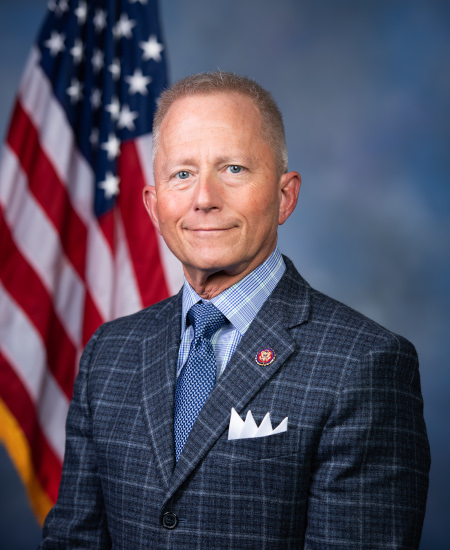
Rep. Jefferson Van Drew
Sponsored bills
Maddy summaryThe QUIET Act (HR 1027) requires that robocalls or text messages using artificial intelligence to mimic human communication must disclose at the beginning that AI is being used. It doubles penalties for violations involving AI impersonation intended to defraud, cause harm, or obtain value, applying to automated calls sent to stored numbers or generated randomly. The bill excludes calls requiring substantial human intervention, focusing on transparency and deterrence in AI-driven automated communications.
Maddy summaryThe HOUSE Act of 2025 would repeal a new federal energy efficiency standard for housing projects funded by the Department of Housing and Urban Development (HUD) and the Department of Agriculture (USDA), reverting to the previous energy efficiency requirements that were in place before the new rule was proposed. It also prohibits the Department of Veterans Affairs and the Federal Housing Finance Agency from implementing similar energy efficiency standards for their housing programs. This bill directly affects new housing developments receiving federal financing from HUD, USDA, VA, or FHFA, allowing them to follow less stringent energy efficiency standards previously required. The change would eliminate the need for builders to meet the updated federal benchmark, shifting compliance back to the older baseline.
Maddy summaryHR 71, the Veterans Health Care Freedom Act, allows eligible veterans enrolled in VA healthcare to choose from a broader network of providers, including non-VA facilities, without geographic restrictions. The bill creates a 3-year pilot program in four diverse locations (rural and urban) where veterans can select primary care and specialty providers within a defined "covered care system" (VA facilities and approved community providers), with VA coordinating care through a primary provider. After the pilot, the law permanently requires the VA to offer this same choice of providers to all enrolled veterans, removing current barriers that limited access to non-VA care outside a veteran’s local VA network. The program uses existing VA funding and mandates regular reports to Congress on implementation and results.
Maddy summaryHR 1007, the Antisemitism Awareness Act of 2025, clarifies how the Department of Education enforces Title VI of the Civil Rights Act of 1964 to address discrimination against Jewish individuals. It requires the Department to consider the International Holocaust Remembrance Alliance (IHRA) definition of antisemitism when investigating complaints involving discrimination based on actual or perceived Jewish ancestry or ethnic characteristics. This affects Jewish students and communities in K-12 schools and colleges receiving federal funding, as it ensures antisemitism is assessed under existing civil rights protections. The bill does not create new laws but specifies that the IHRA definition - already used by the Department since 2018 - must be applied in Title VI enforcement cases.
Maddy summaryThis bill limits the Secretary of Education's authority to create new student loan regulations or executive actions that could increase taxpayer costs. Specifically, it requires the Secretary to determine if a proposed rule would raise subsidy costs before moving forward; if it would, the rule cannot proceed. The restriction applies to any "economically significant" rule (costing $100 million+ annually or materially affecting the economy, jobs, or other key areas). The bill directly affects the Department of Education's regulatory process, not student loan borrowers or lenders.
Maddy summaryHR 934, the Chinese Spy Balloon Assessment Act, requires the Secretary of Defense to submit a report to Congress within 90 days of the bill's enactment. The report must analyze the national security effects of surveillance conducted by China via the high-altitude balloon shot down in U.S. airspace in February 2023, specifically covering impacts on military installations and the technology recovered from the balloon, including its country of origin. This bill directly affects the Department of Defense and Congress by mandating a formal assessment of a specific security incident. It does not create new policies or funding but establishes a procedural requirement for transparency regarding the balloon incident. The report must be unclassified but may include a classified annex.
Maddy summaryHR 925, the "Dismantle DEI Act of 2025," would eliminate diversity, equity, and inclusion (DEI) programs across federal government operations. The bill requires federal agencies to close DEI offices, rescind related executive orders, and prohibit the use of federal funds for DEI training, offices, or initiatives. It defines "prohibited diversity, equity, or inclusion practice" as any activity that discriminates based on race, ethnicity, religion, biological sex, or national origin, or requires employees to complete training asserting that certain groups are inherently superior or inferior. The legislation also prohibits requiring employees to sign statements about race, ethnicity, or gender, and establishes private lawsuits for violations with potential damages of $1,000 per violation per day. This bill would directly affect federal agencies, contractors, grantees, and advisory committees receiving federal funding.
Maddy summaryThe Patriot Day Act (HR 911) designates "Patriot Day" as a federal holiday by adding it to the list of designated holidays in Title 5 of the U.S. Code. This change would require federal offices to close on Patriot Day, aligning it with other federal holidays like Labor Day. The bill does not establish a specific date for the holiday or alter existing holiday observances. It is a procedural measure to formally recognize Patriot Day as a day for federal holiday closure.
Maddy summaryHR 951 authorizes the U.S. Mint to produce commemorative coins (gold $5, silver $1, and half-dollar) in 2028 to mark the 250th anniversary of the Declaration of Independence. Surcharges from coin sales ($35 per gold coin, $10 per silver, $5 per half-dollar) will fund the Stephen Siller Tunnel to Towers Foundation, supporting programs for Gold Star families, first responders, veterans, and their families. The coins must meet specific weight, size, and composition standards, with mintage limits set at 100,000 gold, 500,000 silver, and 750,000 half-dollar coins. All surcharge proceeds directly benefit the Foundation’s existing initiatives, such as mortgage-free housing and scholarships, without requiring additional federal funding.