

John Lewis Every Child Deserves a Family Act This bill prohibits discrimination on the basis of sexual orientation, gender identity, marital status, or religion in the provision of child welfare programs and services by entities receiving federal funding. The Department of Health and Human Services (HHS) must provide technical assistance to help states follow this requirement, including (1) guidance for bringing state laws into compliance, (2) developing training to increase cultural competency related to social identity, and (3) training for judges and attorneys involved in child welfare cases, among other supports. Additionally, HHS must establish the National Resource Center on Safety, Well-Being, Placement Stability, and Permanency for LGBTQ Children and Youth Involved with Child Welfare Services to provide training, technical assistance, and guidance to applicable state and local agencies and service providers. Further, the Religious Freedom Restoration Act may not be the basis for challenging the application or enforcement of this bill. The Government Accountability Office must study and report on states' compliance with the requirements of the bill no later than three years after enactment.
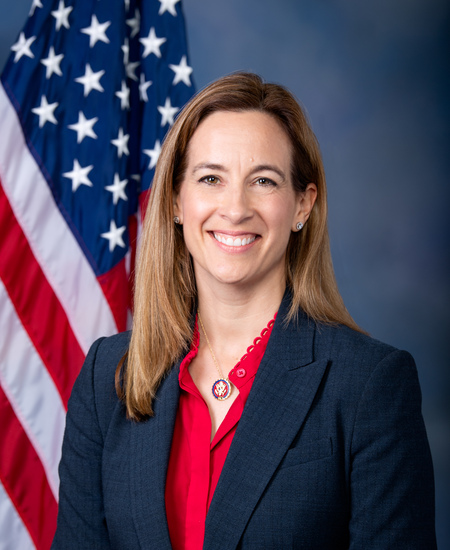
Rep. Mikie Sherrill
Sponsored bills
Keeping All Students Safe Act This bill prohibits the use of seclusion and limits the use of physical restraint in schools and Head Start programs that receive federal funding. Specifically, the bill prohibits the use of seclusion, which is the involuntary confinement of a student alone in a room or area from which the student is physically prevented from leaving. The term does not include a time out, which may involve separating the student from others in a non-locked setting. The bill prohibits the use of mechanical or chemical restraints or physical restraints that restrict breathing or are life threatening. The bill outlines the requirements for the use of physical restraint, including that the student's behavior must pose an imminent danger of serious physical injury to the student or other individual. Each state must ensure that a sufficient number of program personnel are trained and certified by a state-approved crisis intervention training program. Additionally, each program must establish procedures to follow after an incident involving physical restraint. Further, the bill establishes enforcement provisions, including a private right of action for a student who has been subjected to unlawful seclusion or restraint. The Department of Education and the Department of Health and Human Services must withhold payments from a program for unlawful seclusion or restraint. Finally, the bill requires each state educational agency (SEA) to establish, implement, and enforce policies and procedures required by the bill. It also creates a grant program to assist SEAs with these activities.
Documenting Adversarial Trade Aggression Act or the DATA Act This bill requires the Department of Commerce to establish a China Economic Data Coordination Center within the Bureau of Economic Analysis. The center must collect, synthesize, and report on specified Chinese economic data regarding developments in China's financial markets and U.S. exposure to risks and vulnerabilities in China's financial system.
This resolution acknowledges the safety and efficacy of COVID-19 (i.e., coronavirus disease 2019) vaccines and encourages all eligible individuals to receive a vaccination.
Opportunity To Address College Hunger Act This bill requires institutions of higher education (IHEs) that receive grants to operate work-study programs to notify a student receiving work-study assistance that the student may be eligible for participation in the Supplemental Nutrition Assistance Program (SNAP). The Department of Education must provide guidance to states and IHEs on how to identify and communicate with students who are potentially eligible for SNAP.
Concentrating on High-value Alzheimer's Needs to Get to an End Act of 2021 or the CHANGE Act of 2021 This bill modifies the requirements under Medicare for diagnosing and treating Alzheimer's disease and other cognitive impairments in older adults. Specifically, the bill expands the cognitive impairment detection benefit during annual wellness visits to require the use of validated detection tools and documentation of the results in the patient's medical record. Further, when a cognitive impairment is detected, the patient must be referred to an appropriate diagnostic service provider and other specified supports. Additionally, the Centers for Medicare & Medicaid Services must implement Medicare policies that increase the identification and response to patients' Alzheimer's disease risk factors and incentivize providers to utilize high-quality cognitive impairment diagnosis practices. The Government Accountability Office also must conduct a study of policies that may accelerate progress in Alzheimer's disease research and enhance the quality of care for individuals diagnosed with Alzheimer's disease.
This resolution condemns the acts of gun violence that led to the tragic loss of eight lives in Georgia on March 16, 2021.
Real Education and Access for Healthy Youth Act of 2021 This bill requires the Department of Health and Human Services (HHS) to establish grants to support sex education and sexual health services for young people (ages 10 through 29) and repeals requirements that apply to certain federally funded sex education programs. HHS must award grants, in coordination with the Department of Education, to (1) provide sex education to young people through elementary and secondary schools, institutions of higher education, and youth-serving organizations; and (2) train education professionals to effectively teach, and otherwise support, sex education. Sex education refers to high quality teaching and learning that follows, to the maximum extent practicable, specified educational standards; covers a variety of topics concerning sex and sexuality; explores values and beliefs about those topics; and helps young people gain skills to navigate relationships and manage sexual health. Additionally, HHS must award grants for the provision of sexual health services to marginalized youth to youth-serving organizations and health care entities that are eligible to receive covered outpatient drugs at reduced prices through the 340B drug discount program. Recipients of any of these grants must comply with certain nondiscrimination requirements. In addition, they may not use funds for sex education programs or sexual health services that provide incomplete or inaccurate medical information or fail to address specified issues. The bill also eliminates prohibitions regarding the content of specified federally funded sexual health education and information programs and repeals the Abstinence Only Until Marriage program.
GI Bill National Emergency Extended Deadline Act This bill amends various provisions related to educational assistance benefits provided by the Department of Veterans Affairs (VA). First, the bill extends the time limitation for using educational assistance under the Montgomery GI Bill and the Post-9/11 GI Bill, and for eligibility under the Veteran Readiness and Employment program, when educational institutions are temporarily or permanently closed due to an emergency situation or another reason that prevents an individual from participating. Next, the bill requires the VA to disapprove of courses of education provided by public institutions of higher learning that charge higher tuition and fees than in-state tuition for individuals who are entitled to educational assistance under the Survivors' and Dependents' Educational Assistance program. The bill also makes adjustments to the time limitation for using educational assistance under this program. The VA must implement an information technology service using one or more commercial software systems to process claims for VA educational assistance benefits. Finally, the bill requires the Veterans' Employment and Training Service within the Department of Labor to implement a pilot program under which states may use grants or contracts to carry out a short-term fellowship program to provide veterans with opportunities for long-term employment.
Leadership Institute for Transatlantic Engagement Act or the LITE Act This bill establishes the Leadership Institute for Transatlantic Engagement to develop a diverse community of transatlantic leaders who are committed to democratic institutions. The institute shall award grants and develop programs, activities, and services that it considers appropriate for entities and individuals in the United States and abroad to (1) provide training and professional development opportunities for diverse leaders on democratic governance and international affairs, (2) enable international exchanges between leaders to increase understanding and knowledge of democratic models of governance, and (3) increase awareness of the importance of international public service careers in diverse communities.