

This bill directs the Federal Emergency Management Agency (FEMA) to establish a grant program to modify, upgrade, and construct fire and emergency medical services (EMS) department facilities. Grant recipients may use funds received to build, rebuild, or renovate fire and EMS department facilities; upgrade existing facilities to install exhaust emission control systems, install backup power systems, upgrade or replace environmental control systems (such as HVAC systems), remove or remediate mold, and construct or modify living quarters for use by male and female personnel; and upgrade fire and EMS stations or build new stations. The bill sets forth provisions regarding (1) grant fund allocations between career and volunteer fire and EMS departments, and (2) prevailing rate of wage and a requirement for using materials produced domestically for public contracts.
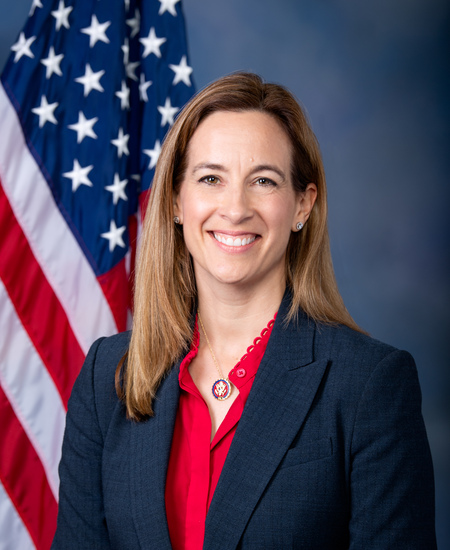
Rep. Mikie Sherrill
Sponsored bills
Armed Forces Transgender Dependent Protection Act This bill expands the policy of the Office of Special Needs within the Department of Defense to address transgender dependents. Specifically, the bill codifies the definition of a medical or educational special need to include gender dysphoria. Under the bill, the policy of the office must prohibit the assignment of a military family with special needs to a permanent duty location where the law restricts medically necessary treatment for a medical or educational special need. A member who is serving at a location when such a law is established may elect to be reassigned.
Clean Water Standards for PFAS Act of 2021 This bill directs the Environmental Protection Agency (EPA) to develop requirements and incentives to limit the discharge of perfluoroalkyl and polyfluoroalkyl substances (PFAS) into certain waters of the United States. PFAS are man-made and may have adverse human health effects. A variety of products contain the compounds, such as nonstick cookware or weatherproof clothing. Within two years, the EPA must publish water quality criteria for each measurable perfluoroalkyl substance, polyfluoroalkyl substance, and class of PFAS. The water quality criteria must determine how much of these substances can be present in water before it is likely to harm human health. Within four years, the EPA must publish a final rule that establishes, for each priority industry category specified in the bill, effluent limitations guidelines and standards for the discharge of each measurable perfluoroalkyl substance, polyfluoroalkyl substance, and class of PFAS. Under the Clean Water Act, effluent limitations restrict the quantities, rates, and concentrations of chemical, physical, biological, and other constituents which are discharged from point sources (e.g., a discernible source such as a pipe) into navigable waters, the ocean, or other specified waters. In addition, the EPA must award grants to owners and operators of publicly owned treatment works for implementing the effluent limitations guidelines and standards.
Surface Transportation Research and Development Act of 202 1 This bill addresses provisions related to surface transportation research, development, and deployment programs of the Department of Transportation (DOT). Among other provisions, the bill reauthorizes through FY2026 DOT highway research and development programs, including highway safety, technology and innovation deployment, training and education, and intelligent transportation systems; sets forth a program to provide awards to institutions of higher education or nonprofit research organizations to establish regional road weather research and development centers; reauthorizes through FY2026 the University Transportation Centers Program, the Bureau of Transportation Statistics, the public transportation research and development program, the National Cooperative Rail Research Program, the hazardous materials research and development program, and the National Cooperative Freight Transportation Research Program; establishes Centers of Excellence to advance research and development that improves the resilience of regions of the United States to natural disasters, extreme weather, and the effects of climate change on modal and multimodal transportation and infrastructure; directs DOT to carry out and publish the results of a study for the purpose of informing land use and transportation planning for accessible health, food, education, and other essential services and activities; and requires DOT to establish a multimodal national cooperative freight transportation research program, a Heavy Freight Automated Trucking Research Initiative, and an Advanced Transportation Research and Innovation Program.
This resolution honors, commends, and recognizes the women who served the United States in military capacities during World War II to aid the war effort. Additionally, the resolution honors the contributions of Congresswoman Edith Nourse Rogers for supporting the establishment of the Women's Army Auxiliary Corps and the Women's Army Corps.
Homeless Youth Menstrual Product Access Act of 20 21 This bill expands the permissible uses of federal grants by local centers serving runaway and homeless youth to include the provision of menstrual hygiene products.
United States Army Rangers Veterans of World War II Congressional Gold Medal Act This bill provides for the award of a single Congressional Gold Medal to the U.S. Army Rangers Veterans of World War II in recognition of their dedicated service during World War II.
Computer Science for All Act of 2021 This bill establishes a program through which the Department of Education must award grants to states, local educational agencies, and eligible tribal schools to serve as models for national replication of computer science education expansion efforts. Grant recipients must use these funds for certain activities, including training teachers to teach computer science and expanding access to high-quality learning materials and online options.
Reproductive Rights are Human Rights Act of 2021 This bill directs the Department of State to include in its annual reports on human rights in countries receiving U.S. development and security assistance a discussion of the status of reproductive rights in each country. This must include whether a country has adopted and enforced policies to (1) promote access to contraception and accurate, nondiscriminatory family planning and sexual health information; (2) provide services to ensure safe and healthy pregnancy and childbirth; (3) expand or restrict access to safe abortion services; and (4) prevent and treat sexually transmitted diseases. For each country, the reports shall also contain (1) data concerning pregnancy-related injuries and deaths; and (2) a description of the nature and extent of discrimination and violence against women, girls, and LGBTQI+ individuals in health care settings and the relevant government's response to such actions.
Safe Gun Storage Act of 20 21 This bill requires safety standards for firearm locks and safes. Under such standards, firearm locks must be reasonably designed to (1) prevent the firearm from discharging while the lock is activated, and (2) prevent unauthorized access to the firearm. Further, firearm safes must be reasonably designed to (1) secure firearms, and (2) prevent unauthorized access to the safe through physical manipulation or damage.