

Maddy summaryThis bill authorizes $700 million in federal grants to fund cancer prevention programs for firefighters, including multi-cancer early detection testing with a $1,750 per-test spending limit. It creates a voluntary program allowing firefighters to share anonymized test results with the CDC and FEMA to identify cancer trends in the profession, while protecting personal privacy. The legislation amends existing law to establish these prevention and research mechanisms, directly supporting firefighters exposed to cancer risks through early detection and data analysis.
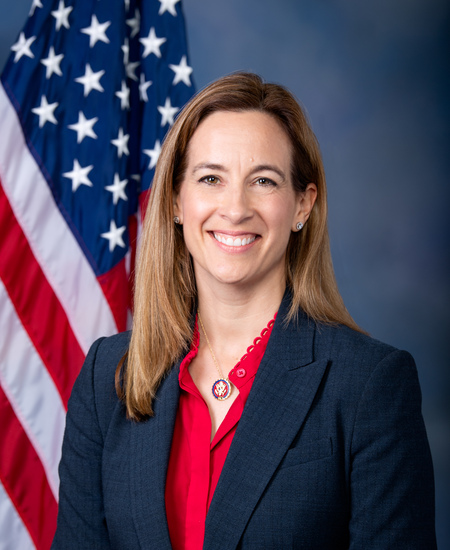
Rep. Mikie Sherrill
Sponsored bills
Maddy summaryHRES 653 is a symbolic resolution expressing the U.S. House of Representatives' support for recognizing August 13-19, 2023, as "Warehouse Worker Recognition Week." It directly honors workers in the logistics industry, who handle critical supply chain tasks like packing, processing, and moving goods. The resolution highlights their contributions to the economy (over 9 million workers), acknowledges challenging conditions like extreme heat in warehouses, and commits to reducing workplace injuries. It does not create new laws but aims to raise awareness of warehouse workers' essential role as frontline employees.
Maddy summaryHR 5147, the Investing in VETS Act, increases the federal government's goal for contracting with service-disabled veteran-owned small businesses from 3% to 5% of total federal contract dollars. It directly affects federal agencies, which must now aim for this higher 5% target, and service-disabled veteran-owned businesses that seek to qualify for these contracts. The bill adds a key provision requiring only businesses officially certified under Section 36 (not self-certified claims) to count toward the 5% goal and agency-specific targets. This change ensures the goal applies only to businesses with verified certification, improving accountability in the program.
Maddy summary# Summary of the "Protecting Our Democracy Act" This comprehensive legislation aims to strengthen democratic processes, increase government transparency, and prevent foreign interference in elections. Key provisions include: ## Ethics and Transparency - **Ethics Pledge**: Requires all appointees to sign an ethics pledge committing to: - Ban on gifts from registered lobbyists - 2-year revolving door ban (prohibiting participation in matters related to former employers) - Golden parachute ban (no special payments from former employers) - Commitment to decision-making based on public interest - **Tax Transparency**: Requires presidential and vice presidential candidates to disclose 10 years of tax returns, with sitting presidents submitting returns within 30 days of enactment ## Campaign Finance and Foreign Interference - **Foreign Contact Reporting**: Requires political committees to report any contact with "covered foreign nationals" within 1 week - **Enhanced Penalties**: Criminal penalties of up to $1 million and 5 years in prison for violations - **Online Advertising Rules** ("Honest Ads Act"): - Requires clear disclosure of who paid for political ads online - Mandates machine-readable public databases of political ads - Requires visible sponsor identification that remains when ads are shared - Defines "qualified political advertisements" to include various online formats ## Preventing Patronage Systems - Limits exceptions to competitive service for federal positions - Restricts transferring positions between competitive and excepted service - Requires employee consent for position transfers ## Use of Federal Property - Prohibits holding national political conventions on federal property - Requires publicly available visitor records at White House and other official locations (with privacy exceptions) The legislation establishes detailed definitions, reporting requirements, and enforcement mechanisms across multiple agencies, with the goal of increasing transparency, preventing foreign interference, and ensuring ethical conduct in government service.
Solutions Not Stigmas Act of 2023 This bill permits the Health Resources and Services Administration to establish a grant program for health professional schools or training programs to develop curricula in substance use disorder treatment or chronic pain education. Among other issues, the curricula must address (1) the reduction of stigma and bias associated with substance use and chronic pain, (2) prevention and early intervention for unhealthy substance use, and (3) best practices for prescribing addictive substances.
Research for Healthy Soils Act This bill includes research on the agricultural impacts of microplastics in land-applied biosolids on farmland as a Department of Agriculture (USDA) high-priority research and extension area. Microplastic is a plastic or plastic-coated particle that is less than 5 millimeters in size. The bill specifically allows grants for carrying out or enhancing research in this area (e.g., the development or analysis of wastewater treatment techniques to filter out or biodegrade microplastics from biosolids intended to be used for agricultural purposes). Further, the bill reauthorizes USDA grants to support competitive specialized research and extension activities, including high-priority areas, through FY2028. The bill also specifically reauthorizes through FY2028 the Pulse Crop Health Initiative; the Comprehensive Food Safety Training Network; pollinator protection research and extension grants; increased USDA capacity and infrastructure to address and conduct research on colony collapse disorder and other pollinator issues; and a USDA-conducted nationwide honey bee pest, pathogen, health, and population status surveillance program.
Maddy summaryThis bill adds spotted lanternfly control to the list of high-priority research initiatives funded by the USDA. It enables federal grants for developing and sharing practical tools to combat this invasive insect pest, directly affecting agricultural researchers and farmers in affected areas (like Pennsylvania, where the pest causes significant crop damage). The key provision modifies existing law to specifically include lanternfly research under funding programs, without changing current grant rules. The bill also extends the funding authorization period for such initiatives through 2028.
Maddy summaryHR 5054, the Equal and Uniform Treatment in the Military Act (EQUITY Act), prohibits discrimination in the U.S. military based on race, color, religion, sex, national origin, gender identity, or sexual orientation. It amends Title 10 of the U.S. Code to require that military service, advancement, and evaluations be based solely on an individual’s merit, fitness, capability, and performance. The bill explicitly bans policies that consider protected characteristics in eligibility or treatment, replacing prior frameworks with this clear standard. It directly affects all active-duty service members, reservists, and military personnel across all branches.
Maddy summaryHR 4963, the Tax Fairness for Workers Act, would restore tax deductions for certain employee expenses. It creates an above-the-line deduction for union dues and expenses paid by wage-earning employees, and allows miscellaneous itemized deductions for other work-related expenses (like uniforms or supplies) that were previously disallowed after 2017 tax law changes. These provisions directly affect employees who pay union dues or incur qualifying job-related costs. The bill amends specific sections of the Internal Revenue Code to make these deductions available for taxable years beginning after December 31, 2022. It does not change tax rates or provide new benefits, only reinstating previously eliminated deductions for eligible workers.
Maddy summaryThis bill removes an age restriction for expunging certain criminal records. It amends federal law to eliminate the requirement that a nonviolent offender must have been under 21 years old at the time of a simple possession conviction involving controlled substances. As a result, individuals convicted of these offenses who are now 21 or older can now qualify for record expungement, regardless of their age at the time of the offense. The bill directly affects nonviolent offenders with past simple possession convictions who previously could not seek expungement due to their age when convicted. This change expands eligibility for record clearance under federal expungement provisions.