

Maddy summaryThe Proxy Voting for New Parents Resolution (HRES 23) would allow U.S. House Members who have given birth or whose spouse has given birth to appoint another Member as a proxy to cast their vote or record their presence in the House and committees for up to 12 weeks after childbirth. To use this, the new parent must submit a signed letter to the Clerk detailing the birth or medical condition and naming the proxy; the proxy must vote exactly as instructed and announce the vote as "by proxy." The proxy vote does not count toward quorum, and the new parent can revoke the proxy at any time by submitting a new letter or casting their own vote. This resolution applies to all House Members, including Delegates and the Resident Commissioner, though they cannot cast votes for the House itself.
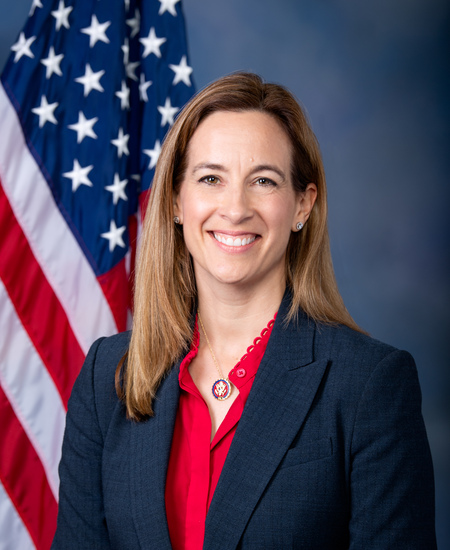
Rep. Mikie Sherrill
Sponsored bills
Maddy summaryThis bill increases healthcare affordability for low- and middle-income people by expanding eligibility for premium tax credits under the Affordable Care Act. It removes the previous 400% of poverty level cap for subsidy eligibility and replaces it with a new sliding scale based on income tiers, ranging from 0% to 8.5% of household income for coverage costs. The scale adjusts linearly across income levels, with households earning 300-400% of poverty paying 6.0%-8.5% of income (up from the prior fixed 400% cap), while lower-income households pay progressively less. These changes apply to tax years beginning after December 31, 2025, directly affecting individuals purchasing health insurance through marketplace plans.
Maddy summaryThis bill raises the federal income tax deduction limit for state and local taxes (SALT) from $10,000 to $100,000 for most taxpayers, and increases the limit for married couples filing jointly to $200,000. It directly affects taxpayers who itemize deductions and live in high-tax states, particularly married couples who previously faced a "marriage penalty" under the $10,000 cap. The change applies to tax years beginning after December 31, 2024, effectively allowing these taxpayers to deduct more state and local taxes on their federal returns.
Maddy summaryHR 82, the Social Security Fairness Act of 2023, repeals two provisions that reduce Social Security benefits for certain government workers. It eliminates the Government Pension Offset (GPO), which cuts spousal or survivor benefits for people with pensions from jobs not covered by Social Security (like federal or state government roles), and the Windfall Elimination Provision (WEP), which lowers retirement benefits for those with similar pensions. The law takes effect for benefits paid after December 2023, requiring the Social Security Administration to adjust benefit calculations to remove these reductions. This change directly affects public-sector employees who previously had their Social Security benefits reduced due to their government pensions.
Maddy summaryThis bill (HR 7607) renames a specific U.S. Postal Service facility in Cape May County, New Jersey, to honor George Henry White. The building at Block 1025, Lots 18 & 19, at the northeast corner of US Route 9 South and Main Street in Middle Township will officially be called the "George Henry White Post Office Building." All official U.S. government references to this location - such as in laws, maps, or documents - will be updated to reflect the new name. This is a procedural designation with no policy changes, solely updating the building's official title.
Maddy summaryThis bill (HR 7606) designates the U.S. Postal Service facility at 1087 Route 47 South in Rio Grande, New Jersey, as the "Carlton H. Hand Post Office Building." It directly affects the physical postal facility and all official references to it (such as maps, documents, or regulations). The bill updates all federal records to use the new name, with no substantive policy changes or impact on services or residents. It is a ceremonial naming resolution with no fiscal or operational provisions.
Maddy summaryThe Women’s Suffrage National Monument Location Act (HR 1318) authorizes the placement of a monument on the National Mall to honor the women’s suffrage movement and the 19th Amendment. The bill specifies that the monument must be located within a designated area on the National Mall known as the "Reserve," bypassing standard requirements for monument locations under existing law. This legislation sets the physical site for a monument already authorized by previous law (Public Law 116-217), without creating new policy or altering commemorative regulations beyond the location.
Maddy summaryThe Think Differently Database Act (HR 670) requires the U.S. Department of Health and Human Services (HHS) to create and maintain a public website within three years. The website will provide clear, accessible information about Medicaid eligibility for people with disabilities - including specific state requirements, contact details for state Medicaid offices, and wait times for home-based services. It directly affects individuals with disabilities, their caregivers, and families seeking support through Medicaid programs. The site will standardize resource access across states, using existing Medicaid rules and modeling after the thinkdifferently.net website.
Washington, D.C. Admission Act This bill provides for the establishment of the State of Washington, Douglass Commonwealth, and its admission into the United States. The state is composed of most of the territory of the District of Columbia (DC), excluding a specified area that encompasses the U.S. Capitol, the White House, the U.S. Supreme Court building, federal monuments, and federal office buildings adjacent to the National Mall and the U.S. Capitol. The excluded territory shall be known as the Capital and serve as the seat of the government of the United States, as provided for in Article I of the Constitution. The state may not impose taxes on federal property except as Congress permits. The bill provides for the DC Mayor to issue a proclamation for the first elections to Congress of two Senators and one Representative of the state. The bill eliminates the office of Delegate to the House of Representatives. The bill applies current DC laws to the state. DC judicial proceedings and contractual obligations shall continue under the state’s authority. The bill also provides for specified federal obligations to transfer to the state upon its certification that it has funds and laws in place to assume the obligations. These include maintaining a retirement fund for judges and operating public defender services. The bill establishes a commission that is generally comprised of members who are appointed by DC and federal government officials to advise on an orderly transition to statehood.
Maddy summaryThis bill allows Members of Congress to use Department of Veterans Affairs (VA) facilities for meetings with veterans who are their constituents. It requires the VA Secretary to create regulations within 90 days, ensuring spaces are visible, accessible during business hours, and rented at rates similar to standard office space in the area. The regulations prohibit campaigning, political discussions, photographing patients without consent, and meetings during the 60 days before federal elections. It directly affects veterans seeking congressional assistance and Members of Congress who can now hold constituent meetings at VA locations. The bill does not change VA benefits or services but streamlines access to representatives for veterans.