Payment Choice Act of 2021 This bill requires retail businesses to accept cash as a form of payment for sales in amounts less than $2,000, and it prohibits them from charging cash-paying customers a higher price compared to customers not paying with cash. Such businesses are those engaged in the business of selling or offering goods or services at retail to the public that accept in-person payments at a physical location. The bill provides for enforcement through preventative relief and civil penalties.
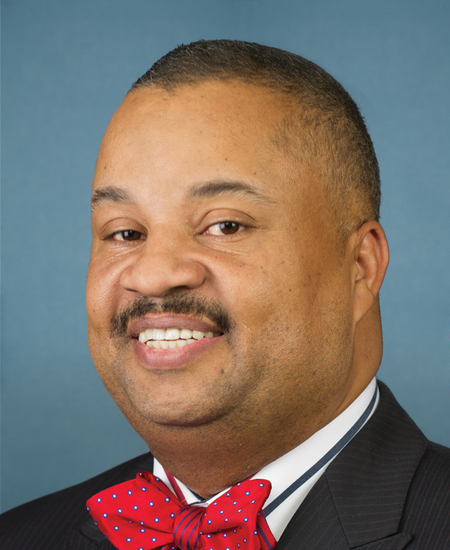
Rep. Donald M. Payne, Jr.
Sponsored bills
Helicopter Safety and Noise Management Act This bill establishes a commission comprised of the Federal Aviation Administration, members of local and state government, and helicopter noise and safety advocates to develop a helicopter usage management plan to substantially reduce the number of nonessential civil rotorcraft (i.e., a helicopter) that can operate in certain airspace at any given time. The plan shall not apply any limitation or requirement to the operation of a civil rotorcraft for purposes of public health and safety, including (1) law enforcement, (2) emergency response, (3) disaster response, (4) medical services, (5) scientific research, and (6) official purposes by a news organization.
Stop Sexual Assault and Harassment in Transportation Act This bill establishes formal sexual assault and harassment policies for the transportation industry. Among other things, the bill requires certain passenger transportation carriers, including passenger airlines and vessels, buses, commuter and intercity passenger railroads, and transportation network companies (e.g., Uber or Lyft) to establish formal policies, training, and reporting structures regarding sexual assault and harassment; sets forth civil penalties for individuals who physically assault or sexually assault or threaten to assault transportation personnel; directs the Department of Transportation (DOT) to collect information on the number of sexual assault and harassment incidents reported by the carriers and make such information publicly available; expands the reporting process for individuals involved in transportation sexual assault or harassment incidents by allowing such individuals to report allegations to law enforcement in a manner that protects their privacy and confidentiality; assesses the accuracy of the reporting of transportation sexual assault or harassment incidents by the carriers; and requires DOT to develop and publish a definition of sexual harassment.
Community Services Block Grant Modernization Act of 2022 This bill reauthorizes the Community Services Block Grant program through FY2032 and otherwise modifies the program. The program supports various antipoverty activities, primarily through formula-based allotments to states, Indian tribes, and territories. In particular, the bill makes changes to the program's administration and leadership; performance measurement; and allotments to states and territories. The bill also expands eligibility for services and activities funded by the program to 200% of the federal poverty line (FPL). Under current law, eligibility is generally set at the FPL.
Rights for the Transportation Security Administration Workforce Act of 2022 or the Rights for the TSA Workforce Act of 2022 This bill modifies the workplace rights, protections, and benefits applicable to Transportation Security Administration (TSA) personnel. Specifically, the bill by December 31, 2022, eliminates personnel authorities of the Department of Homeland Security (DHS) and the Department of Transportation governing the conditions of employment for TSA employees, thus making TSA employees subject to the personnel management system applicable to other federal employees; sets forth transition rules that protect the pay rates, leave rights, and other rights of TSA employees; and requires DHS to consult with the exclusive representative of TSA screening employees to carry out the conversion of those positions. The bill also permits the TSA to consult with organizations representing federal air marshals to address concerns, including mental health and suicide rates; directs the TSA to ensure its employees are provided proper guidance regarding prevention and protections against COVID-19; requires the TSA to provide a one-time bonus payment of $3,000 to each TSA employee carrying out duties that require substantial contact with the public during the COVID-19 national emergency; and requires the Government Accountability Office to report on implementation of the bill, TSA recruitment efforts, and specified TSA personnel policies.

Supreme Court Ethics, Recusal, and Transparency Act of 2022 This bill provides for the establishment of a code of conduct for Supreme Court Justices, judges of the courts of appeals, judges of the district courts, and judges of the Court of International Trade.
Benjamin Berell Ferencz Congressional Gold Medal Act This bill provides for the award of a Congressional Gold Medal to Benjamin Berell Ferencz in recognition of his service to the United States and the international community during the post-World War II Nuremberg trials and his lifelong advocacy for international criminal justice and the rule of law.
This resolution extends collective bargaining rights prescribed in the Congressional Accountability Act of 1995 to employees of the House of Representatives.
Displaced Afghan Women and Girls Education Act of 2022 This bill provides certain educational resources to certain displaced Afghan women and girls domiciled in the United States. For example, the bill (1) requires such displaced Afghan women and girls to receive in-state tuition rates at public institutions of higher education, and (2) provides funding for and establishes the Displaced Afghan Women and Girls Scholarship Grant.
Federal Emergency Management Advancement of Equity Act or the FEMA Equity Act This bill addresses equity in federal disaster assistance policies and programs. The Federal Emergency Management Agency (FEMA) must develop and implement a process to ensure equity in the provision of federal assistance and throughout all FEMA programs and policies. Additionally, FEMA must establish metrics to measure the efficacy of the process and seek input from relevant representatives of state, regional, local, and tribal governments; community-based organizations; subject matter experts; and individuals from underserved communities impacted by disasters. FEMA must designate a senior official as an equity advisor. The bill establishes in FEMA an Equity Enterprise Steering Group. The chief executive officer of an affected county may submit a request for a presidential declaration that a major disaster exists if (1) the governor of the state or territory in which the county is located does not request such a declaration, (2) the affected county is not included in a request for assistance made by such governor, or (3) the affected county communicates with that governor about the disaster or potential request for a major disaster declaration before the relevant period has lapsed. The Government Accountability Office shall issue a report describing the factors that FEMA considers when evaluating a request from a governor to declare that a major disaster or emergency exists and to authorize specified assistance.