

This resolution condemns racism and invidious discrimination as evil and antithetical to the U.S. Constitution and declares unconditional war on racism and invidious discrimination in America. (Invidious discrimination generally refers to discrimination based on a classification that is arbitrary or irrational and not related to a legitimate purpose.) The resolution also expresses the intention of the House of Representatives to pass legislation establishing a Cabinet-level Department of Reconciliation. The department shall be charged with developing and coordinating the implementation of a comprehensive national strategy to eliminate racism and invidious discrimination.
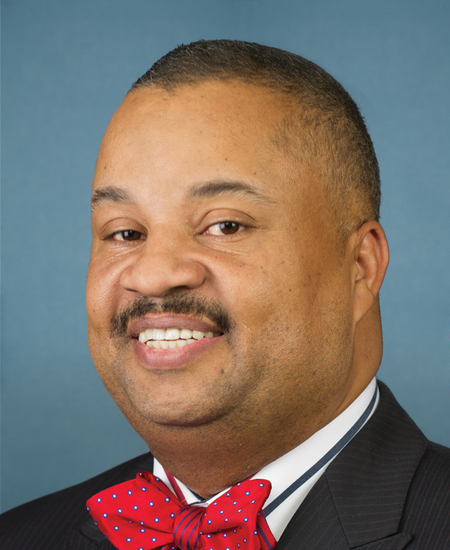
Rep. Donald M. Payne, Jr.
Sponsored bills
This resolution expresses the sense of the House of Representatives that the proposed constitutional amendment known as the Equal Rights Amendment has been duly proposed by Congress and ratified by the states and is therefore valid as the Twenty-Eighth Amendment to the Constitution. (The proposed amendment prohibits the United States or any state from denying or abridging equal rights under the law on account of sex.)
This resolution expresses support for the principles of Transgender Day of Remembrance, memorializing the lives lost to anti-transgender violence this year.
This resolution celebrates the first International Day for People of African Descent and expresses a commitment to a legislative agenda that eliminates persistent racial inequalities in the United States.
Maddy summaryHRES 507 is a non-binding House resolution condemning legislative actions and violence targeting transgender and nonbinary individuals. It references 2021 state bills restricting transgender youth access to gender-affirming medical care, sports participation, and public facilities, alongside statistics on rising violence (44 transgender killings in 2020) and mental health impacts. The resolution formally condemns discriminatory legislation and violence, remembers victims of transphobic hate, and commits to advocating for the community’s safety. As a symbolic resolution - not a law - it expresses congressional disapproval but does not create new policies or alter existing laws.
This resolution expresses support for (1) equal rights and protections for all people, regardless of actual or perceived sexual orientation or gender identity; and (2) the designation of LGBTQ Equality Day on June 26 to commemorate Supreme Court decisions handed down on that day in 2003, 2013, and 2015. The resolution also acknowledges the need for further legislation to ensure that people in the United States are free from all forms of discrimination on the basis of actual or perceived sexual orientation or gender identity.
This resolution expresses the sense of the House of Representatives that (1) lesbian, gay, bisexual, transgender, queer, intersex, and asexual (LGBTQIA+) rights are human rights and protected by the U.S. Constitution; (2) LGBTQIA+ Pride Month should be celebrated; and (3) all Americans should be treated equally regardless of sexual orientation or gender identity.
State Firearms Dealer Licensing Enhancement Act This bill authorizes the Department of Justice to award grants to states and tribal governments for the development, implementation, improvement, or evaluation of firearms dealer licensing programs.
Animal Violence Exposes Real Threat of Future Violence Act of 2022 or the AVERT Future Violence Act of 2022 This bill directs the National Institute of Justice within the Department of Justice (DOJ) to study the factors that contribute to acts of animal cruelty. The report must also analyze acts of animal cruelty as a predictor of future violence against humans. Additionally, the bill authorizes DOJ to establish a grant program to support the development and strengthening of detection strategies and early intervention or diversion resources to stop acts of animal cruelty and rehabilitate offenders.
Restoring Artistic Protection Act of 2022 This bill limits the admissibility of evidence of a defendant's creative or artistic expression against the defendant in a federal criminal case. The term creative or artistic expression means the expression or application of creativity or imagination in the production or arrangement of forms, sounds, words, movements, or symbols, including music, dance, performance art, visual art, poetry, literature, film, and other such objects or media.