

New York-New Jersey Watershed Protection Act This bill requires the U.S. Fish and Wildlife Service to establish the New York-New Jersey Watershed Restoration Program, a nonregulatory program, to coordinate restoration and protection activities among government entities and conservation partners throughout the watershed. The bill also establishes the New York-New Jersey Watershed Restoration Grant Program, a voluntary grant and technical assistance program, to provide competitive matching grants to certain entities to implement restoration and protection activities for the watershed.
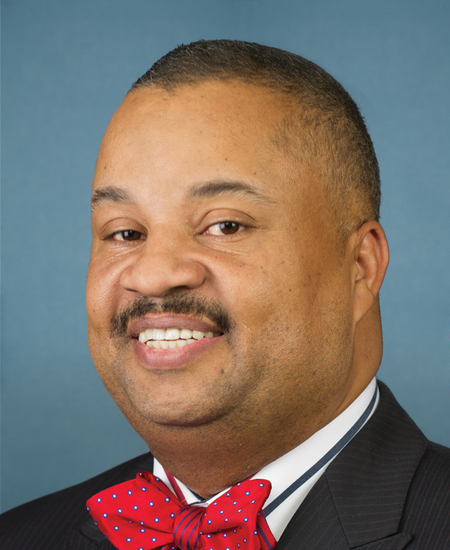
Rep. Donald M. Payne, Jr.
Sponsored bills
Prevent All Soring Tactics Act of 2022 or the PAST Act of 2022 This bill addresses the practice of soring horses. The soring of horses includes various actions taken on horses' limbs to produce higher gaits that may cause pain, distress, inflammation, or lameness. Specifically, the bill expands soring regulation and enforcement at horse shows, exhibitions, sales, and auctions, including by establishing a new system for inspecting horses for soring. In addition, the bill increases penalties for violations.
National Aviation Preparedness Plan Act of 2022 This bill directs the Department of Transportation (DOT) to develop a national aviation preparedness plan for communicable disease outbreaks, including to (1) create a process to identify appropriate personal protective equipment to reduce the likelihood of exposure to a communicable disease that has the potential to cause an epidemic or pandemic of infectious disease that would constitute a public health emergency of international concern (i.e., a covered communicable disease); and (2) improve coordination between airports, air carriers, and governmental entities with respect to preparing for and responding to communicable disease outbreaks. In developing the plan, DOT must consult with aviation industry and labor stakeholders such as air carriers. The Government Accountability Office must conduct a study assessing the plan, including (1) whether the plan meets the obligations of the United States under international conventions and treaties, and (2) the extent to which the U.S. aviation system is prepared to respond to an outbreak of a covered communicable disease.
This concurrent resolution expresses opposition to the application of criminal laws to pregnancy outcomes and affirms that people deserve access to high-quality health care without fear of reprisal or punishment.
This concurrent resolution recognizes that people with disabilities experience barriers to access every day and pledges to make universal and inclusive design a guiding principle for all infrastructure bills and projects.
This joint resolution proposes a constitutional amendment related to the fundamental right to vote. Specifically, it grants every U.S. citizen of legal voting age the fundamental right to vote in any public election held in the jurisdiction in which the citizen resides.
Maddy summaryHJRES 53 proposes a constitutional amendment to ban slavery and involuntary servitude as a criminal punishment. Currently, the 13th Amendment to the U.S. Constitution permits such punishments for crimes, creating a legal loophole. If ratified by 3/4 of state legislatures, this amendment would eliminate that exception nationwide, making it unconstitutional to impose forced labor or slavery as part of criminal sentences. The change would directly affect all states' criminal justice systems, particularly prison labor practices, by prohibiting these punishments for any offense.
This resolution condemns the Supreme Court's holding in Dobbs v. Jackson Women's Health Organization (that there is no constitutional right to abortion) and expresses a commitment to instituting judicial reform and supporting access to abortion and the communities affected by the Court's ruling. It also urges the executive branch to advance reproductive justice.
This resolution expresses support for implementing a Transgender Bill of Rights that guarantees certain rights for transgender and nonbinary people with respect to public services and accommodations, employment, housing, health care, and other specified areas.
This resolution expresses the sense of the House of Representatives that (1) lesbian, gay, bisexual, transgender, queer, intersex, and asexual (LGBTQIA+) rights are human rights and protected by the U.S. Constitution; (2) LGBTQIA+ Pride Month should be celebrated; and (3) all Americans should be treated equally regardless of sexual orientation or gender identity.