Promoting Infrastructure by Protecting Our Subcontractors and Taxpayers Act This bill revises the transportation infrastructure finance and innovation program to require the Department of Transportation (DOT) to ensure that the design and construction of a project carried out under the program must have appropriate payment and performance security, regardless of whether the obligor is a state, local government, agency or instrumentality of a state or local government, public authority, or private party. DOT may accept such payment and performance security requirements if it makes a written determination that the federal interest is adequately protected.
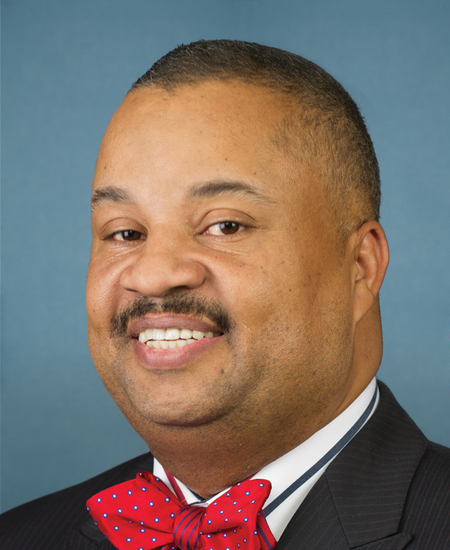
Rep. Donald M. Payne, Jr.
Sponsored bills
Donald Payne Sr. Colorectal Cancer Detection Act of 2021 This bill provides for Medicare coverage and payment, subject to specified frequency limits, of certain colorectal cancer screening blood-based tests.
George Floyd Justice in Policing Act of 2021 This bill addresses a wide range of policies and issues regarding policing practices and law enforcement accountability. It increases accountability for law enforcement misconduct, restricts the use of certain policing practices, enhances transparency and data collection, and establishes best practices and training requirements. The bill enhances existing enforcement mechanisms to remedy violations by law enforcement. Among other things, it does the following: lowers the criminal intent standard—from willful to knowing or reckless—to convict a law enforcement officer for misconduct in a federal prosecution, limits qualified immunity as a defense to liability in a private civil action against a law enforcement officer, and grants administrative subpoena power to the Department of Justice (DOJ) in pattern-or-practice investigations. It establishes a framework to prevent and remedy racial profiling by law enforcement at the federal, state, and local levels. It also limits the unnecessary use of force and restricts the use of no-knock warrants, chokeholds, and carotid holds. The bill creates a national registry—the National Police Misconduct Registry—to compile data on complaints and records of police misconduct. It also establishes new reporting requirements, including on the use of force, officer misconduct, and routine policing practices (e.g., stops and searches). Finally, it directs DOJ to create uniform accreditation standards for law enforcement agencies and requires law enforcement officers to complete training on racial profiling, implicit bias, and the duty to intervene when another officer uses excessive force.
Social Determinants for Moms Act This bill directs various federal departments to address social determinants of maternal health. These are nonclinical factors, such as economic or social factors, that impact maternal health outcomes. First, the Department of Health and Human Services (HHS) must convene a task force to coordinate federal efforts on social determinants of maternal health. HHS must also award grants to support access to free child care during prenatal and postpartum appointments; and address social determinants of, and eliminate racial and ethnic disparities in, maternal health. Second, the Department of Housing and Urban Development must award grants to community-based organizations and government entities to assist pregnant and postpartum individuals with affordable housing. Grantees may use funds to, for example, provide individuals with direct financial assistance. Third, the Department of Transportation must report on transportation barriers that prevent pregnant and postpartum individuals from accessing health care and other services. Fourth, the bill extends to 24 months the postpartum eligibility period for the Special Supplemental Nutrition Program for Women, Infants, and Children (WIC). Currently, WIC eligibility lasts for six months postpartum or one year for those breastfeeding. The Department of Agriculture (USDA) must evaluate the impact of this extension. USDA must also establish a grant program to deliver healthy foods and supplies to pregnant and postpartum individuals in food deserts. Last, the Environmental Protection Agency must enter into an agreement with the National Academies of Sciences, Engineering, and Medicine to study the impact of environmental conditions and contaminants on maternal and infant health outcomes.
LGBTQ Business Equal Credit Enforcement and Investment Act This bill requires financial institutions to report certain credit application data to the Consumer Financial Protection Bureau for the purposes of enforcing fair lending laws. Specifically, financial institutions must report this data regarding lesbian-, gay-, bisexual-, transgender-, or queer-owned businesses. Currently, this data is reported regarding women-owned, minority-owned, and small businesses.
Postal Vehicle Modernization Act This bill establishes requirements for U.S. Postal Service (USPS) vehicle purchases and charging stations. The bill's provisions only apply if specified funding is appropriated. Specifically, the bill requires the USPS to ensure that at least 75% of the total number of next generation delivery vehicles purchased using such funds are electric or zero-emission vehicles. The bill provides for a phase-out of medium- and heavy-duty vehicles that are not electric or zero-emission vehicles. The USPS must provide by January 1, 2026, at each postal facility accessible to the public, at least one electric vehicle charging station for use by the public or USPS officers and employees.
This resolution thanks and honors the journalists and news staff who risked themselves to chronicle the insurrection at the U.S. Capitol on January 6, 2021, and it condemns the harassment and violent attacks on the media during the insurrection.
This joint resolution proposes a constitutional amendment authorizing Congress and the states to set reasonable limits on the raising and spending of money by candidates and others to influence elections. The amendment grants Congress and the states the power to implement and enforce this amendment by legislation. They are allowed to distinguish between natural persons and corporations or other artificial entities created by law, including by prohibiting such entities from spending money to influence elections.
This joint resolution proposes a constitutional amendment limiting the pardon power of the President. The amendment prohibits the President from granting a pardon or reprieve to himself or herself, to family members or members of the administration, to paid campaign employees, to a person or entity for an offense motivated by an interest of any of those people, or to a person or entity for an offense directed by or coordinated with the President. The amendment also invalidates pardons issued for a corrupt purpose.
This resolution impeaches President Donald John Trump for high crimes and misdemeanors. Specifically, the resolution sets forth two articles of impeachment stating that President Trump has abused the powers of the presidency. The first article states that, using the powers of his office, President Trump sought to threaten, intimidate, and solicit the Secretary of State of Georgia to acquiesce to his demand to find enough votes to make him the winner of Georgia's presidential election, even though the votes in Georgia had already been counted three times in favor of his opponent. The article further states that, by doing so, President Trump actively undermined public faith and confidence in the integrity of American elections, subverted the rule of law, and placed his personal interests above the national interest. The second article states that President Trump has endeavored to undermine foundations of U.S. democracy, indicating an intention to make himself an authoritarian ruler who is unaccountable to the U.S. people. The article specifies the following actions by President Trump: refusing to acknowledge, and opposing efforts to protect against, Russian interference in U.S. affairs; expressing willingness to accept foreign assistance to win reelection; refusing to accept the results of the election; undermining the ability of American citizens to exercise their rights as voters; falsely alleging widespread voting fraud while producing no evidence; inciting his supporters to believe falsely that the election had been stolen from him; and failing to take action to protect federal officers, personnel, property, and institutions on January 6, 2021, when the Capitol was besieged by his supporters. Both articles state that, by such conduct, President Trump warrants impeachment and trial, removal from office, and disqualification to hold U.S. office.