

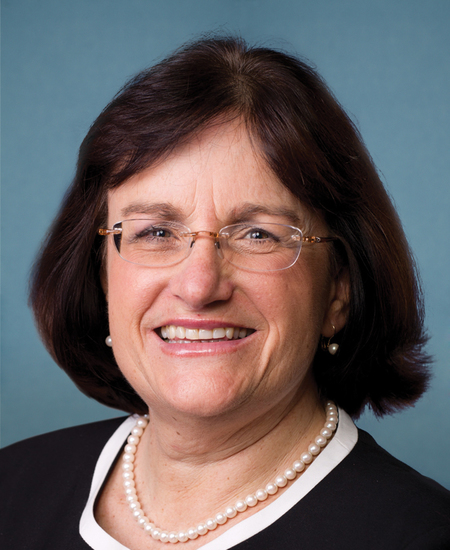
Photo of Ann M. Kuster
D United States House · District 2 · New Hampshire

Rep. Ann M. Kuster

Compare
Total votes
2,168
all sessions
Attendance
97%
74 missed
Lower than 83% of chamber peers
With party
98%
of cast votes
Higher than 82% of chamber peers
Bipartisan score
1%
crosses aisle rarely
Lower than 83% of chamber peers
Sponsored
1,353
bills & resolutions
Higher than 87% of chamber peers
Committees
0
assignments
1,353 bills and resolutions

Sponsored bills

Total
1,353
Primary
58
Co-sponsor
1,295
This page
1,353
matching current filters
Co-sponsor HR 4959
In committee · United States House · Co-sponsor
To require to Comptroller General to submit to Congress a report on the status of dams in the USDA watershed program.

Maddy summaryHR 4959 requires the Comptroller General to submit a report to Congress within one year of enactment on the condition and safety of dams funded through USDA watershed programs. The report must detail each dam's location, structural status, compliance with environmental guidelines, safety risk classification, whether it meets its intended purpose, and if decommissioning is warranted due to safety, cost, or environmental factors. It applies specifically to dams supported under four USDA watershed laws, including the Watershed Protection Act and the 1944 Flood Prevention Act. This is a data-gathering measure focused on transparency, not a policy change or mandate for action.

In committee Aug 28, 2023 1 co-sponsor
Co-sponsor HR 4713
In committee · United States House · Co-sponsor
Rural Hospital Technical Assistance Program Act

Rural Hospital Technical Assistance Program Act This bill provides statutory authority for the Rural Hospital Technical Assistance Program within the Department of Agriculture (USDA). Under the bill, USDA must establish and maintain (directly or by grant, contract, or cooperative agreement) a program to help eligible hospital facilities in rural areas with a population of 50,000 inhabitants or less.  The program must provide tailored technical assistance and training to hospital facilities to identify development needs for maintaining essential health care services and support action plans for financial, operational, and quality improvement projects to meet these needs. Development needs include (1) constructing, expanding, and modernizing health care facilities; (2) increasing telehealth capabilities; and (3) acquiring or upgrading health care information systems (e.g., electronic health records). The program must also provide technical assistance and training to help hospital facilities to better manage their financial and business strategies and identify, and apply for assistance from, USDA loan and grant programs. In selecting eligible hospital facilities to participate in the program, USDA must give priority to borrowers and grantees of certain USDA rural assistance programs.   USDA must also submit an annual report to Congress on the progress and results of the program.

In committee Aug 24, 2023 1 co-sponsor
Co-sponsor HR 4603
In committee · United States House · Co-sponsor
Rural Wellness Act

Rural Wellness Act This bill prioritizes behavioral and mental health treatment services under certain rural development grant and loan programs. The bill also reauthorizes through FY2028 the set-asides and prioritizations for substance use disorder treatment services under the Department of Agriculture's (1) Community Facilities Direct Loan and Grant Program, (2) Rural Health and Safety Education Competitive Grants Program, and (3) Distance Learning and Telemedicine Grant Program. Under the community facilities program, the bill prioritizes direct loans and grants for the development of behavioral and mental health services facilities, including facilities that provide treatment services. Further, loans and grants provided under the program may be used to develop facilities and systems to provide telehealth services for behavioral and mental health treatment. Under the Rural Health and Safety Education Competitive Grants Program, the bill prioritizes grants for behavioral and mental health education and treatment. Under the Distance Learning and Telemedicine Grants Program, the bill includes a 17% set-aside for telemedicine projects that provide substance use disorder treatment services (currently a 20% set-aside).

In committee Aug 24, 2023 1 co-sponsor
Co-sponsor HR 4327
In committee · United States House · Co-sponsor
Converting Our Waste Sustainably (COWS) Act of 2023

Maddy summaryThe Converting Our Waste Sustainably (COWS) Act of 2023 establishes a new federal program to help dairy and livestock producers reduce methane emissions and improve soil health. It directly affects eligible producers who currently use liquid manure lagoons or methane-capturing systems by offering cost-sharing (up to 90% federal funding) to adopt covered management measures like pasture-based grazing, solid manure separation systems, or composting practices. The program allocates $1.5 billion over five years (2024-2028), prioritizing projects near low-income communities and reserving funds for beginning, limited-resource, and socially disadvantaged farmers. Payments require producers to implement at least one approved measure for up to three years, with a $825,000 cap per entity over five years.

In committee Aug 21, 2023 1 co-sponsor
Co-sponsor HR 5216
In committee · United States House · Co-sponsor
Connecticut River Watershed Partnership Act

Maddy summaryThis bill establishes the Connecticut River Watershed Partnership program (Section 3) to coordinate restoration and protection efforts across the 5-state watershed (Connecticut, Maine, Massachusetts, New Hampshire, Vermont). It creates a competitive grant program (Section 4) providing up to 90% federal funding for eligible entities - including states, tribes, nonprofits, and local groups - to carry out projects that improve water quality, restore habitats, and support environmental justice communities. The program requires the Secretary of the Interior to collaborate with Tribal governments, state agencies, and conservation organizations to develop a unified strategy. It mandates annual reporting to Congress and prioritizes projects advancing nature-based solutions, public access, and equitable outcomes in communities facing environmental health risks.

In committee Aug 16, 2023 1 co-sponsor
Co-sponsor HR 5163
In committee · United States House · Co-sponsor
Telehealth Response for E-prescribing Addiction Therapy Services Act

Maddy summaryThe TREATS Act amends the Controlled Substances Act to allow healthcare providers to use telehealth for the initial evaluation when prescribing certain medications for opioid use disorder. Specifically, it replaces the requirement for an in-person medical evaluation with an option for a telehealth evaluation for medications in schedules III, IV, or V (excluding methadone) that are FDA-approved to treat opioid use disorder. The telehealth evaluation must be conducted via real-time audio or video communication meeting federal and state requirements, as defined by the bill. This change directly affects providers prescribing these medications and patients seeking treatment for opioid use disorder in these categories.

In committee Aug 11, 2023 1 co-sponsor
Co-sponsor HR 5140
In committee · United States House · Co-sponsor
Strengthening America’s Families Act of 2023

Maddy summaryThe Strengthening America's Families Act of 2023 establishes a federal program to create infant-toddler court teams that coordinate courts, child welfare agencies, and community services to support infants, toddlers, and their families experiencing or at risk of maltreatment. The bill authorizes $25 million annually for grants to states to establish or enhance these teams, requiring them to meet specific criteria including trauma-informed practices, preventing foster care placements, and addressing developmental needs. States receiving grants must work with a National Infant-Toddler Court Team Resource Center that provides technical assistance and collects data on program effectiveness. This program directly affects young children in the child welfare system, their families, and state child welfare systems by promoting coordinated, community-based support to improve outcomes.

In committee Aug 11, 2023 1 co-sponsor
Co-sponsor HR 4249
In committee · United States House · Co-sponsor
VET PFAS Act

Maddy summaryHR 4249, the VET PFAS Act, provides healthcare benefits to veterans and their families exposed to PFAS chemicals at military bases. Veterans who served at contaminated bases (including through water sources) and developed specific conditions like testicular cancer, ulcerative colitis, or pregnancy-induced hypertension become eligible for VA healthcare without needing medical proof of cause. Family members who lived at these bases or were in utero during such residence also qualify for covered conditions. The bill creates a "presumption of service connection" for these illnesses, meaning the VA assumes PFAS exposure caused the condition. It requires annual VA reports tracking beneficiaries, denials, and conditions treated.

In committee Aug 8, 2023 1 co-sponsor
Co-sponsor HR 5141
In committee · United States House · Co-sponsor
Funding Early Childhood is the Right IDEA Act

Maddy summaryThis bill authorizes increased federal funding for early childhood special education programs under the Individuals with Disabilities Education Act (IDEA). It specifically restores funding for Part C (services for infants and toddlers with disabilities) and Section 619 (preschool programs for children with disabilities ages 3-5) by setting annual appropriations from $503 million to $1.22 billion for Section 619 and $932 million to $1.73 billion for Part C through 2028. These funds would directly support states in delivering high-quality early intervention and preschool services to children with disabilities and their families. The bill aims to reverse decades of reduced per-child funding, which had fallen significantly from historical highs.

In committee Aug 4, 2023 1 co-sponsor
Co-sponsor HR 5116
In committee · United States House · Co-sponsor
Behavioral Health Information Technology Coordination Act

Maddy summaryThis bill provides grants to behavioral health providers (like psychiatrists, community mental health centers, and substance use treatment facilities) to adopt certified health information technology. Eligible providers can receive up to $2 million per grant for up to two years to purchase or upgrade software that meets federal certification standards, enabling electronic sharing of patient data with primary care doctors, hospitals, and emergency departments. The grants require providers to demonstrate improved care coordination for mental health and substance use disorders, including bidirectional data exchange and use of standardized quality metrics. The program requires annual reporting to Congress on outcomes like data-sharing rates and impacts on care access, with $20 million authorized annually for fiscal years 2025-2029.

In committee Aug 4, 2023 1 co-sponsor
Showing 281 to 290 of 1,353 bills
Previous 1 … 28 29 30 … 136 Next