

North Dakota Trust Lands Completion Act This bill authorizes the Department of the Interior to exchange, at the election of North Dakota, certain federal land for certain state land of substantially equal value. Specifically, if North Dakota elects to relinquish a parcel of state land located wholly or partially within the boundaries of any Indian reservation or the Little Missouri National Grassland in North Dakota, the bill authorizes North Dakota to select one or more parcels of federal land of substantially equivalent value within that state. No later than 60 days after Interior approves North Dakota's selection of federal land, Interior shall initiate the actions necessary to convey the federal land to the state. As consideration for the conveyance of the federal land, North Dakota shall concurrently relinquish and convey the state land to Interior or, for a parcel that is located wholly or partially within the boundaries of the grassland, to the Department of Agriculture. Land conveyed to Interior that is within the boundaries of a reservation becomes part of the reservation on request of the tribe.
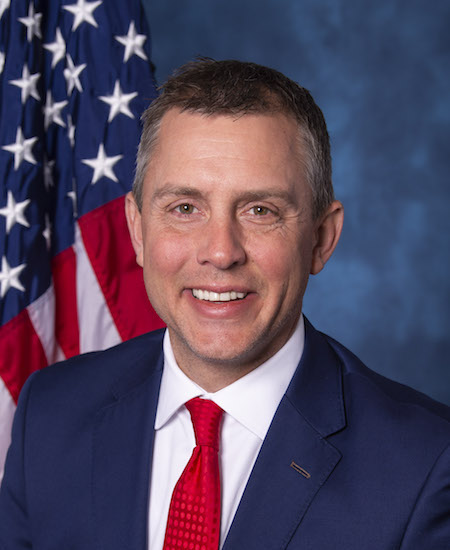
Rep. Kelly Armstrong
Sponsored bills
Higher Education Research Protection Act of 2021 This bill establishes within the Federal Bureau of Investigation an initiative to investigate suspected incidents of Chinese agents participating in federally funded research at institutions of higher education and the National Academies of Science, Engineering, and Medicine.
Maddy summaryHRES 779 is a symbolic resolution introduced in the U.S. House of Representatives on November 5, 2021. It expresses Congress’s disapproval of the Occupational Safety and Health Administration’s (OSHA) emergency temporary standard (ETS) requiring employers with over 100 workers to mandate COVID-19 vaccinations or weekly testing/mask-wearing. The resolution argues OSHA overstepped its authority by treating COVID-19 as a workplace-specific risk, despite Congress having delegated vaccine-related authority to other agencies like the FDA and CDC. As a non-binding resolution, it does not change any laws or enforceable requirements - it only states congressional opinion on the ETS.
Stop Vaccine Mandates Act This bill rescinds the executive order titled Ensuring Adequate COVID Safety Protocols for Federal Contractors and the executive order titled Requiring Coronavirus Disease 2019 Vaccination for Federal Employees , both published on September 9, 2021. The bill provides that these executive orders shall have no force or effect.
Burial Equity for Guards and Reserves Act of 2021 This bill prohibits the Department of Veterans Affairs (VA) from establishing a condition for a cemetery grant that restricts the ability of a state to inter certain reservists (or their spouses and children) at a state-owned veterans' cemetery solely because such individuals are ineligible for burial in an open national cemetery. Specifically, as a condition for grants, the VA cannot restrict the ability of a state to inter a member of a reserve component whose service was terminated under honorable conditions; member of the Army National Guard or Air National Guard whose service was terminated under honorable conditions; member of the Reserve Officers' Training Corps of the Army, Navy, or Air Force who died under honorable conditions while a member; and spouse, minor child, or unmarried adult child of any member described above. The VA is prohibited from (1) denying an application for a grant solely on the basis that the recipient state may use funds to expand, improve, operate, or maintain a veterans' cemetery to allow for the internment of the specified individuals; and (2) enforcing certain conditions on grants for state veterans' cemeteries that were established before the date of enactment of this bill. The bill also provides for plot allowances for the individuals listed in the bill.
Maddy summaryHRES 754 is a non-binding resolution expressing the House of Representatives' opposition to proposed "punitive natural gas taxes" on U.S. businesses, families, and workers. It cites claims that such taxes would raise average energy bills by 17%, reduce GDP by $9 billion, and eliminate 90,000 jobs, while disproportionately harming low-income households. The resolution argues that opposing these taxes supports U.S. energy security, national security, and continued leadership in reducing emissions through domestic natural gas production. As a procedural resolution, it does not create law but formally states the House's position against this policy approach.
This bill prohibits the use of federal funds to require a member of the Armed Forces to receive a COVID-19 vaccination. The bill also prohibits adverse action (e.g., punishment) being taken against a member of the Armed Forces because the member refuses to receive a COVID-19 vaccination.
This resolution recognizes the ultimate sacrifice of the unknown soldiers interred at Arlington National Cemetery and expresses gratitude and appreciation of all the members of the Armed Forces who have served during wars and peacetime. Additionally, the resolution commends all members of the 3d Infantry Regiment, specifically those who guard the Tomb of the Unknown Solider.
State Opioid Response Grant Authorization Act of 2021 This bill reauthorizes through FY2027 and otherwise changes the State Opioid Response Grant program. This program, which is managed by the Substance Abuse and Mental Health Services Administration, provides funding for states, territories, and Indian tribes and tribal organizations to address the opioid crisis. Specific changes to the program include (1) expanding its scope to also address stimulant use and misuse, (2) establishing a funding methodology and minimum funding allocations, and (3) allowing the use of grant funds for recovery support services. The bill also requires the Government Accountability Office to report on issues concerning the funding and other aspects of the program.
Fifth Amendment Integrity Restoration Act of 2021 or the FAIR Act This bill revises federal laws governing civil asset forfeiture. Specifically, the bill makes various changes to the general rules governing civil forfeiture proceedings. Among the changes, the bill requires counsel for an indigent property owner regardless of whether the owner requests counsel, raises the evidentiary standard from preponderance of the evidence to clear and convincing evidence, and sets forth factors courts must consider in determining whether a forfeiture of facilitating property is excessive. Additionally, the bill eliminates statutory authority for equitable sharing and directs forfeiture proceeds to be deposited into the general fund of the Treasury instead of the Department of Justice Assets Forfeiture Fund. Finally, the bill makes changes with respect to the civil forfeiture of money involved in structuring offenses (i.e., structuring currency transactions to evade currency reporting requirements). Among the changes, the bill specifies an evidentiary standard of knowingly for structuring offenses, and requires a prompt probable cause hearing following the seizure of money involved in a structuring offense.