

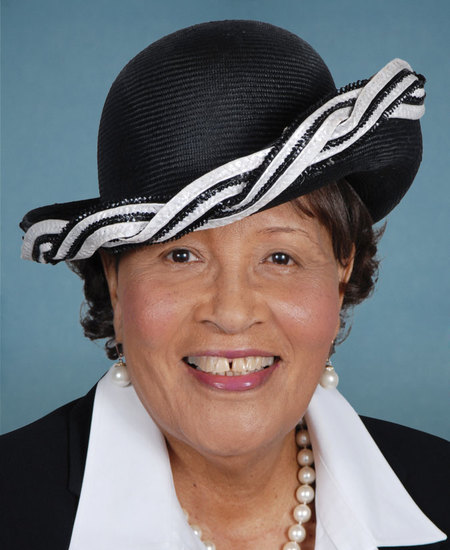
Photo of Alma S. Adams
D United States House · District 12 · North Carolina On the 2026 ballot

Rep. Alma S. Adams

Compare
Total votes
2,837
all sessions
Attendance
99%
27 missed
Higher than 96% of chamber peers
With party
99%
of cast votes
Higher than 94% of chamber peers
Bipartisan score
1%
crosses aisle rarely
Lower than 95% of chamber peers
Sponsored
1,505
bills & resolutions
Near the chamber average
Committees
6
assignments
1,505 bills and resolutions

Sponsored bills

Total
1,505
Primary
105
Co-sponsor
1,400
This page
1,505
matching current filters
Co-sponsor HR 4953
In committee · United States House · Co-sponsor
Preventing HEAT Illness and Deaths Act of 2023

Maddy summaryThis bill establishes a federal system to coordinate efforts across agencies to address health risks from extreme heat. It creates a National Integrated Heat Health Information System (NIHHIS) and an interagency committee to develop a strategic plan for heat health planning and response. The bill authorizes funding for community resilience projects that prioritize historically disadvantaged communities and those with environmental justice concerns. It mandates a study to identify gaps in heat information and response systems across the country. The legislation aims to reduce health impacts of extreme heat, particularly for vulnerable populations including the elderly, low-income communities, and communities of color.

In committee Jul 28, 2023 1 co-sponsor
Co-sponsor HR 4974
In committee · United States House · Co-sponsor
Local 9–8–8 Response Act of 2023

Maddy summaryThis bill requires phone calls, texts, and chats to 9-8-8 (the national suicide prevention and mental health crisis hotline) to be routed to the nearest participating crisis center within 90 days of enactment, while protecting caller privacy by not revealing precise location. It mandates all phone carriers to transmit every 9-8-8 call or text - including those from prepaid or non-initialized handsets - and updates phone systems to allow direct 9-8-8 dialing without extra steps. The law affects crisis centers (by directing calls to their area), callers (through improved routing and privacy), and phone carriers (by requiring transmission compliance). These changes aim to make the 9-8-8 system more efficient and accessible for those seeking mental health support.

In committee Jul 28, 2023 1 co-sponsor
Primary HR 4236
In committee · United States House · Lead sponsor
1890s Advancing and Building Leadership and Excellence Opportunity Act of 2023

Maddy summaryThis bill increases funding for research centers at 1890 institutions (historically Black colleges and universities with agriculture programs) from $10 million to $50 million annually for fiscal years 2024-2028. It allows up to 10 research centers (previously minimum 3) and adds new focus areas including climate change adaptation, forest resilience, food safety, and integrating social sciences into agricultural research. These centers will directly support underserved farmers and communities through targeted research on issues like soil health, renewable energy, and value-added agriculture. The bill modifies existing provisions under the 1990 Food, Agriculture, Conservation, and Trade Act to expand and fund these initiatives.

In committee Jul 28, 2023 0 co-sponsors
Co-sponsor HR 4060
In committee · United States House · Co-sponsor
Food Access and Stability Act of 2023

Maddy summaryThe provided context for HR 4060 (Food Access and Stability Act of 2023) only describes a technical amendment to an existing law (the Fiscal Responsibility Act of 2023), specifically modifying section 311(b)(2) by replacing subsection (a) with subsection (a)(1). It does not explain the policy substance, who is affected, or the practical impact of this change. Without additional details on the amendment's purpose or resulting policy shifts, a substantive summary cannot be generated. This appears to be a procedural adjustment rather than a new policy measure.

In committee Jul 28, 2023 1 co-sponsor
Co-sponsor HR 3955
In committee · United States House · Co-sponsor
Increasing Land Access, Security, and Opportunities Act

Increasing Land Access, Security, and Opportunities Act This bill provides statutory authority for and expands the Farm Service Agency's (FSA's) Increasing Land, Capital, and Market Access Program (the Increasing Land Access Program) for farmers, ranchers, and forest owners. Specifically, the FSA must make competitive grants to, enter into cooperative agreements with, or provide other capital support to eligible entities (e.g., state or local governments, Indian tribes, nonprofit organizations, and institutions of higher education) to provide direct assistance to farmers, ranchers, and forest owners who are (1) historically underserved, or (2) operating in high-poverty areas. The bill specifically excludes from assistance any foreign-based or foreign-owned corporation. The direct assistance may include payments to intended beneficiaries to acquire real property (including air rights and water rights), secure clear title on an heirs' property farmland, and improve or remediate land, water, and soil. Eligible entities may also use grants (1) to provide direct assistance to intended beneficiaries in assessing, purchasing, acquiring, or retaining eligible land; (2) for activities designed to support farm establishment and long-term viability; and (3) to provide technical assistance. The FSA must establish a stakeholder committee and, in collaboration with the committee, develop a process for evaluating proposals and distributing funds to eligible entities. In developing this process, the FSA must consider perspectives from diverse stakeholders, diverse geographic distribution, and diverse farming models, practices, and purposes.

In committee Jul 28, 2023 1 co-sponsor
Co-sponsor HR 4979
In committee · United States House · Co-sponsor
Fairness for Small-Scale Farmers and Ranchers Act

Maddy summaryThis bill aims to reduce corporate concentration in agriculture by imposing a moratorium on large agribusiness mergers and requiring retroactive review of past mergers that may have harmed competition. It mandates that large meatpackers purchase at least 50% of livestock through spot market sales from nonaffiliated farmers, restores mandatory country of origin labeling for beef, pork, and dairy products, and increases funding for beginning, retiring, and socially disadvantaged farmers. The legislation targets unfair practices by large processors and retailers, requiring transparency in pricing and preventing anti-competitive behavior that has driven down farmer income. It directly affects small-scale farmers, ranchers, and rural communities by strengthening their bargaining power in agricultural markets. The bill's provisions aim to reverse decades of consolidation that have driven down farmer income while increasing food prices for consumers.

In committee Jul 27, 2023 1 co-sponsor
Co-sponsor HR 5064
In committee · United States House · Co-sponsor
Public Housing Fire Safety Act

Maddy summaryHR 5064, the Public Housing Fire Safety Act, requires the Department of Housing and Urban Development (HUD) to inspect public housing for automatic sprinkler systems and report findings to Congress within three years. It establishes a competitive grant program using $25 million annually (2024-2033) from the Capital Fund to retrofit older public housing projects without sprinklers, excluding newly rebuilt properties. The bill directly affects public housing agencies managing buildings that lack sprinklers, providing funding to install them while clarifying that inspections and grants do not mandate retrofits for all properties. Key provisions include mandatory reporting on fire safety gaps and targeted funding to improve safety in older housing units.

In committee Jul 27, 2023 1 co-sponsor
Co-sponsor HR 4983
In committee · United States House · Co-sponsor
Equal Employment for All Act of 2023

Maddy summaryHR 4983, the Equal Employment for All Act of 2023, prohibits most employers from using credit reports in hiring decisions or employment-related adverse actions. The bill amends the Fair Credit Reporting Act to ban employers from considering credit history when making job offers, promotions, or other employment decisions, except for positions requiring national security clearances or when specifically required by law. It applies directly to all employers and job applicants nationwide, eliminating the common practice of credit checks during hiring. The law requires employers to stop using credit reports for employment purposes, with limited exceptions, and maintains existing disclosure requirements for other permissible uses of consumer reports.

In committee Jul 27, 2023 1 co-sponsor
Co-sponsor HR 5054
In committee · United States House · Co-sponsor
Equal and Uniform Treatment in the Military Act

Maddy summaryHR 5054, the Equal and Uniform Treatment in the Military Act (EQUITY Act), prohibits discrimination in the U.S. military based on race, color, religion, sex, national origin, gender identity, or sexual orientation. It amends Title 10 of the U.S. Code to require that military service, advancement, and evaluations be based solely on an individual’s merit, fitness, capability, and performance. The bill explicitly bans policies that consider protected characteristics in eligibility or treatment, replacing prior frameworks with this clear standard. It directly affects all active-duty service members, reservists, and military personnel across all branches.

In committee Jul 27, 2023 1 co-sponsor
Co-sponsor HR 4963
In committee · United States House · Co-sponsor
Tax Fairness for Workers Act

Maddy summaryHR 4963, the Tax Fairness for Workers Act, would restore tax deductions for certain employee expenses. It creates an above-the-line deduction for union dues and expenses paid by wage-earning employees, and allows miscellaneous itemized deductions for other work-related expenses (like uniforms or supplies) that were previously disallowed after 2017 tax law changes. These provisions directly affect employees who pay union dues or incur qualifying job-related costs. The bill amends specific sections of the Internal Revenue Code to make these deductions available for taxable years beginning after December 31, 2022. It does not change tax rates or provide new benefits, only reinstating previously eliminated deductions for eligible workers.

In committee Jul 27, 2023 1 co-sponsor
Showing 711 to 720 of 1,505 bills
Previous 1 … 71 72 73 … 151 Next