

Maddy summaryThe Teacher Diversity and Retention Act establishes Centers of Excellence at teacher preparation programs to address the lack of diversity among teachers, authorizing $100 million annually for five years. It specifically targets minority-serving institutions (including Hispanic-serving, Tribal, predominantly Black, and Native American-serving colleges) to improve teacher recruitment, training, and retention. The bill requires institutions to implement reforms that prepare teachers to work in low-performing schools, provide mentorship for new teachers (especially minority teachers), and embed dual certification for special education. It also mandates training in culturally responsive teaching, social-emotional learning, and positive behavior management for all teacher candidates. This legislation directly affects teacher preparation programs, high-need school districts, and the students they serve, particularly students of color who benefit from having teachers of similar backgrounds.
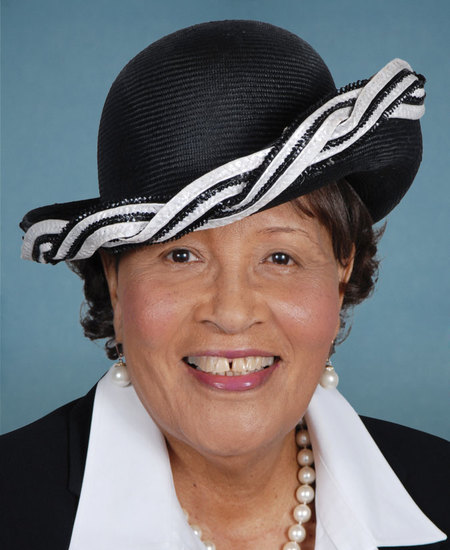
Rep. Alma S. Adams
Sponsored bills
Maddy summaryThis bill creates a new grant program to fund partnerships between Hispanic-serving institutions (HSIs) and local school districts with high Hispanic/Latino enrollment (at least 25% Hispanic/Latino students and 50% poverty rate). It authorizes $150 million for fiscal year 2024 to support specific activities like aligning high school coursework with college requirements, providing college application assistance, addressing non-academic barriers (such as housing and food insecurity), and developing teacher pipeline programs. The grants require eligible partnerships to report on outcomes, disaggregating data by student demographics to measure impact on Hispanic/Latino students' college enrollment, persistence, and completion rates. The program directly affects HSIs, qualifying school districts, and the Hispanic/Latino students they serve, aiming to close educational gaps through targeted collaboration.
Maddy summaryThe Green Ribbon Act of 2023 establishes a voluntary program to recognize schools and institutions meeting three environmental goals: graduating environmentally literate students, reducing emissions from buildings/operations, and achieving a net positive environmental impact on students and staff. It creates a federal award program where schools can earn recognition through State nominations, with $10 million authorized for fiscal years 2024-2029 to fund grants, honorariums ($10,000 per award), and technical assistance. The program directly affects K-12 schools, tribal schools, and institutions of higher education, requiring States to allocate at least 40% of grant funds to underresourced schools. Key provisions include updated criteria aligning with EPA and CDC health standards, annual reporting requirements, and a new Office of School Infrastructure within the Department of Education.
Maddy summaryHR 5433, the Child Care Stabilization Act, provides $16 billion annually from 2024 to 2028 to stabilize the child care sector through grants administered by the Health and Human Services Secretary. It directly affects licensed child care providers by offering stable funding to cover operating costs, while supporting higher wages for early educators without raising family fees. Key provisions include expanding access to high-quality, affordable care - especially for infants/toddlers, rural communities, and children with disabilities - and addressing shortages in underserved areas. The funding builds on existing American Rescue Plan resources, aiming to strengthen the child care workforce and increase available options for working families.
Maddy summaryThis bill requires federal agencies to acquire and maintain opioid overdose reversal kits (like naloxone) and train employees annually on their use, effective within 270 days of enactment. It mandates these actions for all federal agencies - including the Veterans Health Administration - while providing non-mandatory guidance to private employers on similar practices. The law directly affects federal workplaces by making kits and training a requirement, and indirectly encourages private employers to adopt similar safety measures. Key provisions include a 270-day deadline for the Labor Department to issue regulations for federal agencies and non-binding guidance for other employers. The bill focuses on practical workplace safety measures without altering existing federal health or safety laws.
EITC Modernization Act This bill extends the earned income tax credit to taxpayers with certain dependents, including children and aged dependents, and to qualifying students. It also establishes a matching grant program for tax return preparation assistance for low-income taxpayers.
Maddy summaryHR 5341, the Family Farmer and Rancher Tax Fairness Act of 2023, ensures that certain pandemic relief payments made to farmers and ranchers under the American Rescue Plan Act of 2021 and related legislation are not counted as taxable income. Specifically, it excludes payments described in sections 1006(e) of the ARP Act and 22006 of Public Law 117-169 from gross income for recipients. This means eligible farmers and ranchers receiving these payments will not owe income tax on them, and it prevents related tax adjustments that would otherwise reduce deductions or basis. The bill directly affects agricultural businesses that received these specific federal payments during the pandemic.
Haliwa Saponi Indian Tribe of North Carolina Act This bill extends full federal government-to-government relations to the Haliwa Saponi Tribe of North Carolina. The bill makes the tribe and its members eligible for services and benefits provided to federally recognized tribes, without regard to the existence of a reservation. The service area of the tribe shall include Halifax, Warren, Nash, Franklin, Vance, and Granville Counties in North Carolina. The tribe must submit the most recent membership roll and governing documents to the Department of the Interior. The bill also authorizes Interior to take land into trust for the benefit of the tribe and proclaim a reservation for the tribe.
Maddy summaryHR 5224 reauthorizes the Missing Children's Assistance Act through fiscal year 2028, updating definitions and expanding services to better address child sexual exploitation. It adds specific terms like "sextortion" and "sexting" to clarify key concepts, and requires the Administrator to manage the CyberTipline for reporting missing children and exploitation. The bill mandates new data collection on children missing from state care, including those likely victims of sex trafficking, and increases annual funding authorization from $40 million to $49.3 million. These changes directly affect child welfare agencies, law enforcement, and organizations working with missing or exploited children by improving reporting systems, recovery support, and data transparency.
Maddy summaryHJRES 84 designates August 20 as "Slavery Remembrance Day" to commemorate the arrival of the first enslaved Africans in what is now Virginia on August 20, 1619. The resolution urges the President to issue an annual proclamation encouraging Americans to observe the day with ceremonies and activities reflecting on slavery's history. It specifically honors 21 Black Congress members from the Reconstruction Era as honorary cosponsors and calls for acknowledging the enduring impacts of slavery. As a symbolic resolution, it does not create new laws or directly affect any group beyond establishing an annual observance.