

U.S. Military Right to Carry Act This bill requires a state that receives funds under the Edward Byrne Memorial Justice Assistance Grant Program to have implemented (1) a law or policy authorizing members of the Armed Forces who are outside of their state of residence under orders to renew a permit to carry a concealed firearm through the mail, and (2) a law or policy that treats members of the Armed Forces on active duty in the state as residents of the state for purposes of issuing a permit to carry a concealed firearm in the state. The Department of Justice must reduce by 5% the amount that a state would otherwise receive under the grant program if the state fails to comply with either requirement.
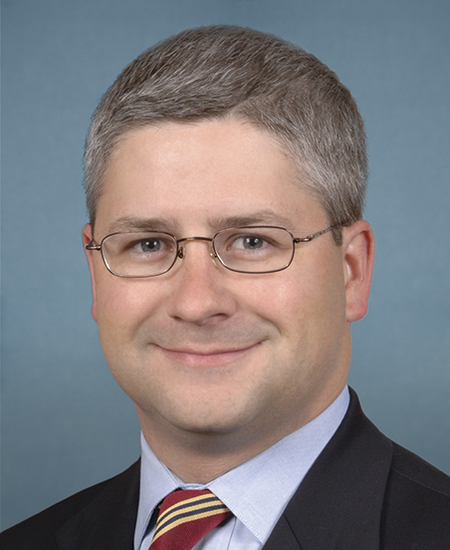
Rep. Patrick T. McHenry
Sponsored bills
Protecting Retirement Savers and Everyday Investors Act This bill prohibits states and local governments from imposing taxes upon a securities industry participant based on the number, volume, or value of securities transactions processed or consummated by the participant, with exceptions.
Protect Equality And Civics Education (PEACE) Act This bill prohibits the use of FY2021 federal education funding for the priorities noticed in the Department of Education's proposed rule titled Proposed Priorities-American History and Civics Education , published on April 19, 2021, or for a priority or requirement related to the teaching of critical race theory under a grant, contract, or cooperative agreement.
Blue Ridge National Heritage Area Reauthorization Act of 2021 This bill extends through FY2036 the authority of the Department of the Interior to provide assistance for the Blue Ridge National Heritage Area in North Carolina and removes the limitation on the total amount that may be appropriated for the heritage area.
Gig Worker Equity Compensation Act This bill preempts any state law that classifies an individual providing labor or services for remuneration (i.e., an independent contractor) as an employee for purposes of wage-rate and benefit requirements. The bill also broadens the existing Securities and Exchange Commission registration exemption for the issuance of securities as part of an employee-compensation package. Specifically, the bill applies this exemption to the issuance of securities as compensation for independent contractors. The Government Accountability Office must report on the bill's effects.
Pain-Capable Unborn Child Protection Act This bill establishes a new criminal offense for performing or attempting to perform an abortion if the probable post-fertilization age of the fetus is 20 weeks or more. A violator is subject to criminal penalties—a fine, a prison term of up to five years, or both. The bill provides exceptions for an abortion (1) that is necessary to save the life of the pregnant woman, or (2) when the pregnancy is the result of rape or incest. A physician who performs or attempts to perform an abortion under an exception must comply with specified requirements. A woman who undergoes a prohibited abortion may not be prosecuted for violating or conspiring to violate the provisions of this bill.
The American PPE Supply Chain Integrity Act This bill requires specified federal departments to purchase certain items, including medical supplies, personal protective equipment (PPE), and clothing, from the United States, with exceptions. Specifically, the bill requires the Department of Health and Human Services, the Department of Homeland Security (DHS), and the Department of Veterans Affairs to purchase items such as specified medical supplies (including disinfecting wipes), PPE, and fabric products (including clothing, bags, and tents) from products that are 100% grown, reprocessed, reused, or produced in the United States. The bill requires regulations to (1) prohibit the use by any federal department or agency of reverse auctions or lowest price technically acceptable contracting methods for the procurement of PPE if the level of quality or failure of the item could result in infection, illness, or death; and (2) establish a preference for the use of best value contracting methods for the procurement of such equipment. The bill applies the Berry Amendment (which requires the Department of Defense to give preference in procurement to domestically produced, manufactured, or homegrown products) to specified supplies and equipment, such as surgical dressing materials, hospital and surgical clothing, and textile medical supplies and equipment.
No Taxpayer Funding for Abortion and Abortion Insurance Full Disclosure Act of 2021 This bill modifies provisions relating to federal funding for, and health insurance coverage of, abortions. Specifically, the bill prohibits the use of federal funds for abortions or for health coverage that includes abortions. Such restrictions extend to the use of funds in the budget of the District of Columbia. Additionally, abortions may not be provided in a federal health care facility or by a federal employee. Historically, language has been included in annual appropriations bills for the Department of Health and Human Services (HHS) that prohibits the use of federal funds for abortions—such language is commonly referred to as the Hyde Amendment. Similar language is also frequently included in appropriations bills for other federal agencies and the District of Columbia. The bill makes these restrictions permanent and extends the restrictions to all federal funds (rather than specific agencies). The bill's restrictions regarding the use of federal funds do not apply in cases of rape, incest, or where a physical disorder, injury, or illness endangers a woman's life unless an abortion is performed. The Hyde Amendment provides the same exceptions. The bill also prohibits qualified health plans from including coverage for abortions. Currently, qualified health plans may cover abortion, but the portion of the premium attributable to abortion coverage is not eligible for subsidies.
Eliminate Barriers to Innovation Act of 2021 This bill requires the Securities and Exchange Commission and the Commodity Futures Trading Commission to jointly establish a working group on digital assets. The working group must (1) report on the impact of the U.S. legal and regulatory framework on the digital asset market; and (2) provide recommendations regarding digital asset market fairness and integrity, cybersecurity standards, and the reduction of fraud and manipulation.
This bill provides for increased oversight of American Rescue Plan activities relating to housing and small business. The Office of the Special Inspector General for Pandemic Recovery (which is within the Department of the Treasury) shall conduct, supervise, and coordinate audits and investigations of such activities undertaken by Treasury, the Department of Housing and Urban Development (HUD), and the Department of Agriculture. The Congressional Oversight Commission shall conduct oversight of implementation of such activities by Treasury and HUD. HUD and other specified entities must testify on a quarterly basis before specified congressional committees regarding such activities.