

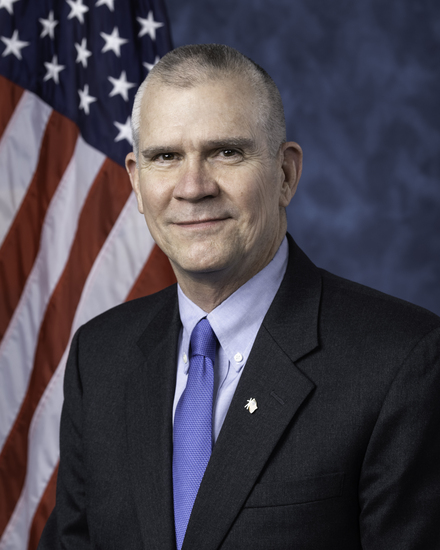
Dual Loyalty Disclosure Act This bill requires a candidate for federal office (other than a nominee for Vice President) who is a citizen of any country other than the United States to disclose such citizenship in the candidate's statement of candidacy. A statement of candidacy collects basic information about the candidate and is where the candidate designates their principal campaign committee.
Rep. Matthew M. Rosendale, Sr.
Sponsored bills
Maddy summaryHR 29, the Border Safety and Security Act of 2023, grants the Secretary of Homeland Security authority to restrict entry at U.S. land or maritime borders for certain immigrants deemed "covered aliens" (those inadmissible under immigration law due to lack of proper documentation). The bill requires the Secretary to suspend entry if they cannot detain or process these individuals as required by existing immigration law. It also allows state attorneys general to sue the Secretary in federal court if they believe border policies harm their state's residents. The law defines "operational control" using terms from the Secure Fence Act of 2006. This bill directly affects immigrants seeking entry who fall under the specified inadmissibility category.
Maddy summaryHJRES 31 is a procedural resolution seeking congressional disapproval of a specific rule issued by the Department of Veterans Affairs (VA) concerning reproductive health services. It targets the VA's September 2022 rule (published in the Federal Register as 87 Fed. Reg. 55287), which established policies for reproductive health care access for veterans. If passed, this resolution would nullify the VA rule, preventing it from taking effect under the Congressional Review Act (Chapter 8 of Title 5, U.S. Code). The bill directly affects the VA’s ability to implement its reproductive health services policy for veterans.
Maddy summaryHCONRES 13 is a concurrent resolution expressing Congress's support for maintaining the current policy that prohibits imposing new fees on local radio stations for playing music. It states that Congress should not impose any performance fee, tax, royalty, or charge on local radio stations for broadcasting sound recordings over the air, or on businesses like bars and restaurants that play music publicly. The resolution argues that such fees would harm local radio stations - critical sources for emergency information and community programming - and jeopardize the economic model that has supported both radio and the music industry for decades. This resolution does not create new law but formally opposes potential legislative changes to the existing fee structure.
Maddy summaryHR 812, titled the "Inflation Reduction Act of 2023," would repeal the Inflation Reduction Act of 2022 (Public Law 117-169) and rescind unobligated funds from that law. This bill does not establish new policy but reverses the existing 2022 legislation, halting its ongoing programs and redirecting unused funding. It directly affects the continuation of the 2022 act's provisions, including climate and healthcare initiatives, by formally terminating them. The key mechanism is the repeal of the 2022 law and the rescission of remaining unobligated balances.
This resolution impeaches Secretary of Homeland Security Alejandro Nicholas Mayorkas for high crimes and misdemeanors related to his actions regarding border security and immigration.
Maddy summaryThis bill helps new car dealers affected by pandemic-era supply chain disruptions by changing tax rules for inventory sales. It allows dealers using LIFO accounting to treat certain sales of unsold vehicles (liquidations) between March 2020 and December 2021 as "qualified" for tax purposes. Dealers can defer recognizing income from these sales and have until 2026 to replace the sold vehicles before potential tax adjustments apply. The provision specifically targets dealers who couldn't replenish inventory during the supply chain crisis.
Maddy summaryHR 646, the SHORT Act, clarifies firearm definitions under federal law to exclude antique firearms and certain collector items from the "firearm" category. It removes restrictions on short-barreled rifles and shotguns used lawfully by eliminating specific prohibitions in federal law and preempts state laws imposing taxes or registration requirements on these weapons. The bill also mandates the destruction of federal records related to short-barreled rifles, shotguns, and other weapons defined under the National Firearms Act within 365 days of enactment. This directly affects owners of these specific firearms, particularly collectors and individuals possessing short-barreled weapons legally under federal law. The key mechanisms include revised definitions, federal preemption of state regulations, and record destruction requirements.
Health Freedom and Flexibility Act This bill revises provisions relating to health savings accounts (HSAs), including to eliminate the requirement that a participant in an HSA be enrolled in a high deductible health plan; repeal certain limitations on deductions for contributions to HSAs; repeal rules relating to eligible individuals who participate in HSAs; repeal the limitation on use of HSAs to purchase health insurance; include certain medical items as medical expenses for HSA purposes, including menstrual care products, over-the-counter medicines, and medically necessary items; include as HSA-eligible medical expenses, direct primary care, exercise equipment, and dental care items; and prohibit the use of HSAs to pay for abortions or for insurance that includes coverage for abortions.
Maddy summaryThe Restoring Military Focus Act (HR 678) repeals the Chief Diversity Officer position in the Department of Defense and prohibits the creation of similar roles. It specifically eliminates two existing positions: the Chief Diversity Officer (under pre-2021 Title 10, U.S. Code) and the Senior Advisor for Diversity and Inclusion (under the 2021 National Defense Authorization Act). The bill bans federal funding for any new position that matches or closely resembles these roles. This directly affects the Department of Defense's organizational structure by removing diversity-focused leadership roles and preventing their replacement.