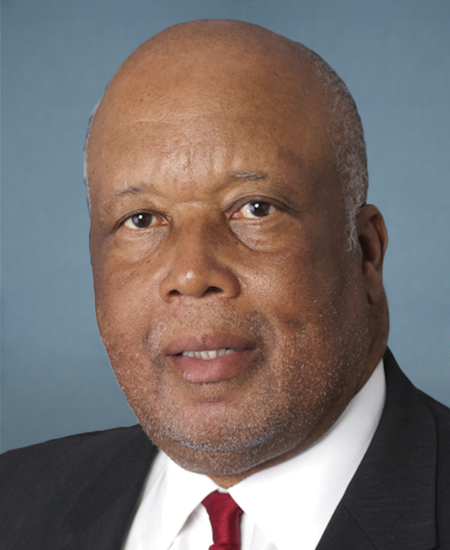
Photo of Bennie G. Thompson
D United States House · District 2 · Mississippi On the 2026 ballot

Rep. Bennie G. Thompson

Compare
Total votes
2,837
all sessions
Attendance
98%
63 missed
Near the chamber average
With party
98%
of cast votes
Higher than 77% of chamber peers
Bipartisan score
1%
crosses aisle rarely
Lower than 78% of chamber peers
Sponsored
1,263
bills & resolutions
Higher than 78% of chamber peers
Committees
1
assignment
1,263 bills and resolutions

Sponsored bills

Total
1,263
Primary
43
Co-sponsor
1,220
This page
1,263
matching current filters
Co-sponsor HR 3904
In committee · United States House · Co-sponsor
Reducing COVID–19 Disparities by Investing in Public Health Act

Reducing COVID-19 Disparities by Investing in Public Health Act This bill provides additional funding for FY2021 and subsequent fiscal years to specified components of the Department of Health and Human Services, including the Centers for Disease Control and Prevention, the National Institute on Minority Health and Disparities, and the Office of Minority Health.

In committee Jun 16, 2021 1 co-sponsor
Co-sponsor HR 2070
In committee · United States House · Co-sponsor
Puerto Rico Self-Determination Act of 2021

Puerto Rico Self-Determination Act of 2021 This bill establishes a process for the people of Puerto Rico to vote on the political status (e.g., statehood) of the territory. Congress may ratify the decision through a joint resolution. The bill declares that the legislature of Puerto Rico has the authority to call a status convention regarding the political status of the territory. The bill provides for public financing of delegate elections to the status convention and establishes a Congressional Bilateral Negotiating Commission to provide advice and consultation to delegates of the status convention. The status convention must provide self-determination options for a referendum of the people of Puerto Rico. Ranked-choice voting is a permitted format for the referendum. Delegates shall carry out an educational campaign through traditional paid media related to the referendum. The bill provides for congressional consideration of a joint resolution to ratify the self-determination option selected through the referendum.

In committee Jun 16, 2021 1 co-sponsor
Co-sponsor HR 1316
In committee · United States House · Co-sponsor
National Heritage Area Act of 2021

National Heritage Area Act of 2021 This bill establishes a National Heritage Areas System to recognize certain areas of the United States that tell nationally significant stories and to conserve, enhance, and interpret the areas' natural, historic, scenic, and cultural resources that illustrate significant aspects of U.S. heritage, and authorizes appropriations through FY2034 for each National Heritage Area. Through such system, the Department of the Interior may provide technical and financial assistance to local coordinating entities to support the establishment, development, and continuity of such areas. The bill extends the authority for the Erie Canalway National Heritage Corridor Commission and the Gullah/Geechee Cultural Heritage Corridor Commission until September 30, 2034. The local coordinating entity of a National Heritage Area, not later than three years after the area is included in the National Heritage Area System, shall submit to Interior a management plan for approval. Interior, not later than one year before the authorization for federal funding expires for a National Heritage Area, shall (1) conduct an evaluation of the accomplishments of that area, and (2) submit a report detailing the evaluation to specified congressional committees. Based upon the evaluation, Interior shall prepare a report with recommendations for the National Park Service's continued role, if any, with respect to the area. Interior may carry out or certify a study to assess the suitability and feasibility of designating a specific geographic area as a National Heritage Area to be included in the National Heritage Area System.

In committee Jun 15, 2021 1 co-sponsor
Co-sponsor HR 3836
In committee · United States House · Co-sponsor
Protecting our Students in Schools Act of 2021

Protecting our Students in Schools Act of 2021 This bill prohibits the use of corporal punishment in schools that receive federal funding. Specifically, the bill authorizes the Department of Education (ED) to take specified actions (e.g., withholding funds and issuing cease-and-desist orders) for schools that allow school personnel, law enforcement officers, or school security guards to subject students to corporal punishment. The bill also establishes enforcement provisions, including a private right of action for a student who has been subjected to corporal punishment. Each state educational agency (SEA) that receives federal funding must submit specified information to ED, including a school climate report that describes the SEA's policies and procedures related to exclusionary and aversive discipline practices in schools. Additionally, the bill authorizes ED to award three-year grants to SEAs and, through them, subgrants to local educational agencies to implement positive behavioral interventions and supports to address student behavior and reduce exclusionary and aversive discipline practices. ED must promulgate regulations as necessary to ensure compliance with the bill. The Department of Defense and the Department of the Interior must ensure that the schools they operate or fund also comply with these regulations.

In committee Jun 11, 2021 1 co-sponsor
Co-sponsor HR 3778
In committee · United States House · Co-sponsor
Nullifying Opportunities for Variants to Infect and Decimate Act

Nullifying Opportunities for Variants to Infect and Decimate Act or the NOVID Act This bill establishes the Pandemic Preparedness and Response Program to coordinate and carry out the U.S. government's global health response to COVID-19, its variants, and other pathogens with pandemic potential. As part of the program, the bill requires, within 30 days, the development of a comprehensive strategy to end the COVID-19 pandemic. The strategy must outline efforts to increase COVID-19 vaccinations worldwide, including through the immediate release of the COVID-19 vaccine doses that the United States committed to sending abroad. The bill also requires a long-term strategy for the program to prevent future pandemics.

In committee Jun 9, 2021 1 co-sponsor
Co-sponsor HR 7
Passed · United States House · Co-sponsor
Paycheck Fairness Act

Paycheck Fairness Act This bill addresses wage discrimination on the basis of sex, which is defined to include pregnancy, sexual orientation, gender identity, and sex characteristics. Specifically, it limits an employer's defense that a pay differential is based on a factor other than sex to only bona fide job-related factors in wage discrimination claims, enhances nonretaliation prohibitions, and makes it unlawful to require an employee to sign a contract or waiver prohibiting the employee from disclosing information about the employee's wages. The bill also increases civil penalties for violations of equal pay provisions. Additionally, the Equal Employment Opportunity Commission (EEOC) and the Office of Federal Contract Compliance Programs must train EEOC employees and other affected parties on wage discrimination. The bill directs the Department of Labor to (1) establish and carry out a grant program to provide training in negotiation skills related to compensation and equitable working conditions, (2) conduct studies to eliminate pay disparities between men and women, and (3) make available information on wage discrimination to assist the public in understanding and addressing such discrimination. The bill establishes the National Award for Pay Equity in the Workplace for an employer who has made a substantial effort to eliminate pay disparities between men and women. It also establishes the National Equal Pay Enforcement Task Force to address compliance, public education, and enforcement of equal pay laws. Finally, the bill requires the EEOC to issue regulations for collecting from employers compensation and other employment data according to the sex, race, and national origin of employees for use in enforcing laws prohibiting pay discrimination.

Passed Jun 8, 2021 1 co-sponsor
Co-sponsor HRES 458
In committee · United States House · Co-sponsor
FPS 50th Anniversary Resolution

Federal Protective Service 50th Anniversary Resolution or the FPS 50th Anniversary Resolution This resolution recognizes the 50th anniversary of the establishment of the Federal Protective Service and the role it plays in protecting the people and property of the federal government.

In committee Jun 7, 2021 1 co-sponsor
Co-sponsor HR 3699
In committee · United States House · Co-sponsor
Toxic Free Food Act of 2021

Toxic Free Food Act of 2021 This bill requires the Food and Drug Administration (FDA) to revise its regulations relating to food additives that may be considered generally recognized as safe (GRAS). (A substance deemed GRAS is not subject to the premarket review requirements for food additives. A manufacturer may notify the FDA that it has determined that a substance is GRAS.) The revised regulations must prohibit a manufacturer from marketing a substance as GRAS (or manufacturing or selling a food containing that substance) unless the manufacturer has notified the FDA that it has determined that the substance is GRAS and submitted certain information supporting this position, including information about the substance's cumulative effects. The FDA must maintain a public website with each GRAS submission and supporting information. There must be a period of at least 90 days for the FDA and the public to review and object to such submissions. Furthermore, under the revised regulations, newly synthesized or novel chemicals and carcinogenic substances may not be deemed GRAS. The FDA may not rely on experts with conflicts of interest when making a GRAS determination. The FDA must also (1) incorporate in its rules certain best practices for convening a GRAS panel, (2) create a process to systematically reassess any substances previously determined to be GRAS, and (3) reestablish the Food Advisory Committee to assist with establishing standards and procedures for reassessing substances.

In committee Jun 7, 2021 1 co-sponsor
Co-sponsor HR 2361
In committee · United States House · Co-sponsor
Rebuild Rural America Act of 2021

Rebuild Rural America Act of 2021 This bill directs the Department of Agriculture (USDA) to establish the Rural Innovation and Partnership Administration and the Rural Future Partnership Fund to provide five-year renewable rural partnership block grants to certified rural regions to implement locally-developed regional revitalization plans. For purposes of these grants, the following areas may constitute a rural region: a micropolitan statistical area (i.e., at least 10,000 but fewer than 50,000 people); a collection of rural census tracts or counties that fall outside of a micropolitan or metropolitan statistical area (i.e., 50,000 people or more) and that demonstrate evidence of economic, social, and cultural cooperation; or an Indian reservation. To be eligible to receive a grant, a rural region must be certified by its state (or in the case of an Indian reservation, approved by USDA) after having formed a rural partnership council made up of representatives from across different sectors. USDA must provide each rural partnership council with training, education, support, and advice to enhance the technical assistance, research, organizational, and other capacities of the council. The bill also establishes a Rural Future Corps to (1) help rural communities expand critical services such as child care, health, nutrition assistance, education, and job training; and (2) strengthen the capacity of local governments and economic and community development organizations.


In committee Jun 7, 2021 1 co-sponsor
Co-sponsor HR 3689
In committee · United States House · Co-sponsor
Americans Giving Care to Elders (AGE) Act of 2021

Americans Giving Care to Elders (AGE) Act of 2021 This bill allows a tax credit for a portion of a taxpayer's expenses for eldercare. The credit applies to expenses to care for certain relatives or members of the taxpayer's household who have attained the age of 60 and require assistance with activities of daily living. Eldercare expense include amounts paid for: medical care, lodging away from home, adult day services, personal care, respite care, assistive technologies and devices (including remote health monitoring), environmental modifications (including home modifications), and counseling or training for a caregiver. The amount of eldercare expenses incurred during any year that may be taken into account for the credit may not exceed $6,000.

In committee Jun 4, 2021 1 co-sponsor
Showing 1,081 to 1,090 of 1,263 bills