

Maddy summaryThis bill requires that AM radio receivers be included as standard equipment in all new motor vehicles (such as cars and trucks) sold in the United States, with a rule to be issued by the Department of Transportation within one year. The rule must ensure AM radio is easily accessible on the dashboard and allows manufacturers to use digital AM radio technology instead of traditional AM. During the one-year period between the bill's enactment and the rule's effective date, manufacturers must clearly label vehicles without AM radio. The bill also directs a study to evaluate whether an alternative system could deliver emergency alerts as reliably as AM radio across the country, especially during crises.
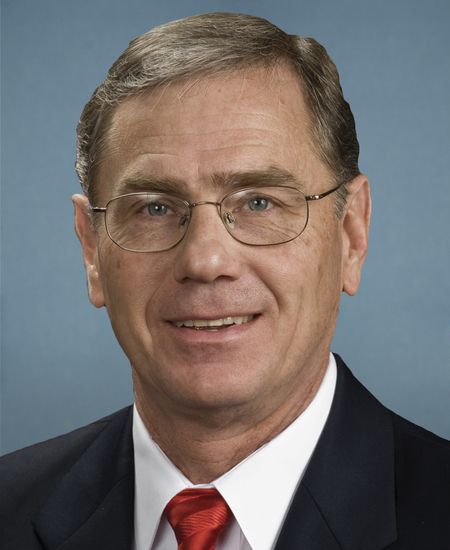
Rep. Blaine Luetkemeyer
Sponsored bills
Affordable Homeownership Access Act This bill exempts from certain mortgage licensing and registration requirements a person (other than a depository institution) who engages in owner financing. Owner financers (1) originate a limited number of residential mortgage loans in a year, and (2) only originate residential mortgages with respect to property owned by the owner financer.
National Law Enforcement Officers Remembrance, Support and Community Outreach Act This bill directs the Department of Justice (DOJ) to establish a National Law Enforcement Officers Remembrance, Support, and Community Outreach Program. The bill further directs DOJ to award a grant under the program to the National Law Enforcement Officers Memorial Fund for the expenses associated with community outreach, public education, and officer safety and wellness programs operated by the of the National Law Enforcement Officers Memorial Fund and National Law Enforcement Museum.
Small Business Stability Act This bill allows the Federal Deposit Insurance Corporation (FDIC) to guarantee an insured depository institution's uninsured deposits in noninterest-bearing transaction accounts for a single period not to exceed 60 days without complying with requirements to minimize cost to the Deposit Insurance Fund. This authority requires (1) written recommendations from the FDIC board and the Board of Governors of the Federal Reserve System, and (2) a determination from the Department of the Treasury that this step would avoid or mitigate adverse effects on the stability of the banking system.
This bill establishes the Bank Term Funding Program, which allows a Federal Reserve bank to make advances to depository institutions that pledge certain collateral fully guaranteed by the United States. An advance must be made available with a term of up to one year.
Stopping Illicit Fentanyl Trafficking Act of 2023 or the SIFT Act of 2023 This bill permanently adds five fentanyl analogues and the entire category of fentanyl-related substances to schedule I of the Controlled Substances Act. A schedule I controlled substance is a drug, substance, or chemical that has a high potential for abuse; has no currently accepted medical value; and is subject to regulatory controls and administrative, civil, and criminal penalties under the Controlled Substances Act. Fentanyl-related substances are currently regulated under schedule I through a temporary order issued by the Drug Enforcement Administration. The temporary order expires on December 31, 2024. The bill also creates a process to remove from schedule I certain fentanyl-related substances that do not have a high potential for abuse.
Maddy summaryHRES 362 is a symbolic House resolution recognizing elementary and secondary school teachers' contributions to U.S. civic, cultural, and economic well-being. It specifically thanks teachers and encourages students, parents, school leaders, and officials to acknowledge National Teacher Appreciation Week (May 8-12, 2023). The resolution has no binding effect or policy changes - it solely promotes public appreciation for the teaching profession through a formal expression of gratitude. It directly affects teachers by affirming their societal value but does not alter laws, funding, or educational standards.
Maddy summaryThe SAFE Banking Act of 2023 would protect banks and financial institutions that provide services to state-legal marijuana businesses and hemp-related businesses by preventing federal regulators from taking adverse actions against them solely for serving these businesses. It clarifies that income from state-legal marijuana businesses can be considered for mortgage applications, and requires regulators to update guidance on suspicious activity reports related to these businesses. The bill does not require financial institutions to serve these businesses, but ensures they won't face penalties for doing so. It extends similar protections to hemp-related businesses, which have faced banking challenges despite being federally legal under the 2018 Farm Bill.
Catastrophic Risk Transfer Act of 2023 or the CART Act of 2023 This bill establishes a system for the taxation of catastrophic risk transfer companies and their security holders to ensure sufficient capital to cover catastrophic insurance losses. The bill defines catastrophic risk as a risk of loss that has a low likelihood of occurring but that would be large in amount. The bill defines catastrophic risk transfer company as any domestic corporation created and regulated under state law with the purpose of entering into one or more insurance or reinsurance agreements covering catastrophic risk.
Maddy summaryThis bill protects living organ donors from insurance discrimination by prohibiting life, disability, and long-term care insurers from denying coverage, raising premiums, or altering policy terms solely because someone donated an organ while alive. It also updates the Family and Medical Leave Act to include recovery from organ donation surgery as a qualifying health condition, allowing donors to take protected leave for this purpose. Additionally, the bill requires the Health and Human Services Secretary to update public educational materials about living donation benefits, risks, and insurance protections within six months of enactment. These changes directly affect living organ donors, insurers, employers, and healthcare systems by ensuring fair access to insurance and workplace leave.