

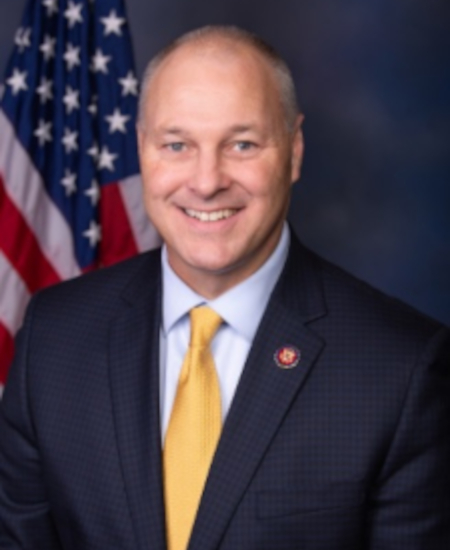
Photo of Pete Stauber
R United States House · District 8 · Minnesota On the 2026 ballot

Rep. Pete Stauber

Compare
Total votes
2,837
all sessions
Attendance
97%
96 missed
Near the chamber average
With party
94%
of cast votes
Near the chamber average
Bipartisan score
3%
crosses aisle rarely
Near the chamber average
Sponsored
1,094
bills & resolutions
Near the chamber average
Committees
9
assignments
1,094 bills and resolutions

Sponsored bills

Total
1,094
Primary
74
Co-sponsor
1,020
This page
1,094
matching current filters
Co-sponsor HR 5482
In committee · United States House · Co-sponsor
Energy Poverty Prevention and Accountability Act of 2024

Maddy summaryThis bill requires federal agencies to assess whether energy policies and rules disproportionately affect at-risk communities, including low-income, minority, rural, elderly, and Native American communities. Agencies must conduct studies before actions like leasing federal land or issuing new energy rules, and include an "energy poverty statement" certifying the policy won't cause energy poverty. Within one year, the Comptroller General and OMB must jointly report to Congress on how current policies impact these communities and recommend solutions to reduce energy poverty. The law aims to prevent energy poverty by mandating concrete evaluations of policy impacts on vulnerable groups.

In committee Dec 18, 2024 1 co-sponsor
Co-sponsor HR 3269
In committee · United States House · Co-sponsor
Law Enforcement Innovate to De-Escalate Act

Maddy summaryHR 3269, the Law Enforcement Innovate to De-Escalate Act, exempts specific less-than-lethal projectile devices from federal firearm taxes and National Firearms Act restrictions. The bill defines these devices as those firing projectiles at under 500 feet per second and designed not to cause death or serious injury. This directly affects law enforcement agencies using such devices and manufacturers producing them, by removing tax burdens and registration requirements. The key change is creating a clear legal exemption for these devices under federal law, streamlining their use for de-escalation purposes.

In committee Dec 18, 2024 1 co-sponsor
Co-sponsor HR 2989
In committee · United States House · Co-sponsor
Save Our Sequoias Act

Maddy summaryThe Save Our Sequoias Act establishes a coordinated approach to protect giant sequoia groves in California from wildfires, insects, and drought. It creates a Giant Sequoia Lands Coalition including federal agencies, state governments, and the Tule River Indian Tribe to assess grove health, develop protection projects, and recommend forest management activities. The bill streamlines implementation of certain projects through categorical exclusion from environmental reviews, authorizes $10-40 million annually for conservation efforts, and establishes a fund for philanthropic support of sequoia protection.

In committee Dec 18, 2024 1 co-sponsor
Co-sponsor HR 1419
In committee · United States House · Co-sponsor
Comprehensive Grizzly Bear Management Act of 2023

Maddy summaryThis bill directs the U.S. Fish and Wildlife Service to remove the Northern Continental Divide Ecosystem grizzly bear population from the federal endangered species list within 180 days of the bill's enactment. It directly affects grizzly bears in Montana and Idaho by ending their federal protected status. The key provision mandates the removal without regard to other legal requirements and explicitly prohibits judicial review of the decision. This would shift management authority to state agencies while ending federal protections for this specific bear population.

In committee Dec 18, 2024 1 co-sponsor
Co-sponsor HR 188
In committee · United States House · Co-sponsor
Proven Forest Management Act of 2022

Maddy summaryThe Proven Forest Management Act of 2022 streamlines forest management activities on National Forest System land, primarily focusing on reducing wildfire risk through fuel reduction projects. It requires the Secretary of Agriculture (managing National Forests) to coordinate with local governments and communities when planning projects, while mandating multiple ecosystem benefits like reducing forest fuels, improving water quality, and maintaining biodiversity - unless costs are deemed excessive. A key provision allows projects under 10,000 acres (with up to 3,000 acres of mechanical thinning) to bypass certain environmental reviews under the National Environmental Policy Act (NEPA), provided they align with local input and forest plans. This directly affects federal land managers and communities near National Forests by accelerating wildfire risk mitigation while maintaining ecological standards.

In committee Dec 18, 2024 1 co-sponsor
Co-sponsor HR 8977
In committee · United States House · Co-sponsor
Improving Access to Emergency Medical Services Act of 2024

Maddy summaryThis bill creates a new Medicare payment model for emergency medical services (EMS) that allows coverage when ambulance providers deliver critical care on-site without transporting patients to a hospital. It directly affects Medicare beneficiaries receiving such on-site emergency care and ambulance providers who would previously not be reimbursed for non-transport services. The key provision requires Medicare to pay for these services at rates matching what would have been paid for transport, based on state protocols and emergency call responses, for a 5-year trial period. A report due 4 years after implementation will evaluate impacts on patient outcomes, system efficiency, and regional access.

In committee Dec 17, 2024 1 co-sponsor
Co-sponsor HR 8801
In committee · United States House · Co-sponsor
MOMS Act

Maddy summaryThe MOMS Act establishes a federal resource website called pregnancy.gov that will help pregnant and postpartum women find local services through a ZIP code-based search system. It creates grant programs to support nonprofit organizations providing services like medical care, housing assistance, and parenting support to pregnant women, while prohibiting organizations that provide or support abortion from receiving these funds. The bill also amends child support laws to allow enforcement of child support obligations for unborn children, beginning from the month of conception with the mother's consent. These provisions aim to improve access to prenatal and postnatal resources while maintaining a focus on supporting women and their families.

In committee Dec 17, 2024 1 co-sponsor
Co-sponsor HR 8702
In committee · United States House · Co-sponsor
Improving Seniors’ Timely Access to Care Act of 2024

Maddy summaryThis bill requires Medicare Advantage plans to implement electronic prior authorization systems by 2027 and publish detailed data on their approval and denial rates for medical services by 2026. It directly affects Medicare Advantage plans (private insurers offering Medicare coverage) and their enrollees (seniors 65+), mandating transparency about prior authorization decisions, processing times, and appeal outcomes. Key provisions include requiring plans to report annual statistics on request approvals/denials, average processing times, and use of technology, with this data published publicly by the Centers for Medicare & Medicaid Services. The bill also sets timelines for plan responses to prior authorization requests and mandates reports to Congress on implementation and impacts.

In committee Dec 17, 2024 1 co-sponsor
Co-sponsor HR 8331
In committee · United States House · Co-sponsor
Essential Caregivers Act of 2024

Maddy summaryThe Essential Caregivers Act of 2024 requires nursing homes and similar facilities to allow residents to designate essential caregivers who provide emotional support or assistance with daily activities. During emergencies when regular visitation is restricted, facilities must permit at least one essential caregiver access to residents daily and cannot deny access without following specific procedures. Facilities may deny access for a maximum of 7 days during emergencies (or 14 days with state approval), and must provide a written explanation and appeal process if access is denied. The bill establishes a 48-hour appeal process for residents and caregivers to challenge denials, with facilities required to prove violations during appeals. This law applies to Medicare skilled nursing facilities, Medicaid nursing facilities, intermediate care facilities, and certain inpatient rehabilitation facilities.

In committee Dec 17, 2024 1 co-sponsor
Co-sponsor HR 7254
In committee · United States House · Co-sponsor
Hearing Device Coverage Clarification Act

Maddy summaryThis bill clarifies that Medicare must cover fully implanted active middle ear hearing devices as prosthetics, not as hearing aids. It requires the Centers for Medicare & Medicaid Services (CMS) to update its rules within 60 days of the bill's enactment to remove these devices from Medicare's hearing aid coverage exclusion. This directly affects Medicare beneficiaries who rely on these specific implanted devices for hearing. The change means these devices will now be covered under Medicare's prosthetic benefits, not excluded under hearing aid rules, without altering existing coverage for other hearing aids.

In committee Dec 17, 2024 1 co-sponsor
Showing 371 to 380 of 1,094 bills
Previous 1 … 37 38 39 … 110 Next