

Maddy summaryThe College for All Act of 2025 would eliminate tuition and required fees for eligible students at public community colleges and 4-year institutions through a federal-state partnership. The federal government would cover 100% of costs in the first year (2026-2027), gradually decreasing to 80% by 2030-2031, while states would start with 0% and increase to 20% by 2030-2031. Eligible students would include those with family income below $150,000 for single parents or $300,000 for married parents, regardless of immigration status. The bill also includes requirements to maintain instruction funding, improve transfer pathways between community colleges and 4-year institutions, and provide additional support for students after tuition elimination.
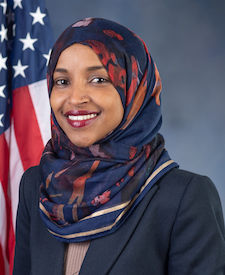
Rep. Ilhan Omar
Sponsored bills
Maddy summaryHR 3546, the Prescription Drug Price Relief Act of 2025, directs the Secretary of Health and Human Services to determine if brand-name drug prices are "excessive" by comparing U.S. prices to median prices in Canada, the UK, Germany, France, and Japan, or by evaluating factors like patient population size, drug value, and R&D costs. If a price is deemed excessive, the bill automatically voids the manufacturer’s government-granted drug exclusivity (like patent protections) and allows any company to produce generic versions using the original drug data. New manufacturers must pay a reasonable royalty (capped at IRS average rates for pharma) and sell the drug at a price below the "excessive" level. The bill also requires drug manufacturers to submit detailed annual pricing reports with penalties for non-compliance and creates a public database tracking all excessive price determinations and licensing activity.
Maddy summaryThis bill would establish 18-year fixed terms for all Supreme Court justices, replacing lifetime appointments. It requires the President to nominate one justice every two years (during first and third years after presidential elections), with Senate confirmation within 90 days, and prohibits reappointments after a single term. Current justices would be phased out in order of seniority as new justices are appointed under this schedule. The bill directly affects all sitting and future Supreme Court justices by mandating term limits and a structured appointment process.
Maddy summaryThe Real Education and Access for Healthy Youth Act of 2025 would provide federal grants to support comprehensive sex education and sexual health services for young people aged 10-29. The bill establishes four grant programs: for K-12 schools and youth organizations, for colleges and universities, for educator training, and for sexual health services specifically targeting underserved youth. To qualify for funding, programs must be evidence-informed, medically accurate, inclusive of diverse gender identities and sexual orientations, culturally responsive, and trauma-informed. The bill appropriates $100 million annually for fiscal years 2026-2031, with specific funding allocations for each program type. It prohibits funding for programs that withhold health information, promote stereotypes, or fail to address the needs of specific groups like pregnant youth or survivors of violence.
Maddy summaryHR 3505, the Barriers to Suicide Act of 2025, creates a federal grant program administered by the Department of Transportation to fund the installation of proven safety barriers and nets on specific high-risk structures. The program provides competitive grants (up to 80% federal funding) to states, local governments, or other eligible entities for projects installing suicide deterrents on bridges, buildings, parking garages, highway-rail crossings, or rail stations. It prioritizes areas with high suicide rates and mandates a study by the Comptroller General to evaluate effective deterrents for non-bridge structures and their costs, with a report due within one year of enactment. The bill authorizes $10 million annually from 2026-2030 for this initiative.
Stronger Communities through Better Transit Act This bill requires the Department of Transportation (DOT) to establish a grant program to support operating projects for public transportation and related service improvements, particularly in underserved communities and areas of persistent poverty. Specifically, the bill requires DOT to allocate funding under the program for urbanized areas, states, and Indian tribes that are recipients of funds under either the Federal Transit Administration's (FTA's) Urbanized Area Formula Funding program or Formula Grants for Rural Areas program. Eligible recipients may use funding for operating costs associated with projects that improve public transportation service for transit-dependent populations and support increased transit ridership (e.g., service expansion, information technology enhancements, and workforce development). DOT must apportion the funding so that recipients receive funds that are proportional to their share of operating costs. The bill also provides for an increased federal cost share for operating assistance for projects or programs carried out in areas of persistent poverty or underserved communities. DOT must set up a multimodal access measurement interface for public agencies to aid transit agencies in determining and reporting on access to jobs and essential services. A grant recipient must (1) report specific information to the FTA for inclusion in the National Transit Database, and (2) survey transit riders and non-riding residents regarding transit service improvements. Further, the bill expands the purposes of the public transportation programs to include supporting public transportation's role in combating climate change through growing/retaining transit ridership.
Maddy summaryHJRES 96 is a congressional resolution that would block a specific proposed military sale to the United Arab Emirates. It targets defense articles and services listed in Transmittal No. 25-25 (submitted May 13, 2025), specifically F-16 aircraft components, spares, accessories, and related logistics support. The resolution would prohibit this sale under the Arms Export Control Act, requiring congressional disapproval before it could proceed. This directly affects the U.S. government (which would need to halt the sale) and the UAE (which would lose access to these defense items).
Maddy summaryHJRES 97 is a congressional resolution blocking a specific proposed military sale to the United Arab Emirates (UAE). It prohibits the sale of defense articles and services detailed in Transmittal No. 24-118, including six Chinook helicopters, missile warning systems, communications equipment, and machine guns. The resolution exercises Congress’s authority under the Arms Export Control Act to disapprove the sale before it proceeds. This directly affects the UAE government, which sought these defense items, and requires the U.S. State Department to halt the transaction. The bill does not create new policy but stops a specific foreign military sale.
Maddy summaryHRES 414 is a symbolic resolution recognizing the U.S. government's moral and legal obligation to provide reparations for the harms of slavery and its lasting impacts on Black Americans. It acknowledges the historical and ongoing effects of chattel slavery, systemic racism, and discriminatory policies on Black communities, including economic disparities, environmental racism, and the criminal justice system. The resolution encourages support for H.R. 40, which would establish a commission to study reparations proposals, and calls for formal acknowledgment of slavery's legacy through congressional apologies. This resolution does not create new legal obligations or provide reparations itself, but serves as a statement of recognition and a call to action for further policy development.
Maddy summaryThis non-binding House resolution recognizes the ongoing Nakba (catastrophe) of Palestinian displacement since 1948 and affirms Palestinian refugees' rights under UN Resolution 194 and international law. It calls for commemorating the Nakba, denouncing current displacement efforts (including home demolitions and settlements), supporting UNRWA services for refugees, and ending U.S. weapons transfers used in forced removals. As a symbolic measure, it does not create new laws or directly affect refugees but aims to shape U.S. diplomatic policy by urging the government to reject denial of the Nakba and halt complicity. The resolution focuses on rhetorical recognition and policy alignment rather than concrete legal changes.