

This bill directs the Federal Emergency Management Agency (FEMA) to establish a grant program to modify, upgrade, and construct fire and emergency medical services (EMS) department facilities. Grant recipients may use funds received to build, rebuild, or renovate fire and EMS department facilities; upgrade existing facilities to install exhaust emission control systems, install backup power systems, upgrade or replace environmental control systems (such as HVAC systems), remove or remediate mold, and construct or modify living quarters for use by male and female personnel; and upgrade fire and EMS stations or build new stations. The bill sets forth provisions regarding (1) grant fund allocations between career and volunteer fire and EMS departments, and (2) prevailing rate of wage and a requirement for using materials produced domestically for public contracts.
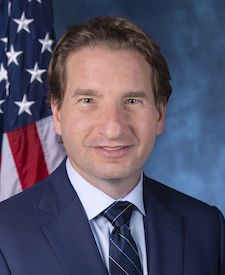
Rep. Dean Phillips
Sponsored bills
Hamas International Financing Prevention Act This bill imposes sanctions targeting Hamas, the Palestinian Islamic Jihad, and any affiliate or successor groups. The President shall periodically report to Congress a list of each foreign person or instrumentality that knowingly assists, provides significant support or services to, or is involved in a significant transaction with a senior member or supporter of any of the targeted groups. The President shall impose two or more sanctions on the named persons. Specifically, the person may be (1) denied credit and services from the Export-Import Bank, (2) barred from purchasing certain controlled defense articles, (3) denied exports of items on the U.S. Munitions List, (4) prevented from receiving exports of certain goods or technology controlled for national security reasons, (5) prohibited from receiving financing of more than $10 million from any U.S. financial institution, or (6) subject to property-blocking restrictions. The President shall periodically report to Congress a list of foreign governments that have repeatedly provided material support for the targeted groups' terrorist activities. The President shall bar these governments from receiving for one year (1) U.S. assistance, or (2) exports of controlled munitions. The Department of Treasury shall instruct U.S. leadership of international financial institutions to oppose the provision of assistance to an identified government for one year. The bill provides for certain exceptions and waivers, such as for transactions that would serve U.S. national interests. The President shall report to Congress and periodically provide briefings on other specified topics related to the targeted groups, such as where these groups secure financing and surveillance equipment.
Made in America Emergency Preparedness Act This bill establishes in the legislative branch the National Commission on United States Preparedness for National Emergencies and requires any medical, pharmaceutical, or emergency preparedness product deemed integral to a response to a national emergency to be manufactured and procured in the United States beginning on and after January 1, 2026. The commission must, among other things, examine and report on the COVID-19 pandemic in the United States in 2020 and the private sector response, investigate the origin of the COVID-19 virus and measures for mitigating the impacts of future physical and medical national disasters, determine what medical, pharmaceutical, and emergency preparedness products are deemed to be essential to emergency preparedness, and report on infrastructure or capability deficiencies in hospitals and medical centers. States must implement the commission's findings or lose access to federal emergency preparedness funds. The bill allows 100% tax expensing for qualified pharmaceutical and medical device manufacturing property (e.g., personal protective equipment) placed in service after 2020 and before 2027.
Better Way for Providers To Repay Act of 2021 This bill modifies recoupment provisions under the Medicare Accelerated and Advance Payment Program during the public health emergency relating to COVID-19. The program provides Medicare payments in advance to eligible providers experiencing claims or cash flow disruptions, such as during national emergencies; the program was specifically expanded in response to COVID-19 to encompass more types of providers, subject to certain recoupment and repayment provisions. The bill provides for an additional one year before recoupment of advance payments (through claims offsets) begins, so that recoupment begins two years (rather than one year) after payments are made. The bill also applies repayments that providers have already made toward the collection of offsets for a corresponding amount of time.
Trust in Public Service Act This bill incorporates customer experience as a central measure of performance for federal agencies. Specifically, the bill requires each agency to develop a high-quality customer experience by allocating sufficient resources to and prioritizing customer experience capabilities and initiatives, adapting government-wide and global good practices, streamlining the process for soliciting voluntary customer feedback and requiring limited internal review if the collection is within the scope of Office of Management and Budget (OMB) guidance, and using human-centered design practices. Each agency shall develop and use tools to experiment with different approaches to improve customer experience, ensure the privacy of federal customers, use the data collected to continually improve customer experience and agency performance, and share the data collected with research entities to permit external analysis. The bill sets forth agency communication responsibilities. In addition, the OMB must issue guidance for agencies in collaboration with specified entities. It may establish programs that annually recognize individuals and teams across the federal workforce meeting customer service-related goals. The bill (1) integrates customer experience provisions into the U.S. code and the Federal Citizen Services Fund, (2) directs the OMB to establish an Office of Customer Experience, and (3) integrates customer experience into the responsibilities of key agency officials. The OMB, in coordination with the Office of Customer Experience, must establish the Participatory Government and Civic Dialogue Advisory Council. The Government Accountability Office shall report to Congress, assessing agency efforts and examining best practices.
United States Army Rangers Veterans of World War II Congressional Gold Medal Act This bill provides for the award of a single Congressional Gold Medal to the U.S. Army Rangers Veterans of World War II in recognition of their dedicated service during World War II.
Innovation and Growth Now by Investing in Tomorrow's Enterprises Act or the IGNITE American Innovation Act This bill allows certain C corporation taxpayers to elect an increased advance refund of net operating loss carryovers attributable to COVID-19 research expenditures in 2020 and 2021. The bill also allows such taxpayers an advance refund of certain other net operating loss carryovers arising during 2015 through 2021. The bill allows an increased research tax credit for COVID-19 research expenditures paid or incurred on or after February 15, 2020, and before January 1, 2022.
Reducing Barriers for Military Voters Act This bill requires the Department of Defense (DOD) to develop a plan for providing end-to-end electronic voting services (e.g., services for registering to vote and returning a ballot) in participating states for absent uniformed service members who are deployed or mobilized in locations with limited or no postal service. Specifically, DOD must develop the plan by consulting with state and local election officials. Further, the plan must include (1) methods to ensure that voters have the opportunity to verify that their ballots are received and tabulated, (2) methods to generate a verifiable and auditable vote trail, and (3) an assessment of whether commercially available technologies may be used to carry out the plan. DOD must implement the plan for a trial group of voters in participating states for the 2024 federal elections. The plan must be implemented for all voters in participating states for the 2026 federal elections and subsequent years.
Preventing Lead Poisoning Act of 2021 This bill requires coverage under the Children's Health Insurance Program (CHIP) of screening blood lead tests. Specifically, CHIP must cover a child's test once at the age of 12 months and once at the age of 24 months, or once between the ages of 24 months and 72 months if the child has never been assessed, as well as testing at such other times as recommended by a child's health care provider. The bill also provides statutory authority for these requirements (regarding testing intervals) for state Medicaid programs.
John Lewis Every Child Deserves a Family Act This bill prohibits discrimination on the basis of sexual orientation, gender identity, marital status, or religion in the provision of child welfare programs and services by entities receiving federal funding. The Department of Health and Human Services (HHS) must provide technical assistance to help states follow this requirement, including (1) guidance for bringing state laws into compliance, (2) developing training to increase cultural competency related to social identity, and (3) training for judges and attorneys involved in child welfare cases, among other supports. Additionally, HHS must establish the National Resource Center on Safety, Well-Being, Placement Stability, and Permanency for LGBTQ Children and Youth Involved with Child Welfare Services to provide training, technical assistance, and guidance to applicable state and local agencies and service providers. Further, the Religious Freedom Restoration Act may not be the basis for challenging the application or enforcement of this bill. The Government Accountability Office must study and report on states' compliance with the requirements of the bill no later than three years after enactment.