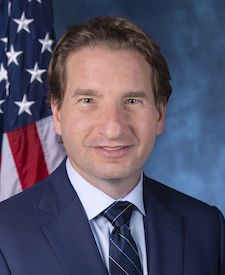
Photo of Dean Phillips
D United States House · District 3 · Minnesota

Rep. Dean Phillips

Compare
Total votes
2,168
all sessions
Attendance
84%
349 missed
Lower than 94% of chamber peers
With party
97%
of cast votes
Near the chamber average
Bipartisan score
2%
crosses aisle rarely
Near the chamber average
Sponsored
1,166
bills & resolutions
Higher than 85% of chamber peers
Committees
0
assignments
1,166 bills and resolutions

Sponsored bills

Total
1,166
Primary
55
Co-sponsor
1,111
This page
1,166
matching current filters
Co-sponsor HR 6860
In committee · United States House · Co-sponsor
Restore Protections for Dialysis Patients Act

Maddy summaryThis bill, HR 6860, protects patients with end-stage kidney disease (ESRD) who require dialysis by preventing health insurance plans from discriminating against them. It amends Medicare rules to prohibit plans from treating dialysis coverage differently than other medical services based on a patient’s ESRD diagnosis, need for dialysis, or any other factor. The bill clarifies that plans can still choose which dialysis providers to include in their networks but cannot deny or limit coverage for dialysis services solely because of the patient’s condition. It ensures Medicare remains the secondary payer for these services as intended, without forcing plans to cover specific providers.

In committee Dec 17, 2024 1 co-sponsor
Co-sponsor HR 6780
In committee · United States House · Co-sponsor
Medically Tailored Home-Delivered Meals Demonstration Pilot Act

Maddy summaryHR 6780 establishes a 4-year Medicare demonstration program testing whether hospitals providing medically tailored home-delivered meals to specific patients improves health outcomes and reduces hospital readmissions. The program targets Medicare beneficiaries with diet-sensitive chronic conditions (like diabetes or heart failure) who are at high risk of readmission and meet specific discharge criteria, such as limited daily living activities. Selected hospitals must screen patients, provide at least two tailored meals daily for 12 weeks, and offer medical nutrition therapy, all without patient cost-sharing. The program requires hospitals to submit data for evaluation, with the goal of assessing impacts on hospital admissions, care costs, and patient satisfaction before reporting to Congress in 2027 and 2030.

In committee Dec 17, 2024 1 co-sponsor
Co-sponsor HR 6790
In committee · United States House · Co-sponsor
New Era of Preventing End-Stage Kidney Disease Act

Maddy summaryHR 6790 establishes National Institutes of Health centers to advance research, early detection, and public awareness of rare kidney diseases, with a focus on rural and underserved communities. It mandates a federal study on genetic testing barriers, treatment patterns, and public awareness for rare kidney diseases affecting disproportionately impacted populations, including barriers to insurance coverage and access to specialists. The bill also funds nephrology training programs to increase specialists serving these communities and requires experiments to delay or prevent the need for dialysis and transplants. Total funding of $7 million is authorized for fiscal years 2024-2028 to support these research, education, and early intervention efforts.

In committee Dec 17, 2024 1 co-sponsor
Co-sponsor HR 6748
In committee · United States House · Co-sponsor
PEERS Act of 2023

Maddy summaryThe PEERS Act of 2023 (HR 6748) would add Medicare coverage for "peer support services" starting January 1, 2025. These services, provided by certified specialists who have recovered from mental health or substance use conditions, offer emotional, informational, and community support to Medicare beneficiaries diagnosed with mental disorders or substance use disorders. The bill establishes payment rates (80% of a fee schedule) for community mental health centers and certified community behavioral health clinics offering these services and modifies Medicare exclusions to allow coverage. It directly affects Medicare beneficiaries with these diagnoses, certified peer support specialists, and eligible healthcare providers like Federally Qualified Health Centers.

In committee Dec 17, 2024 1 co-sponsor
Co-sponsor HR 6270
In committee · United States House · Co-sponsor
State-Based Universal Health Care Act of 2023

Maddy summaryThis bill creates a framework for states to develop their own universal health care systems by applying for waivers from certain federal health care requirements. States must demonstrate they can provide comprehensive coverage meeting or exceeding current federal standards (like Medicaid, Medicare, and CHIP) for at least 95% of residents within 5 years, with the federal government redirecting funds that would have gone to federal programs to support state systems. States must include specific protections like reproductive health care coverage and submit regular reports on coverage rates, affordability, and quality. The bill includes special provisions to protect Indian health care services and ensure they remain accessible under state plans. States that fail to meet coverage goals may face consequences, including potential termination of their waiver.

In committee Dec 17, 2024 1 co-sponsor
Co-sponsor HR 6094
In committee · United States House · Co-sponsor
Providing Realistic Opportunity To Equal and Comparable Treatment for Rare Act

Maddy summaryThis bill amends Medicare, Medicaid, and private insurance rules to improve coverage for drugs treating rare diseases (defined as conditions affecting 200,000 or fewer people in the U.S.). It requires coverage for rare disease drug uses supported by peer-reviewed medical literature and not listed as contraindicated in FDA labeling or medical reference guides. Private insurers must provide expedited review processes for denials of such drugs. The changes apply 30 days after enactment, affecting insurers and patients seeking coverage for rare disease treatments.

In committee Dec 17, 2024 1 co-sponsor
Primary HR 6030
In committee · United States House · Lead sponsor
Expanding Health Care Options for First Responders Act

Maddy summaryThis bill creates a Medicare buy-in option for retired or disabled first responders aged 50-64 who have lost employer health coverage. It allows them to enroll in Medicare Part A, B, and D (including prescription drug coverage) before age 65, with premiums calculated based on Medicare's average per-person costs. The coverage counts as "minimum essential coverage" under the Affordable Care Act, qualifying individuals for ACA premium tax credits and cost-sharing subsidies. It also establishes an oversight board and outreach grants to assist enrollment, while ensuring the program doesn't reduce benefits for existing Medicare beneficiaries or harm Medicare trust funds.

In committee Dec 17, 2024 0 co-sponsors
Co-sponsor HR 6028
In committee · United States House · Co-sponsor
States Reform Act of 2023

Maddy summary# Summary of the Proposed "States Reform Act" This comprehensive federal legislation proposes to comprehensively reform U.S. cannabis policy by: 1. **Decriminalizing and regulating cannabis**: Removing cannabis from Schedule I of the Controlled Substances Act and establishing a federal regulatory framework similar to alcohol regulation. 2. **Creating a regulatory structure**: - Establishing a federal excise tax of 3% on cannabis products - Creating categories for different cannabis products (flower, pre-rolls, extracts, etc.) - Implementing packaging, labeling, and safety requirements - Establishing a certification process for designated State medical cannabis products 3. **Medical cannabis provisions**: - Creating a process for FDA to certify medical cannabis products - Allowing for specific medical indications (arthritis, nausea, pain, PTSD, etc.) - Permitting State medical cannabis programs to operate under federal framework - Creating a "Law Enforcement Retraining and Successful Second Chances Fund" (30% of tax revenue) 4. **Business and economic provisions**: - Removing barriers for cannabis-related businesses to access SBA loans - Establishing "cannabis-related legitimate business" definitions - Creating new reporting requirements for the cannabis industry - Mandating demographic data collection on cannabis industry workers 5. **Veterans' access**: - Prohibiting federal employment discrimination against veterans who use medical cannabis - Allowing VA health providers to discuss State-approved medical cannabis programs with veterans 6. **Other key provisions**: - Establishing a "cannabis" term to replace "marijuana" or "marihuana" in all federal law - Allowing veterans to have security clearances reconsidered if denied for cannabis use - Creating international trade policy for cannabis - Mandating continued federal drug testing for employees in certain positions - Establishing a 10-year moratorium on increasing cannabis excise tax The bill would establish a comprehensive federal framework for legal cannabis that would operate alongside existing State programs, with detailed tax, regulatory, and reporting requirements. It would also include significant provisions to address social equity, veterans' access, and economic opportunities in the emerging cannabis industry.


In committee Dec 17, 2024 1 co-sponsor
Co-sponsor HR 6020
Passed · United States House · Co-sponsor
Honor Our Living Donors Act

Maddy summaryHR 6020, the Honor Our Living Donors Act, amends federal law to ensure living organ donors are fully reimbursed for qualifying expenses without considering the recipient's income. It prohibits organ recipients from having their income factored into reimbursement calculations and requires the Secretary to annually report whether current funding covers all donor expenses, including estimates of unmet needs. This bill directly affects living organ donors and the federal reimbursement program under the Public Health Service Act.

Passed Dec 17, 2024 1 co-sponsor
Co-sponsor HR 5819
In committee · United States House · Co-sponsor
Connecting Our Medical Providers with Links to Expand Tailored and Effective Care Act

Maddy summaryHR 5819, the COMPLETE Care Act, incentivizes Medicare primary care providers to integrate behavioral health services by increasing payments for specific services (like mental health and substance use disorder support) during 2025-2027. Providers using designated HCPCS codes for integrated care would receive 125-175% of standard payment rates, with the percentage declining annually. The bill also requires these providers to report on integration quality measures and mandates technical assistance for practices adopting integrated models, funded through new appropriations for 2024-2027. It directly affects Medicare-participating primary care practices serving beneficiaries needing mental health or substance use services.

In committee Dec 17, 2024 1 co-sponsor
Showing 31 to 40 of 1,166 bills
Previous 1 3 4 5 117 Next