

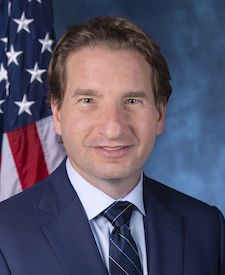
Photo of Dean Phillips
D United States House · District 3 · Minnesota

Rep. Dean Phillips

Compare
Total votes
2,168
all sessions
Attendance
84%
349 missed
Lower than 98% of chamber peers
With party
97%
of cast votes
Near the chamber average
Bipartisan score
2%
crosses aisle rarely
Near the chamber average
Sponsored
1,166
bills & resolutions
Higher than 85% of chamber peers
Committees
0
assignments
1,166 bills and resolutions

Sponsored bills

Total
1,166
Primary
55
Co-sponsor
1,111
This page
1,166
matching current filters
Co-sponsor HRES 1063
In committee · United States House · Co-sponsor
Reaffirming the United States full and unwavering commitment to the North Atlantic Treaty Organization in its 75th anniversary year and its goals of achieving collective security through transatlantic partnerships.

Maddy summaryHRES 1063 is a non-binding resolution passed by the U.S. House of Representatives to reaffirm America's commitment to NATO ahead of its 75th anniversary. It formally recognizes NATO's role in collective security, emphasizes Article 5's importance for mutual defense, and supports Finland and Sweden's membership. The resolution also calls on NATO allies to meet the 2% defense spending target, but does not create new laws or affect specific individuals or groups.

In committee May 16, 2024 1 co-sponsor
Co-sponsor HR 8426
In committee · United States House · Co-sponsor
Public Service Freedom to Negotiate Act of 2024

Maddy summaryThe Public Service Freedom to Negotiate Act of 2024 establishes federal minimum standards for collective bargaining rights for public employees and supervisory employees. The Federal Labor Relations Authority will determine if each state's laws "substantially provide" for these rights, and if not, federal standards will apply to that state. These standards include the right to self-organization, collective bargaining, recognition of labor organizations, and procedures for resolving disputes. The bill preserves existing collective bargaining agreements and excludes certain employee categories like emergency services workers from some provisions.

In committee May 16, 2024 1 co-sponsor
Co-sponsor HR 8427
In committee · United States House · Co-sponsor
Stop Arming Cartels Act of 2024

Maddy summaryHR 8427, the Stop Arming Cartels Act of 2024, bans the civilian possession, sale, or transfer of rifles capable of firing .50 caliber ammunition, with exceptions for government use and rifles already owned before the law's enactment. It requires owners of such rifles to register them with the federal government within 12 months (without fees) and adds a new provision allowing lawsuits against sellers who knowingly supply these rifles to foreign drug traffickers. The bill also expands federal firearm prohibitions to bar individuals designated as significant foreign narcotics traffickers under existing law from purchasing or possessing firearms. These changes directly affect civilian rifle owners, gun sellers, and foreign drug traffickers targeted by U.S. sanctions.

In committee May 16, 2024 1 co-sponsor
Co-sponsor HR 8341
In committee · United States House · Co-sponsor
Cost Estimates Improvement Act

Maddy summaryThe Cost Estimates Improvement Act (HR 8341) requires the Congressional Budget Office (CBO) and Joint Committee on Taxation (JCT) to include, to the extent practicable, the costs of servicing the national debt - such as interest payments - in their budget estimates. This change makes cost analyses more comprehensive by reflecting the full financial burden of government borrowing. The bill amends the Congressional Budget and Impoundment Control Act of 1974 to add this requirement, directly affecting how the CBO and JCT produce their budget reports. It does not alter spending or tax laws but ensures estimates better account for long-term debt costs when Congress reviews legislation.

In committee May 16, 2024 1 co-sponsor
Co-sponsor HR 3246
In committee · United States House · Co-sponsor
Sanction Russian Nuclear Safety Violators Act of 2023

Maddy summaryHR 3246, the Sanction Russian Nuclear Safety Violators Act of 2023, imposes U.S. sanctions on Russian individuals or entities that endangered the Zaporizhzhia Nuclear Power Plant’s safety or Ukrainian operational control since Russia’s 2022 invasion of Ukraine. Key provisions require the President to block assets and deny visas to targeted foreign persons, with exceptions for humanitarian aid and efforts to restore Ukrainian control of the plant. The bill directly affects Russian officials and Rosatom personnel involved in the plant’s operations, aiming to address safety risks highlighted by the IAEA.

In committee May 16, 2024 1 co-sponsor
Co-sponsor HR 1199
In committee · United States House · Co-sponsor
Facilitating Innovative Nuclear Diagnostics Act of 2023

Maddy summaryThis bill requires Medicare to pay separately for certain high-cost diagnostic drugs used in nuclear imaging (like those for cancer detection) starting in 2024. It applies to drugs with a daily cost of $500 or more (adjusted annually), ensuring they are not bundled with other services. Payments will be based on either the drug's average sales price or wholesale cost, with adjustments to keep overall Medicare spending unchanged. This directly affects Medicare Part B providers (hospitals, clinics) and beneficiaries receiving these specific diagnostic treatments.

In committee May 16, 2024 1 co-sponsor
Co-sponsor HR 681
In committee · United States House · Co-sponsor
READ Act Reauthorization Act of 2023

Maddy summaryThe READ Act Reauthorization Act of 2023 extends the authorization period for the Reinforcing Education Accountability in Development Act (commonly known as the READ Act) from five to ten fiscal years. This change allows U.S. international education programs, administered by agencies like USAID, to operate without annual reauthorization for a longer period. The bill directly affects programs providing educational support in developing countries, such as teacher training and literacy initiatives. The key mechanism is amending Section 4(a) of the existing law to adjust the funding duration, ensuring continued program stability.

In committee May 16, 2024 1 co-sponsor
Co-sponsor HR 8366
In committee · United States House · Co-sponsor
To extend authorities to impose sanctions under certain laws relating to Hong Kong, Tibet, and the Xinjiang Uyghur Autonomous Region.

Maddy summaryHR 8366 extends the duration of US sanctions authorities targeting Hong Kong, Tibet, and Xinjiang from five to ten years under four existing laws. It modifies specific provisions in the Hong Kong Human Rights and Democracy Act (2019), the Reciprocal Access to Tibet Act (2018), and the Uyghur Human Rights Policy Act (2020) to extend sanction periods. The bill also extends the expiration date for a 2019 law banning munitions exports to the Hong Kong Police Force to December 31, 2029. These changes maintain current sanctions policies without introducing new restrictions.

In committee May 10, 2024 1 co-sponsor
Co-sponsor HCONRES 89
Passed · United States House · Co-sponsor
Authorizing the use of Emancipation Hall in the Capitol Visitor Center for a ceremony as part of the commemoration of the days of remembrance of victims of the Holocaust.

Maddy summaryHCONRES 89 authorizes the use of Emancipation Hall in the Capitol Visitor Center for a Holocaust remembrance ceremony on May 7, 2024, as part of official observances honoring victims. The resolution specifies that preparations for the event must follow conditions set by the Architect of the Capitol. This procedural bill directly affects Capitol Visitor Center operations and the event organizers hosting the commemoration. It does not create new laws or alter policies, but formally permits space use for this specific ceremonial purpose.

Passed May 3, 2024 1 co-sponsor
Co-sponsor HR 8185
In committee · United States House · Co-sponsor
Exposing the Financing of Human Trafficking Act

Maddy summaryThis bill amends the Trafficking Victims Protection Act of 2000 to require the U.S. government to evaluate whether foreign countries actively investigate, prevent, and prosecute financial crimes that help human traffickers operate. It directly affects how foreign governments are assessed in the annual U.S. anti-trafficking report, potentially influencing their ranking (e.g., Tier 1, Tier 2). The key provision adds a new criterion to this report, specifically examining countries' enforcement of financial crime measures tied to trafficking. This change aims to strengthen international accountability for financial aspects of human trafficking without altering existing U.S. laws or programs.

In committee Apr 30, 2024 1 co-sponsor
Showing 171 to 180 of 1,166 bills
Previous 1 … 17 18 19 … 117 Next