

Equality Act This bill prohibits discrimination based on sex, sexual orientation, and gender identity in areas including public accommodations and facilities, education, federal funding, employment, housing, credit, and the jury system. Specifically, the bill defines and includes sex, sexual orientation, and gender identity among the prohibited categories of discrimination or segregation. The bill expands the definition of public accommodations to include places or establishments that provide (1) exhibitions, recreation, exercise, amusement, gatherings, or displays; (2) goods, services, or programs; and (3) transportation services. The bill allows the Department of Justice to intervene in equal protection actions in federal court on account of sexual orientation or gender identity. The bill prohibits an individual from being denied access to a shared facility, including a restroom, a locker room, and a dressing room, that is in accordance with the individual's gender identity.
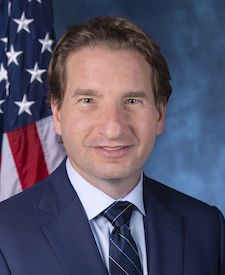
Rep. Dean Phillips
Sponsored bills
Educational Notification and Disclosure of Actions risking Loss of Life by Hazing Act or the END ALL Hazing Act This bill requires institutions of higher education (IHEs) that participate in federal student-aid programs to collect information and publicly report on hazing-related misconduct. Specifically, IHEs must prepare biannual reports and post the reports on their websites. The reports must include information on hazing-related misconduct committed by a student organization, including the name of the student organization that committed the violation, a description of the violation, and sanctions placed on the organization. Further, IHEs must report to campus police and law enforcement authorities within 72 hours of becoming aware of any allegation of hazing that involved serious bodily injury or a significant risk of serious bodily injury. The bill does not apply to foreign IHEs.
Supporting Veteran Families in Need Act This bill permanently extends the authorization for the Department of Veterans Affairs to provide financial assistance for supportive services for very low-income veteran families in permanent housing.
Veterans Cannabis Use for Safe Healing Act This bill prohibits the Department of Veterans Affairs (VA) from denying a veteran any VA benefit due to participation in a state-approved marijuana program. For veterans participating in these approved programs, the VA must ensure its health care providers (1) discuss marijuana use with such veterans and adjust treatment plans accordingly, and (2) record such use in the veterans' medical records. Under the bill, the VA shall authorize physicians and other VA health care providers to provide recommendations to veterans who are residents of states with approved programs.
Pharmacy Benefit Manager Accountability Study Act of 2021 This bill requires the Government Accountability Office to report on the role of pharmacy benefit managers in the pharmaceutical supply chain and recommend legislative actions to lower the cost of prescription drugs. The report must address the use of rebates and fees, the average prior authorization approval time, and the use of step therapy within the 10 largest pharmacy benefit managers.
Funding for Aviation Screeners and Threat Elimination Restoration Act or the FASTER Act This bill repeals the requirement that a portion of aviation security service fees collected from passengers be credited as offsetting receipts and deposited in the general fund of the Treasury. It requires such fees to be deposited into a separate account in the Treasury for expenditure to pay only the costs of activities and services for which the fee is imposed (i.e., aviation security screening).
Reserve Employers Comprehensive Relief and Uniform Incentives on Taxes Act of 2021 or the RECRUIT Act of 2021 This bill allows employers with less than 500 employees a new tax credit for 40% of the wages paid to a member of the National Guard or a reserve component of the Armed Forces. The employer may elect to claim a payroll tax credit for wages paid to such service members.
Developing Responsible Individuals for a Vibrant Economy Act or the DRIVE-SAFE Act This bill directs the Department of Transportation to promulgate regulations to implement an apprenticeship program for licensed commercial motor vehicle drivers under the age of 21. Under the program, an apprentice must complete two probationary periods that total 400 hours of on-duty time, of which at least 240 hours must be driving time in a commercial motor vehicle. Additionally, the apprentice must be accompanied in the cab of the commercial motor vehicle by an experienced driver. Further, the bill requires all commercial motor vehicles used in the program for training to be equipped with safety technology such as active braking collision mitigation systems and video event capturing systems. An employer shall not knowingly allow, require, permit, or authorize a driver under the age of 21 to operate a commercial motor vehicle unless the driver is participating in, or has completed, an apprenticeship program that meets the requirements set forth in this bill.
For the People Act of 2021 This bill addresses voter access, election integrity and security, campaign finance, and ethics for the three branches of government. Specifically, the bill expands voter registration (e.g., automatic and same-day registration) and voting access (e.g., vote-by-mail and early voting). It also limits removing voters from voter rolls. The bill requires states to establish independent redistricting commissions to carry out congressional redistricting. Additionally, the bill sets forth provisions related to election security, including sharing intelligence information with state election officials, supporting states in securing their election systems, developing a national strategy to protect U.S. democratic institutions, establishing in the legislative branch the National Commission to Protect United States Democratic Institutions, and other provisions to improve the cybersecurity of election systems. Further, the bill addresses campaign finance, including by expanding the prohibition on campaign spending by foreign nationals, requiring additional disclosure of campaign-related fundraising and spending, requiring additional disclaimers regarding certain political advertising, and establishing an alternative campaign funding system for certain federal offices. The bill addresses ethics in all three branches of government, including by requiring a code of conduct for Supreme Court Justices, prohibiting Members of the House from serving on the board of a for-profit entity, and establishing additional conflict-of-interest and ethics provisions for federal employees and the White House. The bill requires the President, the Vice President, and certain candidates for those offices to disclose 10 years of tax returns.
Speeding Therapy Access Today Act of 2021 This bill requires and authorizes various actions to accelerate the development of therapies for rare diseases. The Food and Drug Administration (FDA) shall establish the Intercenter Institute on Rare Diseases and Conditions. The institute shall (1) coordinate engagement with relevant stakeholders, (2) build the FDA's expertise in the review of medical products to treat rare diseases, (3) coordinate regulatory science initiatives related to rare diseases, (4) establish and implement a program to make recommendations to address challenges associated with developing medical products to treat rare diseases in an individual or in very small populations, (5) convene a stakeholder meeting to consider potential amendments to labels for medical products to treat rare diseases, and (6) establish and carry out a program to facilitate voluntary communication between the sponsors of such medical products and third-party payers (e.g., insurance companies). The bill also authorizes the FDA to make grants to assist in developing practices related to the development and production of individualized therapies or therapies to treat very small populations. The bill also establishes an advisory committee to advise the FDA on issues related to the development of therapies to treat rare diseases.