

Global Electoral Exchange Act of 2021 This bill authorizes the Department of State to establish a Global Electoral Exchange Program to promote sound election-administration practices around the world. The State Department may award grants to qualified, tax-exempt, U.S.-based organizations that have expertise and experience in relevant topics, such as election-system integrity. Grants may be used to design programs to bring relevant individuals, such as election administrators and poll workers, together to study and discuss election procedures. The State Department shall periodically report to Congress on the program's activities.
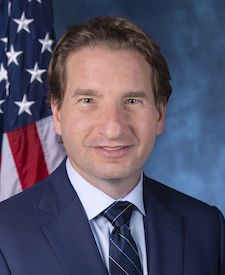
Rep. Dean Phillips
Sponsored bills
Countering Russian and Other Overseas Kleptocracy Act or the CROOK Act This bill requires various actions designed to combat public corruption in foreign countries. The bill establishes within the Department of the Treasury the Anti-Corruption Action Fund to help foreign states fight public corruption and develop rule-of-law-based governance structures. For certain fines and penalties imposed under the Foreign Corrupt Practices Act, an additional fine shall be imposed and deposited into the fund. The Department of State must (1) manage U.S. government efforts to fight foreign public corruption, and (2) establish an interagency task force to assist in coordinating such efforts. Each U.S. embassy must have a point of contact responsible for coordinating the embassy's anti-corruption efforts. The State Department must report to Congress on its anti-corruption activities and make various reports publicly available online.
This resolution states that the August 9, 2020, election in Belarus was neither free nor fair and, as such, the House of Representatives does not recognize Alyaksandr Lukashenka as the country's legitimate president. The resolution also states that the people of Belarus have the right to determine the country's future without unwelcome intervention from outside actors and condemns the human rights violations committed by Belarusian authorities.
Chiropractic Medicare Coverage Modernization Act of 2021 This bill expands Medicare coverage of chiropractic services to include all services provided by chiropractors, rather than only subluxation corrections through manual manipulation of the spine.
Tropical Forest and Coral Reef Conservation Reauthorization Act of 2021 This bill extends through FY2026 authority for debt-for-nature swaps and debt buyback programs that reduce or convert debt obligations from an eligible country to the United States into funding for nature conservation and protection efforts in that country.
National Committee on Fiscal Responsibility and Reform Act of 2021 This bill establishes the National Committee on Fiscal Responsibility and Reform to make recommendations to reduce the budget deficit by at least $3.25 trillion over FY2021-FY2031. The committee must be established as a joint select committee of Congress and consist of 12 Members of Congress appointed by specified members of the congressional leadership. The specific functions of the committee are to investigate policies to improve the fiscal situation in the medium term; achieve fiscal sustainability over the long run; propose legislation designed to balance the budget, excluding interest payments on the debt, by 2031; and issue a final report to Congress. Congress must use specified expedited legislative procedures to consider legislation that is approved by at least eight members of the committee.
FDA Modernization Act of 2021 This bill allows an applicant for market approval for a new drug to use methods other than animal testing to establish the drug's safety and effectiveness. Under this bill, these alternative methods may include cell-based assays, organ chips and microphysiological systems, sophisticated computer modeling, and other human biology-based test methods.
Time to Rescue United States Trusts Act of 2021 or the TRUST Act of 2021 This bill establishes congressional rescue committees to develop recommendations and legislation to improve critical social contract programs. A critical social contract program is a federal program for which a federal trust fund is established (e.g., Social Security, Medicare, and federal highway programs), with outlays of at least $20 billion during the year preceding the year in which this bill is enacted, and for which the amount of dedicated federal funds and federal trust fund balances will be inadequate to meet the total amount of outlays of the program that would otherwise be made. Each rescue committee may develop recommendations and legislation to improve the program for which it was established, including by (1) increasing the duration of positive balances of the federal trust fund established for the program, and (2) providing for the solvency of the federal trust fund established for the program during a 75-year period. Congress must use specified expedited legislative procedures to consider legislation that is approved and submitted by the rescue committees.
Tax Fairness for Workers Act This bill allows an above-the-line tax deduction for union dues and expenses. (An above-the-line deduction is subtracted from gross income and is available whether or not a taxpayer itemizes other deductions.) The bill also reinstates the miscellaneous itemized tax deduction for unreimbursed expenses attributable to the performance of services as an employee (Under current law, all miscellaneous itemized deductions are suspended through 2025).
Affordable Housing Credit Improvement Act of 2021 This bill revises provisions of the low-income housing tax credit and renames it as the affordable housing credit . The bill increases the per capita dollar amount of the credit and its minimum ceiling amount beginning in 2021 and extends the inflation adjustment for such amounts. The bill modifies tenant income eligibility requirements and the average income formula for determining such income. It also revises rules for student occupancy of rental units and tenant voucher payments, and prohibits any refusal to rent to victims of domestic abuse. The bill further modifies the credit to increase state allocations of the credit; repeal the qualified census tract population cap; prohibit local approval and contribution requirements; increase the credit for certain projects designated to serve extremely low-income households; increase the credit for certain bond-financed projects designated by state agencies; eliminate the basis reduction for properties that receive certain energy-related tax benefits; and increase the population cap for difficult development areas (i.e., areas with high construction, land, and utility costs relative to area median gross income). The bill also includes Indian and rural areas as difficult development areas and modifies other requirements relating to casualty losses, acquisition credits, and foreclosures.