

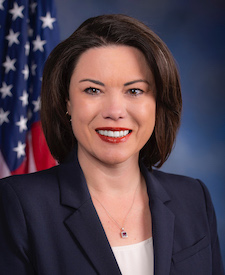
Photo of Angie Craig
D United States House · District 2 · Minnesota

Rep. Angie Craig

Compare
Total votes
2,837
all sessions
Attendance
98%
60 missed
Near the chamber average
With party
93%
of cast votes
Near the chamber average
Bipartisan score
4%
crosses aisle rarely
Near the chamber average
Sponsored
1,831
bills & resolutions
Higher than 95% of chamber peers
Committees
1
assignment
1,831 bills and resolutions

Sponsored bills

Total
1,831
Primary
87
Co-sponsor
1,744
This page
1,831
matching current filters
Co-sponsor HR 2094
In committee · United States House · Co-sponsor
HELPER Act of 2025

Homes for Every Local Protector, Educator, and Responder Act of 2025 or the HELPER Act of 2025 This bill establishes a program administered by the Department of Housing and Urban Development to provide mortgage assistance to law enforcement officers, elementary and secondary school teachers, firefighters, or other first responders. Specifically, these individuals may be eligible for a first-time mortgage on a primary family residence with no down payment. Instead, the mortgage is subject to a one-time, up-front mortgage insurance premium.

In committee Mar 14, 2025 1 co-sponsor
Co-sponsor HRES 218
In committee · United States House · Co-sponsor
Recognizing and honoring teachers who have earned or maintained National Board Certification.

Maddy summaryHRES 218 is a resolution recognizing and honoring teachers who have earned or maintained National Board Certification as of March 2025. It specifically honors approximately 141,464 certified teachers nationwide, acknowledges their contributions to student learning (including research showing improved outcomes for students), and encourages school districts and states to support more teachers in pursuing this certification. The resolution has no legal effect or funding provisions - it is purely a symbolic gesture of appreciation for educators meeting rigorous teaching standards.

In committee Mar 11, 2025 1 co-sponsor
Co-sponsor HR 2049
In committee · United States House · Co-sponsor
Access to Family Building Act

Maddy summaryThe Access to Family Building Act establishes legal rights for individuals seeking fertility care and health care providers offering assisted reproductive technology (ART) services. It prohibits states or localities from imposing unreasonable restrictions on ART access - such as excessive costs, health barriers, or arbitrary limitations - that don’t advance safety or health outcomes. The bill allows patients, providers, or insurers to sue to enforce these rights, while explicitly preserving state health/safety regulations that protect patient safety. It does not override existing state insurance laws or require changes to medical facility safety standards. This bill directly affects patients pursuing fertility treatment, fertility clinics, and health insurers covering ART services.

In committee Mar 11, 2025 1 co-sponsor
Co-sponsor HR 2029
In committee · United States House · Co-sponsor
Stop Comstock Act

Maddy summaryHR 2029, the "Stop Comstock Act," amends federal obscenity laws to remove outdated restrictions on abortion and contraception. It deletes references to "indecent" materials and abortion-related language from Title 18 (e.g., removing "or means for procuring abortion" from section 552 and revising definitions in sections 1461 and 1462). The bill clarifies that federal law does not prohibit the distribution of materials related to abortion or contraceptives, updating how "obscene" is defined. These changes directly affect federal enforcement of obscenity laws, particularly regarding medical information and devices. The bill focuses on modernizing statutory language to align with current legal standards for protected speech and healthcare access.

In committee Mar 11, 2025 1 co-sponsor
Co-sponsor HR 2048
In committee · United States House · Co-sponsor
Metastatic Breast Cancer Access to Care Act

Metastatic Breast Cancer Access to Care Act This bill expedites payment of Social Security Disability Insurance (SSDI) benefits and eligibility for Medicare coverage for those with metastatic breast cancer (i.e., breast cancer that has spread to other sites in the body). Specifically, the bill eliminates the 5-month waiting period for SSDI benefits and the subsequent 24-month waiting period for Medicare coverage for individuals with metastatic breast cancer. Under current law, individuals generally must wait 5 months after the onset of disability to begin receiving SSDI benefits and an additional 24 months to become eligible for Medicare.

In committee Mar 11, 2025 1 co-sponsor
Co-sponsor HR 2028
In committee · United States House · Co-sponsor
REDI Act

Resident Education Deferred Interest Act or the REDI Act This bill allows borrowers in medical or dental internships or residency programs to defer student loan payments until the completion of their programs.

In committee Mar 11, 2025 1 co-sponsor
Co-sponsor HR 2086
In committee · United States House · Co-sponsor
Rights for the TSA Workforce Act

Maddy summaryThis bill requires the Transportation Security Administration (TSA) to transition its workforce from a special personnel management system to the standard federal personnel system under Title 5 of the U.S. Code by December 31, 2025. It protects TSA employees by ensuring no reduction in pay, benefits, or retirement rights during the transition, while preserving collective bargaining rights for screening agents. The legislation also mandates consultation with labor unions during the process and requires several reports on workforce issues including recruitment, harassment policies, and workplace safety.

In committee Mar 11, 2025 1 co-sponsor
Co-sponsor HR 2031
In committee · United States House · Co-sponsor
HOME Investment Partnerships Reauthorization and Improvement Act of 2025

Maddy summaryThe HOME Investment Partnerships Reauthorization and Improvement Act of 2025 reauthorizes the HOME program through fiscal year 2029 with annual funding increasing from $5 billion in 2025 to over $6 billion in 2029. The bill makes several key changes including increasing administrative resources from 10% to 15% of funds, eliminating a commitment deadline for using funds, and creating new provisions for small-scale housing (up to 4 rental units) to qualify as affordable housing. It also establishes a new home loan guarantee program with a $2 billion cap for fiscal year 2025, designed to help finance affordable housing development and preservation. These changes directly affect state and local governments administering the HOME program, as well as developers and residents of affordable housing properties.

In committee Mar 11, 2025 1 co-sponsor
Co-sponsor HRES 206
In committee · United States House · Co-sponsor
Recognizing the importance of stepped-up basis under section 1014 of the Internal Revenue Code of 1986 in preserving family-owned farms and small businesses.

Maddy summaryThis is a non-binding resolution (HRES 206), not a legislative bill. It expresses the House's support for preserving the "stepped-up basis" tax provision (Section 1014 of the Internal Revenue Code), which allows heirs to reset the tax cost basis of inherited assets like farmland or business equipment to their current market value. The resolution cites that 98% of farms and 19% of businesses are family-owned, noting that eliminating this provision could increase taxes for 66% of midsized farms. It specifically urges opposition to new taxes on family farms and small businesses but does not change any tax law or policy.

In committee Mar 10, 2025 1 co-sponsor
Co-sponsor HR 1990
In committee · United States House · Co-sponsor
American Innovation and R&D Competitiveness Act of 2025

Maddy summaryHR 1990, the American Innovation and R&D Competitiveness Act of 2025, amends tax rules for businesses to make research and development (R&D) costs more flexible. It allows companies to deduct R&D expenses immediately as business costs (instead of capitalizing them) or to spread these costs over a minimum 60-month period. The bill clarifies which R&D expenses qualify, excludes land improvements and mineral exploration costs, and ensures companies can claim R&D tax credits without conflict with expense treatment. This directly affects businesses that conduct R&D, changing how they account for these costs on tax returns starting for 2022 taxable years.

In committee Mar 10, 2025 1 co-sponsor
Showing 581 to 590 of 1,831 bills
Previous 1 … 58 59 60 … 184 Next