

Qualified Immunity Act of 2021 This bill codifies the defense of qualified immunity for law enforcement officers in any case under provisions regarding civil actions for deprivation of rights under color of law. Specifically, a law enforcement officer subject to such an action in his or her individual capacity shall not be found liable if the officer establishes that the right, privilege, or immunity secured by the Constitution or federal law was not clearly established at the time of the deprivation, or that at this time, the state of the law was not sufficiently clear that every reasonable law enforcement officer would have understood that the conduct alleged constituted a violation of the Constitution or federal law; or a court of competent jurisdiction had issued a final decision on the merits holding, without reversal, vacatur, or preemption, that the specific conduct alleged to be unlawful was consistent with the Constitution and federal laws. A law enforcement agency or unit of local government that employed a law enforcement officer subject to such an action shall not be liable if the officer is found not liable and to have been acting within the scope of his or her employment.
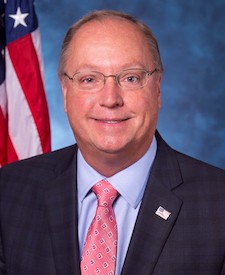
Rep. Jim Hagedorn
Sponsored bills
Support Peaceful Protest Act This bill imposes additional penalties upon an individual who is convicted of a federal offense related to conduct during the course of a protest (e.g., rioting). First, in addition to the penalty for the conviction, the individual must pay restitution to cover the cost of federal policing during the protest. Second, the individual is ineligible for pandemic unemployment assistance.
Protecting American Energy Jobs Act This bill limits the President's authority to prohibit or withdraw federal land or waters from energy production activities. Specifically, the bill requires the President and federal agencies to obtain the approval of Congress before prohibiting or substantially delaying certain new energy or mineral leases or permits on federal lands, including oil and gas leases, coal leases, hard rock leases, or critical minerals leases. In addition, the President and agencies must obtain the approval of Congress before withdrawing certain federal lands from mineral and geothermal leasing activities. Further, the bill repeals the President's authority to withdraw unleased lands on the outer Continental Shelf from oil and gas leasing. The bill nullifies Executive Order 13990 titled Protecting Public Health and the Environment and Restoring Science To Tackle the Climate Crisis; Executive Order 14008 titled Tackling the Climate Crisis at Home and Abroad; and the Department of the Interior's Secretarial Order 3395 concerning a temporary suspension of delegated authority to all of Interior's Bureaus and Offices, including the authority to approve leases.
Protecting American Energy Production Act This bill prohibits the President from declaring a moratorium on the use of hydraulic fracturing unless Congress authorizes the moratorium. The bill also expresses the sense of Congress that states should maintain primacy for the regulation of hydraulic fracturing for oil and natural gas production on state and private lands.
Concealed Carry Reciprocity Act This bill establishes a federal statutory framework to regulate the carry or possession of concealed firearms across state lines. Specifically, an individual who is eligible to carry a concealed firearm in one state may carry or possess a concealed handgun (other than a machine gun or destructive device) in another state that allows its residents to carry concealed firearms. It sets forth requirements for the lawful concealed carry across state lines. The bill preempts most state and local laws related to concealed carry and establishes a private right of action for a person adversely affected by interference with a concealed-carry right established by this bill.
This concurrent resolution expresses the sense of Congress that school administrators should safely reopen schools for in-person instruction as soon as possible.
PPP Flexibility for Farmers and Ranchers Act This bill expands eligibility for agricultural producers under the Paycheck Protection Program, established to support small businesses in response to COVID-19 (i.e., coronavirus disease 2019), to include certain agricultural producers organized as partnerships. Currently, only certain agricultural producers that are sole proprietorships, independent contractors, or self-employed individuals may receive support under the program.
Keystone XL Pipeline Construction and Jobs Preservation Act This bill authorizes the TransCanada Keystone Pipeline to construct, connect, operate, and maintain the pipeline facilities in Phillips County, Montana, for the import of oil from Canada to the United States.
Protecting Our Wealth of Energy Resources Act or the POWER Act This bill requires the President and federal agencies to obtain the approval of Congress before prohibiting or substantially delaying certain new energy or mineral leases or permits on federal lands, including oil and gas leases, coal leases, hard rock leases, or critical minerals leases. In addition, the President and agencies must obtain the approval of Congress before withdrawing certain federal lands from mineral and geothermal leasing activities.
Saving America's Mines Act This bill bars the President, the Department of the Interior, or the Department of Agriculture from declaring a moratorium on or reversing any existing lease, permit, or claim, for the mining and extraction of any critical mineral or common varieties of sand, stone, and gravel on National Forest System or Bureau of Land Management land unless specifically authorized by statute or upon the lessee, permittee, or claimant's failure to comply with any of the provisions of its agreement.