This act designates the facility of the United States Postal Service located at 100 3rd Avenue Northwest in Perham, Minnesota, as the Charles P. Nord Post Office.

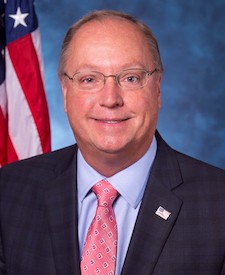
Rep. Jim Hagedorn
Sponsored bills
This act designates the facility of the United States Postal Service located at 317 Blattner Drive in Avon, Minnesota, as the W.O.C. Kort Miller Plantenberg Post Office.
This act designates the facility of the United States Postal Service located at 155 Main Avenue West in Winsted, Minnesota, as the James A. Rogers Jr. Post Office.
This act designates the facility of the United States Postal Service located at 123 East Main Street, in Vergas, Minnesota, as the Jon Glawe Post Office.
This act designates the facility of the United States Postal Service located at 10 Broadway Street West, in Akeley, Minnesota, as the Neal Kenneth Todd Post Office.
This resolution (1) supports the constitutional rights of parents to assemble and petition school boards, and (2) condemns the weaponization of federal law enforcement agencies against parents exercising their rights.
Illegal Immigrant Payoff Prohibition Act This bill prohibits the payment of a settlement to an alien for a civil action brought against the United States in connection with the alien's inadmissibility to, or unlawful presence in, the United States.
Safeguards Ensuring Criminal and Unvetted Refugees don't Enter America Act or the SECURE America Act This bill imposes restrictions on the admission of aliens, including refugees, and addresses related issues. Specifically, no refugees may be admitted until Congress enacts a joint resolution setting the maximum number of refugees allowed to be admitted in a particular fiscal year. Currently, that number is set each fiscal year by the President. The Department of Homeland Security (DHS) must notify Congress at least 30 days before determining that an alien or class of aliens is eligible for refugee status. Congress may nullify the determination by enacting a joint resolution of disapproval. Further, an alien shall be inadmissible for holding certain beliefs, such as (1) believing that a system of religious law should be implemented in the United States, (2) believing that the alien does not need to learn English if the alien is not already fluent, or (3) any belief that the Department of State determines is incompatible with the principles of the United States. DHS may not parole into the United States an alien who does not have status under immigration law. Currently, DHS may provide parole in certain instances, including for urgent humanitarian reasons. Federal agencies must notify a state at least 30 days before resettling a refugee in that state. The refugee may not be resettled in that state if the state expresses disapproval. An alien who has committed a crime of violence (generally one involving the use or threat of physical violence against person or property) may not be eligible for refugee status and must be removed.

Exposing Agricultural Trade Suppression Act This bill restricts state and local governments from imposing certain standards or conditions on the production or manufacture of agricultural products sold or offered for sale in interstate commerce. Specifically, it prohibits the imposition of such standards or conditions if (1) the production or manufacture occurs in another state, and (2) the standard or condition adds to requirements applicable under federal law and the laws of the state or locality where the product is produced or manufactured. The bill also allows for a private right of action to challenge state or local regulations relating to agricultural goods sold in interstate commerce. A person may bring an action in (1) the U.S. district court for the judicial district in which the person is affected by a regulation or the person resides, operates, or does business; or (2) any other appropriate court with jurisdiction.
Firearm Due Process Protection Act This bill expands the grounds for pursuing judicial remedies related to certain firearm transfers. Additionally, the bill establishes procedural rules applicable to actions for judicial remedies. Current law authorizes judicial remedies for an individual who is erroneously denied a firearm (e.g., an individual is denied a firearm but the individual is eligible to receive or possess a firearm). This bill authorizes remedies for an individual who experiences an extended delay (i.e., a delay of more than 60 days) on a firearm transfer. Additionally, the bill requires an expedited hearing on an action for judicial remedies and places the burden of proof on the respondent to show by clear and convincing evidence that the individual was ineligible to receive or possess a firearm.