

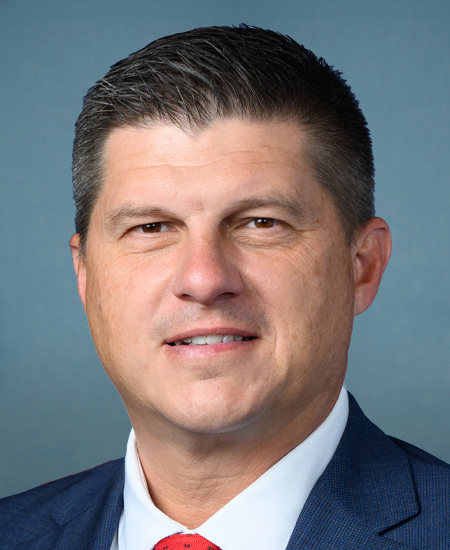
Photo of Brad Finstad
R United States House · District 1 · Minnesota On the 2026 ballot

Rep. Brad Finstad

Compare
Total votes
2,001
all sessions
Attendance
99%
17 missed
Higher than 78% of chamber peers
With party
96%
of cast votes
Higher than 83% of chamber peers
Bipartisan score
2%
crosses aisle rarely
Lower than 84% of chamber peers
Sponsored
815
bills & resolutions
Near the chamber average
Committees
11
assignments
815 bills and resolutions

Sponsored bills

Total
815
Primary
67
Co-sponsor
748
This page
815
matching current filters
Co-sponsor HR 2594
In committee · United States House · Co-sponsor
To establish a Water Risk and Resilience Organization to develop risk and resilience requirements for the water sector.

Maddy summaryHR 2594 establishes a Water Risk and Resilience Organization (WRRO), certified by the EPA Administrator, to develop and enforce cybersecurity standards for large water systems. It directly affects community water systems serving 3,300+ people or similar treatment works, requiring them to meet WRRO-developed cybersecurity risk and resilience requirements. The WRRO proposes these standards, which the EPA must approve within 90 days if deemed reasonable, and monitors compliance through annual self-attestations and 5-year third-party assessments. The bill creates a process for penalties (up to $25,000/day) for noncompliance, with appeals to the EPA, while ensuring state authority remains intact.

In committee Apr 2, 2025 1 co-sponsor
Co-sponsor HR 2570
In committee · United States House · Co-sponsor
Maximum Pressure Act

Maddy summaryThis bill codifies a "maximum pressure" policy toward Iran, requiring the U.S. to maintain all sanctions until Iran meets specific conditions related to its nuclear program, missile development, support for terrorism, and human rights violations. It expands sanctions on Iran's Revolutionary Guard Corps (IRGC) and entities supporting Iran's ballistic missile program, while prohibiting waivers of sanctions on these entities. The bill mandates regular reports to Congress on Iran's nuclear activities, support for terrorist groups like Hamas and Hezbollah, and human rights abuses within Iran. It also directs the use of frozen Iranian assets to support victims of state-sponsored terrorism and prevents the release of funds that could benefit Iran's terrorist proxies. The bill aims to maintain economic and diplomatic pressure on Iran until it changes its behavior across multiple fronts.

In committee Apr 1, 2025 1 co-sponsor
Co-sponsor HR 2581
In committee · United States House · Co-sponsor
Iranian Terror Prevention Act

Maddy summaryHR 2581, the Iranian Terror Prevention Act, requires the U.S. government to designate 29 specific Iranian-backed militant groups as terrorist organizations within 90 days of the bill’s passage. The President must then decide within 60 days whether to impose sanctions on these groups, blocking their U.S. assets and transactions under existing law. The bill also mandates regular reports to Congress on these designations and sanctions, including for any new groups meeting the criteria. This law directly affects the 29 named groups (such as the Badr Organization and Houthis) and any entities controlled by Iran’s Islamic Revolutionary Guard Corps.

In committee Apr 1, 2025 1 co-sponsor
Co-sponsor HR 2552
In committee · United States House · Co-sponsor
RIFLE Act

Maddy summaryHR 2552, the RIFLE Act, repeals the federal tax on firearm transfers (Section 5811 of the Internal Revenue Code). This directly affects firearm sellers and purchasers by removing the tax paid when transferring firearms. The bill also updates related tax code references to reflect the repeal and specifies the tax removal applies to transfers after the law's enactment. It clarifies that the repeal does not change how firearms are regulated under the National Firearms Act or involve the Consumer Product Safety Commission.

In committee Apr 1, 2025 1 co-sponsor
Co-sponsor HR 2558
In committee · United States House · Co-sponsor
SAFETY Act of 2025

Maddy summaryThe SAFETY Act of 2025 defines "common names" for agricultural products and food items (such as "Parmesan" for cheese, "Chardonnay" for wine, or "Bologna" for sausage) to protect U.S. producers' ability to use these terms in international markets. It requires the Agriculture Secretary and U.S. Trade Representative to negotiate agreements with other countries that secure the continued use of these common names on product labels and in exports. The bill provides specific examples of common names and establishes criteria for determining them, including customary market use and alignment with international standards like the Codex Alimentarius. This law directly affects U.S. agricultural exporters who rely on familiar product names to compete globally.

In committee Apr 1, 2025 1 co-sponsor
Co-sponsor HR 1048
Passed · United States House · Co-sponsor
DETERRENT Act

Maddy summaryThe DETERRENT Act requires higher education institutions receiving federal funding to disclose foreign gifts and contracts meeting certain value thresholds ($50,000 or more for regular foreign sources, all for "foreign countries of concern" or "foreign entities of concern"). Institutions must report details including the foreign source's identity, purpose, and financial value, with all disclosures made public through a searchable database. The bill prohibits contracts with designated "foreign countries of concern" or "foreign entities of concern" without a specific waiver, and includes enforcement mechanisms with fines for non-compliance. Institutions must also maintain policies requiring faculty and staff to disclose foreign connections that meet certain criteria.

Passed Mar 31, 2025 1 co-sponsor
Co-sponsor HR 1995
In committee · United States House · Co-sponsor
Securing American Agriculture Act

Maddy summaryHR 1995, the Securing American Agriculture Act, requires the Secretary of Agriculture to annually assess U.S. dependency on critical agricultural inputs that could be exploited by China, such as fertilizers, feed, veterinary drugs, seeds, and equipment. The assessment must detail current domestic production, supply chain vulnerabilities, and recommend ways to reduce reliance on China, including legislative changes to encourage domestic production. It protects confidential business data by prohibiting the use of submitted information for purposes beyond aggregate reporting and ensuring no identifiable details are disclosed. The bill directly affects the Department of Agriculture, which must report these findings to Congress annually, without mandating new regulations or actions.

In committee Mar 28, 2025 1 co-sponsor
Co-sponsor HR 1906
In committee · United States House · Co-sponsor
Rural Wellness Act

Maddy summaryHR 1906, the Rural Wellness Act, extends a deadline for rural development funding to 2029 and requires that 17% of funds prioritize projects offering behavioral and mental health services like prevention, treatment, and recovery. It directs grant administrators to give preference to rural community facilities providing these services and employing staff trained in mental health care. The law applies to programs under the Consolidated Farm and Rural Development Act and the Rural Development Act of 1972. This affects rural communities seeking health facility grants and changes how funding is allocated to address mental health needs.

In committee Mar 28, 2025 1 co-sponsor
Co-sponsor HR 1648
In committee · United States House · Co-sponsor
A–PLUS Act

Amplifying Processing of Livestock in the United States Act or the A–PLUS Act This bill directs the Department of Agriculture (USDA) to revise its regulations to allow certain packers to hold an ownership interest in, finance, or participate in the management or operation of a market agency selling livestock on a commission basis. The bill applies to packers that have a cumulative slaughter capacity of (1) less than 2,000 animals per day or 700,000 animals per year with respect to cattle or sheep, and (2) less than 10,000 animals per day or 3 million animals per year with respect to hogs. In addition, USDA must revise its regulations to include a disclosure requirement for a market agency that has an ownership interest in, finances, or participates in the management or operation of a packer. Specifically, the market agency must disclose the existence of such ownership interest, financial relationship, or participation.

In committee Mar 28, 2025 1 co-sponsor
Co-sponsor HR 1719
In committee · United States House · Co-sponsor
Farm to Fly Act of 2025

Maddy summaryThe Farm to Fly Act of 2025 amends agricultural programs to include sustainable aviation fuel (SAF) as a qualifying biofuel, directly affecting U.S. farmers, agricultural producers, and the aviation industry by creating new market opportunities. It defines SAF with specific requirements - meeting ASTM standards, not derived from palm oil or petroleum, and achieving at least a 50% lifecycle greenhouse gas emissions reduction compared to jet fuel. The bill mandates the Secretary of Agriculture to lead a new collaboration initiative focusing on advancing SAF development through partnerships with farmers, rural economic support, and public-private partnerships. Additionally, it expands existing manufacturing assistance programs to include SAF production, aiming to strengthen domestic energy security and grow markets for agricultural feedstocks.

In committee Mar 28, 2025 1 co-sponsor
Showing 231 to 240 of 815 bills
Previous 1 … 23 24 25 … 82 Next