

Countering Human Trafficking Act of 2022 This bill provides statutory authority for the Center for Countering Human Trafficking (CCHT) within the Department of Homeland Security (DHS). The CCHT coordinates DHS efforts to combat human trafficking and the importation of goods produced with forced labor. The bill requires the CCHT to develop a strategy to improve the systems and processes used throughout DHS to combat human trafficking and the importation of goods produced with forced labor. The bill transfers the functions and resources of the Blue Campaign (i.e., the national public awareness effort to combat human trafficking) to the CCHT. DHS may also transfer to the CCHT any other component, directorate, or office of the department related to combating human trafficking.
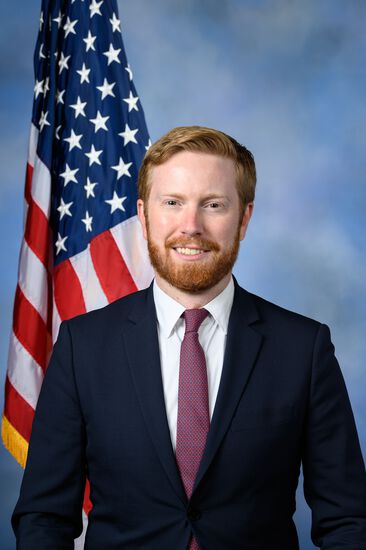
Rep. Peter Meijer
Sponsored bills
Never Yielding Europe's Territory (NYET) Act of 2022 This bill addresses Russia's actions against Ukraine and other countries in the region. The bill authorizes and expedites the provision of security assistance, including by (1) prioritizing delivering excess defense articles to Ukraine, (2) authorizing the Department of State to waive certain costs for defense articles leased to Ukraine, and (3) authorizing additional Foreign Military Financing for programs in Europe. The bill also provides funding for (1) Foreign Military Financing assistance to Ukraine, (2) the Global Engagement Center to counter foreign-sponsored propaganda and disinformation, (3) the Countering Russian Influence Fund to support Ukraine and other countries in response to Russia's aggression, and (4) International Military Education and Training assistance for Ukraine. Furthermore, the bill imposes sanctions, including on (1) senior Russian military officials responsible for planning or executing military operations that violated Ukraine's sovereignty or territorial integrity, and (2) foreign individuals or entities that acted on behalf of Russia's government to destabilize Ukraine or disrupt Ukraine's critical infrastructure. The bill also addresses additional matters, including (1) prohibiting the National Aeronautics and Space Administration from sponsoring visas for Russian nationals affiliated with ROSCOSMOS, the entity that implements Russia's space program; (2) authorizing Radio Free Europe/Radio Liberty to explore opening new bureaus to reach audiences on Russia's periphery; and (3) providing for expedited approval of natural gas exports to qualifying nations, including NATO members, whereas currently expedited approval is only available for exports to countries that are in a free trade agreement relating to natural gas with the United States.
Midland Over Moscow Act This bill imposes sanctions related to the Nord Stream 2 pipeline and revises the expedited approval process for natural gas imports and exports in or out of the United States. (Nord Stream 2 is a pipeline constructed to increase the export of natural gas from Russia to Europe.) Within 10 days of this bill's enactment, the President must impose sanctions on any entity responsible for the planning, construction, maintenance, financing, or operation of Nord Stream 2, as well as any corporate officer or principal shareholder with a controlling interest in such an entity. The bill also revokes the President's authority to waive certain sanctions related to Nord Stream 2 and TurkStream, another Russian natural gas pipeline project. The bill also allows any nation, with specified exclusions, to use an expedited process to receive approval to import or export natural gas in or out of the United States (currently only a nation with a free trade agreement with the United States may use the expedited process). Specifically, the bill excludes any nation (1) subject to U.S.-imposed sanctions or trade restrictions, or (2) excluded by the President or Congress for national security reasons.
Dignity for Immigrants while Guarding our Nation to Ignite and Deliver the American Dream Act or as the DIGNIDAD (Dignity) Act This bill addresses immigration-related issues, such as requiring the Department of Homeland Security (DHS) to resume construction of barriers along the U.S.-Mexico border and providing removal deferral for eligible non-U.S. nationals ( aliens under federal law). For example, the bill requires DHS to resume all barrier construction activities along the southern border that were underway or being planned prior to January 20, 2021; authorizes DHS to request National Guard support to secure the southern border; requires the hiring of additional U.S. Customs and Border Protection personnel; provides funding for border infrastructure and equipment; provides statutory authority for the Flores settlement, which established policies pertaining to the treatment of minors without lawful immigration status by DHS; requires employers to verify the immigration status of individuals using an electronic employment eligibility confirmation system modeled after the E-Verify system; provides a path to permanent resident status to eligible individuals without lawful immigration status who entered the United States as minors (commonly referred to as Dreamers); establishes the Dignity Program, which defers the removal of eligible individuals without lawful immigration status who meet various requirements, including paying into a fund to provide training to U.S. workers; establishes the Redemption Program, which provides a path to permanent resident status to individuals who complete the Dignity Program and meet various requirements, including making additional payments into the U.S. worker fund; and requires the Department of State to implement a strategy to address the key factors contributing to individuals from Central America traveling to the United States.
Federal Prisons Accountability Act of 2022 This bill modifies the appointment procedures and term of service for the Director of the Bureau of Prisons. Currently, the director is appointed by the Attorney General. This bill requires the director to be appointed by the President and confirmed by the Senate. The bill also limits the director to a single term of 10 years.
COPS on the Beat Grant Program Reauthorization and Parity Act of 2022 This bill reauthorizes through FY2031 and makes changes to the Community Oriented Policing Services grant program. Among the changes, the bill reduces the required matching contribution for certain rural communities during the first three years of a grant and eliminates the preference for agencies that exceed the matching requirements; allows grant funds to be used to increase wages of career law enforcement officers in states or localities that have a median household income of less than 70% of the national median household income and qualify for a reduced matching contribution; and provides statutory authority for the Office of Community Oriented Policing Services within the Department of Justice. Additionally, the bill requires the Government Accountability Office to report on whether law enforcement workforces are representative of the communities they serve, the percentage of law enforcement employees who live in the community they serve, the average pay of officers compared to the cost of living in the community they serve, and recommendations for improvements.
Guaranteeing Ukrainian Autonomy by Reinforcing its Defense (GUARD) Act of 2022 This bill provides support for Ukraine and imposes sanctions related to Nord Stream 2, the pipeline constructed to increase exports of natural gas from Russia. The Department of State must periodically report to Congress a determination as to whether Russia's government meets the criteria to be designated a state sponsor of terrorism. The bill authorizes the State Department to provide Foreign Military Financing assistance to Ukraine in FY2022. The bill also authorizes providing Ukraine with lethal assistance, such as anti-armor weapon systems and anti-aircraft weapons systems. From FY2022-FY2026, Ukraine shall have priority access to excess defense articles. During the same time period, the bill also authorizes providing Ukraine with assistance, including (1) International Military Education and Training assistance; (2) assistance to strengthen cybersecurity and intellectual property enforcement; (3) support and training for banking reform, subsidy reform, corporate governance, and the privatization of state-owned enterprises; and (4) assistance to combat corruption and improve the rule of law. Within 15 days of this bill's enactment, the President must impose sanctions on any entity responsible for planning, constructing, or operating Nord Stream 2, as well as any corporate officer of such an entity. The bill also subjects the President's authority to waive certain sanctions to congressional review. The U.S. Agency for Global Media may expand broadcasting in countries of the former Soviet Union to combat Russian disinformation. The bill requires reports to Congress on various topics, including a strategy on using U.S. diplomacy to support Ukraine.
Harnessing Opportunities by Pursuing Expungement Act of 2021 or the HOPE Act of 2021 This bill authorizes the Department of Justice (DOJ) to make grants to states and local governments to reduce the financial and administrative burden of expunging convictions for state cannabis offenses. The bill also requires DOJ to study and report on (1) the effects on an individual of a criminal record report of a conviction for a criminal offense related to cannabis, and (2) the costs incurred for incarcerating an individual for a criminal offense related to cannabis.
Closing the Warrantless Digital Car Search Loophole Act of 2021 This bill generally prohibits investigative and law enforcement officers from accessing vehicle data (onboard and telematics data in a noncommercial vehicle, such as navigation data and data captured by onboard sensors or cameras) unless pursuant to a warrant. Vehicle data acquired in violation of this bill is inadmissible as evidence in any trial, hearing, or other legal proceeding.
States Reform Act This bill removes marijuana from Schedule I of the Controlled Substance Act and provides for federal regulation of marijuana in a manner similar to alcohol. Among other provisions, the bill establishes a federal permitting process for marijuana businesses, provides for federal oversight of interstate medical marijuana products, and creates an excise tax structure for marijuana.