

Maddy summaryThis bill strengthens the Voting Rights Act of 1965 by clarifying how to prove voting discrimination and expanding requirements for preclearance of voting changes. It establishes new standards for determining when voting practices dilute minority voting strength or deny/abridge voting rights, requiring plaintiffs to show specific conditions for vote dilution claims and including factors like historical discrimination and racial polarization in court analyses. The bill modifies the criteria for determining which states and political subdivisions must seek preclearance for voting changes, and adds new transparency requirements for jurisdictions to publicly disclose changes to voting qualifications, polling locations, and election districts. It directly affects states and local governments that implement voting policies, particularly those with a history of voting rights violations or that make changes to voting qualifications, procedures, or district boundaries. The bill aims to prevent discriminatory voting practices by providing clearer standards for courts and requiring greater transparency in voting rule changes.
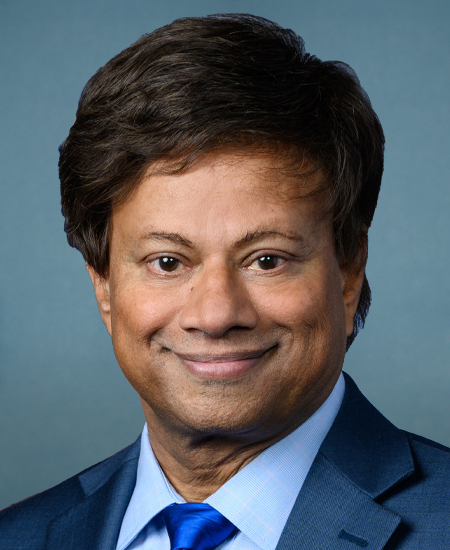
Rep. Shri Thanedar
Sponsored bills
Maddy summaryThe Richard L. Trumka Protecting the Right to Organize Act of 2025 strengthens workers' organizing rights by making it an unfair labor practice for employers to threaten permanent replacement of striking workers, discriminate against workers who support unions, or require employees to attend employer campaigns unrelated to their job duties. It expands the definition of "employee" to make it harder for companies to classify workers as independent contractors and requires employers to post notices about workers' rights in conspicuous locations. The bill establishes a new electronic voting system for union elections, creates a 90-day bargaining period before mediation can be requested, and increases penalties for violations of labor laws. These changes are intended to make it easier for workers to form unions and negotiate better wages and working conditions.
Maddy summaryHRES 188 is a resolution affirming the President's constitutional duty to comply with court orders, as established by landmark cases like *Marbury v. Madison* and *Youngstown Sheet & Tube Co. v. Sawyer*. It specifically calls on President Trump and his administration to adhere to recent court rulings blocking executive actions, such as those related to citizenship eligibility, federal funding freezes, and access to government payment systems. The resolution serves as a formal statement of the House's position on the separation of powers without creating new legal requirements or altering existing law.
Maddy summaryHR 1835 (MERIT Act) provides reinstatement or compensation to federal employees who were terminated during a specific mass layoff period (January 20, 2025, through the bill’s enactment date). Affected probationary employees - newly hired workers on a trial period or not yet permanent - can choose to return to a similar position with matching benefits or receive a lump-sum payment covering the pay difference between their terminated role and any new federal job they held during the layoff period. Agencies must notify affected employees within 30 days and offer reinstatement or payment within 90 days, with employees required to accept or decline within 30 days to avoid losing eligibility. The bill defines "mass termination" as 15+ separations in a 30-day period by a single agency.
Maddy summaryHJRES 67 designates August as Slavery Remembrance Month to commemorate the arrival of enslaved Africans in 1619 and honor freedom fighters who opposed slavery. The resolution condemns slavery and its lasting impacts - including convict leasing, Jim Crow laws, and systemic racism - while encouraging public remembrance through ceremonies. It requests the President issue a proclamation urging Americans to observe the month with appropriate activities. The resolution also posthumously recognizes 15 Black Congress members from the Reconstruction Era as honorary cosponsors. This is a symbolic commemorative resolution with no binding policy changes.
Maddy summaryHRES 181 is a symbolic resolution recognizing Black History Month by highlighting the historical and ongoing contributions of Black labor to the U.S. economy and society. It commemorates Black labor from slavery through modern times, including agricultural work, unionization efforts (like A. Philip Randolph’s Brotherhood of Sleeping Car Porters), and contemporary issues like the racial wage gap (where Black workers earned $878 weekly vs. $1,059 for others in 2023). The resolution does not create new laws or policies but formally acknowledges these contributions to raise public awareness. It is sponsored by 70+ House members and aligns with the 2025 Black History Month theme focused on "African Americans and Labor." As a commemorative resolution, it has no direct effect on individuals or legislation.
Maddy summaryThis bill directs the National Institutes of Health (NIH) to expand research on triple-negative breast cancer (TNBC), a highly aggressive form disproportionately affecting African-American and Hispanic women. It requires the Centers for Disease Control and Prevention (CDC) to create public education materials about TNBC incidence, treatment options, and racial disparities, and directs health agencies to provide updated TNBC information to healthcare providers. The legislation specifically targets gaps in understanding TNBC prevalence, treatment costs, and prevention methods among minority women. It authorizes funding for these research and education efforts from fiscal years 2026 through 2031.
Maddy summaryThis bill permanently removes the expiration date for employer payments toward employee student loans under tax-exempt educational assistance programs. It amends the tax code to eliminate the previous deadline of January 1, 2026, making the tax exclusion for such payments permanent. The change directly affects employers offering student loan repayment benefits as part of their compensation packages, allowing them to continue providing this tax-advantaged benefit without future expiration. The key provision simply extends an existing tax exclusion indefinitely, with no new requirements or funding changes.
Maddy summaryThe American Apprenticeship Act (HR 1783) provides federal grants to states to fund pre-apprenticeship programs that prepare individuals for registered apprenticeships in industries with low apprenticeship participation (less than 10% of available roles). States must apply with detailed plans for partnering with employers, aligning with existing workforce laws, and prioritizing underserved groups like minorities, veterans, and people with disabilities. Grants cover tuition, materials, and related instruction costs for these preparatory programs, with federal funding covering 20-50% of costs, and $15 million authorized annually for 2026-2031. The bill directly affects state workforce agencies, community organizations running pre-apprenticeship programs, and workers entering targeted sectors like healthcare and advanced manufacturing.
Safe Schools Improvement Act This bill requires states to direct their local educational agencies (LEAs) to establish policies that prevent and prohibit bullying and harassment of elementary and secondary school students. In particular, these policies must prohibit bullying and harassment based on race, color, national origin, disability, religion, or sex. Sex includes sexual orientation, gender identity, and sex characteristics (including intersex traits). Further, LEAs must provide (1) students, parents, and educational professionals with annual notice of the conduct prohibited in their disciplinary policies; (2) students and parents with grievance procedures that target such conduct; and (3) the public with annual data on the incidence and frequency of that conduct at the school and LEA level. The Department of Education must conduct and report on an independent biennial evaluation of programs and policies to combat bullying and harassment in elementary and secondary schools. The National Center for Education Statistics must collect state data to determine the incidence and frequency of the conduct prohibited by LEA disciplinary policies.