

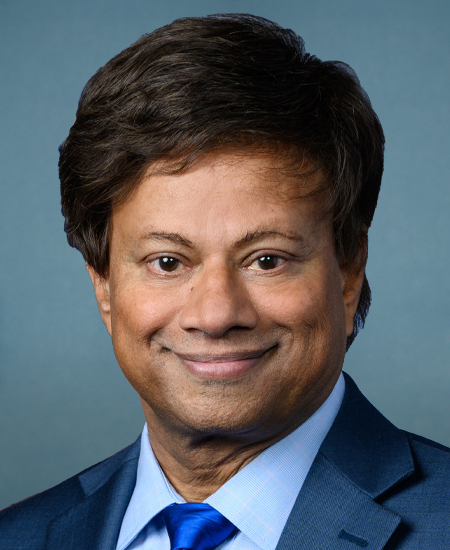
Photo of Shri Thanedar
D United States House · District 13 · Michigan

Rep. Shri Thanedar

Compare
Total votes
1,879
all sessions
Attendance
99%
12 missed
Near the chamber average
With party
97%
of cast votes
Near the chamber average
Bipartisan score
2%
crosses aisle rarely
Near the chamber average
Sponsored
1,693
bills & resolutions
Higher than 98% of chamber peers
Committees
4
assignments
1,693 bills and resolutions

Sponsored bills

Total
1,693
Primary
69
Co-sponsor
1,624
This page
1,693
matching current filters
Co-sponsor HR 1901
In committee · United States House · Co-sponsor
CHIPP Act

Maddy summaryHR 1901, the CHIPP Act, makes Children's Health Insurance Program (CHIP) funding permanent for all future fiscal years, removing previous expiration dates that required annual congressional renewal. This directly affects low-income children and families who rely on CHIP coverage and the states that administer these programs. The key mechanism is amending federal law to require "such sums as are necessary" for CHIP funding starting in fiscal year 2029 and beyond. Other provisions adjust funding for related programs like pediatric quality measures and outreach, but the primary change is CHIP’s permanent funding structure.

In committee Mar 6, 2025 1 co-sponsor
Co-sponsor HR 1903
In committee · United States House · Co-sponsor
Congressional Trade Authority Act of 2025

Congressional Trade Authority Act of 2025 This bill requires congressional approval for a presidential import adjustment due to a national security threat from an import and limits the adjustments to certain goods that are essential to national security. Specifically, the bill limits the President's authority for such import adjustments to goods related to the development, maintenance, or protection of military equipment, energy resources, or critical infrastructure essential to national security. The bill specifies that the term national security (1) means the protection of the United States from foreign aggression, and (2) does not otherwise include the protection of the general welfare of the United States. The bill requires the President to submit a proposal to Congress to adjust imports. Congress must then approve the proposal with a joint resolution before an import adjustment takes effect. Under current law, the President determines whether any adjustment of an import is necessary and must submit to Congress the reasons for any action taken or not taken. Currently, there is a congressional disapproval mechanism to override presidential actions related to petroleum imports. The bill also requires the Department of Defense (currently, the Department of Commerce) to investigate the effect of these imports on national security and submit a report before the President determines whether an adjustment to an import is necessary, establishes requirements for a process to grant requests to exclude certain goods from import adjustments, and  applies retroactively to any proposed action taken up to six years before the enactment of this bill.

In committee Mar 6, 2025 1 co-sponsor
Co-sponsor HR 1895
In committee · United States House · Co-sponsor
Delphi Retirees Pension Restoration Act

Maddy summaryThis bill restores pension benefits for retirees affected by the termination of specific Delphi pension plans. It requires the Pension Benefit Guaranty Corporation (PBGC) to recalculate monthly benefits to the "full vested plan benefit" (the amount retirees would have received without prior reductions) and pay lump-sum payments for past underpayments, including 6% annual interest. The law applies to retirees of six Delphi pension plans, including the Delphi Hourly-Rate Employees Pension Plan and Delphi Retirement Program for Salaried Employees, who are currently receiving benefits or eligible for future payments. Payments will be funded from existing PBGC resources without changing prior asset allocations.

In committee Mar 6, 2025 1 co-sponsor
Co-sponsor HR 1942
In committee · United States House · Co-sponsor
DELIVER Act of 2025

Maddy summaryHR 1942, the DELIVER Act of 2025, increases the IRS standard mileage reimbursement rate for delivering meals to vulnerable populations. It specifically raises the rate to 14 cents per mile for vehicles used to deliver meals directly to homebound elderly, disabled, frail, or at-risk individuals. This change applies to mileage expenses claimed under tax code sections 162 and 212, which cover business expenses. The bill directly affects meal delivery organizations and volunteers providing services to these at-risk groups. The amendment takes effect for miles driven after the bill's enactment date.

In committee Mar 6, 2025 1 co-sponsor
Co-sponsor HRES 194
In committee · United States House · Co-sponsor
Expressing support for the designation of March 6, 2025, as "Great Lakes Day".

Maddy summaryThis symbolic resolution (HRES 194) designates March 6, 2025, as "Great Lakes Day" to honor the Great Lakes region. It does not create new laws or funding but expresses non-binding support for the designation and recognizes the lakes' importance to the region's environment, economy (serving 40 million people, supporting $3.1 trillion in GDP), and cultural heritage. The resolution calls for continued preservation efforts through existing programs like the Great Lakes Restoration Initiative. It directly affects the eight Great Lakes-bordering states (MI, WI, MN, OH, IN, IL, PA, NY) and their residents.

In committee Mar 5, 2025 1 co-sponsor
Primary HR 1893
In committee · United States House · Lead sponsor
LIONs Act of 2025

Maddy summaryThe LIONs Act of 2025 increases the maximum loan amounts available through two key Small Business Administration (SBA) programs. It raises the cap for standard 7(a) loans from $3.75 million to $7.5 million (with a $10 million ceiling), and doubles the maximum for development company loans from $5 million to $10 million. This bill directly affects small businesses seeking SBA financing for operations, expansion, or equipment, allowing them to access larger loans. The changes simplify access to capital by removing previous funding limits for qualifying businesses.

In committee Mar 5, 2025 0 co-sponsors
Co-sponsor HR 1855
In committee · United States House · Co-sponsor
National Amusement Park Ride Safety Act

Maddy summaryHR 1855, the National Amusement Park Ride Safety Act, clarifies that permanently fixed amusement rides (like stationary roller coasters) are excluded from the definition of "amusement ride" under the Consumer Product Safety Act. This amendment shifts regulatory focus to portable rides (like carnival equipment) by directing $5 million annually for non-permanently fixed rides and $6.5 million for permanently fixed rides to the Consumer Product Safety Commission. The bill directly affects amusement parks with portable rides and the CPSC’s enforcement scope, without creating new safety standards. It specifically revises existing definitions and funding allocations under the Consumer Product Safety Act.

In committee Mar 5, 2025 1 co-sponsor
Co-sponsor HR 1888
In committee · United States House · Co-sponsor
Nuclear Weapons Abolition and Conversion Act of 2025

Maddy summaryThis bill would redirect U.S. nuclear weapons funding to clean energy and social programs, but only after the President certifies all nuclear-armed nations have begun verifiable global elimination under the Treaty on the Prohibition of Nuclear Weapons. It requires converting nuclear weapons industry facilities and retraining workers for clean energy development. Funds would support climate initiatives, healthcare, housing, education, and environmental restoration. The bill's implementation is contingent on international progress toward nuclear disarmament, as it does not mandate immediate action.

In committee Mar 5, 2025 1 co-sponsor
Co-sponsor HR 1877
In committee · United States House · Co-sponsor
Protecting Americans’ Social Security Data Act

Protecting Americans’ Social Security Data Act This bill prohibits political appointees and special government employees from accessing Social Security data systems that contain personally identifiable information about Social Security beneficiaries. Specifically, political appointees and special government employees may not access systems maintained by the Social Security Administration (SSA) that issue or record Social Security account numbers, that are used to determine eligibility for or to pay Social Security benefits, or that otherwise contain personally identifiable information about individuals receiving or applying for benefits.  The bill also establishes a civil right of action for an individual whose information was negligently accessed or disclosed in violation of these provisions. The individual may bring suit against the United States if the violator was a U.S. employee or officer, or against the violator if they were not a U.S. employee or officer. Such a claim must be brought within two years of the affected individual’s discovery of the violation. Upon a finding of liability, defendants are liable for specified monetary damages.  If an individual is criminally charged or subject to proposed disciplinary or adverse action by a federal or state agency for having accessed or disclosed information in violation of these provisions, SSA must notify the individual whose information was accessed or disclosed of the violation as soon as practicable.  Finally, the bill requires the SSA Office of the Inspector General to investigate and report to Congress on any unauthorized access to or disclosure of information in a beneficiary data system.

In committee Mar 5, 2025 1 co-sponsor
Co-sponsor HR 1876
In committee · United States House · Co-sponsor
Keeping Our Field Offices Open Act

Maddy summaryHR 1876, the "Keeping Our Field Offices Open Act," prevents the Social Security Administration (SSA) from closing, consolidating, or restricting access to its field offices, hearing offices, or resident stations for 180 days after enactment, with exceptions for emergencies. The bill requires the SSA Commissioner to submit a detailed report to Congress by January 2029, analyzing closure criteria, transportation burdens for elderly/disabled users, cost-benefit impacts, and plans to replace lost services. For future closures, it mandates 120 days of public notice, two public hearings, and a final report to Congress, while ensuring total office numbers don’t fall below 2025 levels. This directly affects SSA field offices, their users (including elderly and disabled individuals), and employees. The bill’s key mechanism is a procedural safeguard to ensure transparency and minimize disruption before any office changes take effect.

In committee Mar 5, 2025 1 co-sponsor
Showing 911 to 920 of 1,693 bills
Previous 1 … 91 92 93 … 170 Next