

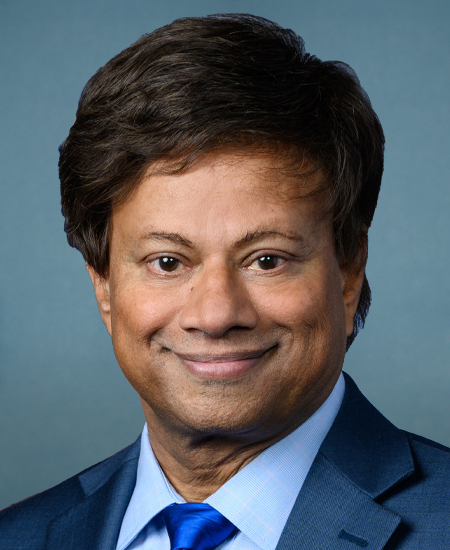
Photo of Shri Thanedar
D United States House · District 13 · Michigan

Rep. Shri Thanedar

Compare
Total votes
1,879
all sessions
Attendance
99%
12 missed
Near the chamber average
With party
97%
of cast votes
Near the chamber average
Bipartisan score
2%
crosses aisle rarely
Near the chamber average
Sponsored
1,693
bills & resolutions
Higher than 98% of chamber peers
Committees
4
assignments
1,693 bills and resolutions

Sponsored bills

Total
1,693
Primary
69
Co-sponsor
1,624
This page
1,693
matching current filters
Co-sponsor HR 2679
In committee · United States House · Co-sponsor
Cool Roof Rebate Act of 2025

Maddy summaryHR 2679, the Cool Roof Rebate Act of 2025, creates a federal program providing rebates to low-income households for installing highly reflective roofing products that reduce home cooling costs. Eligible households must have incomes below 200% of their ZIP code’s median income and reside in areas ranked in the top 25% for heat vulnerability by the CDC. Rebates range from $0.25 to $0.75 per square foot, depending on roof type (low-sloped or steep-sloped) and the product’s ability to reflect sunlight and emit heat, as measured by standardized testing. The program runs from 2026 through 2030 with $25 million annually allocated for rebates, requiring participants to report on roof types and products used.

In committee Apr 7, 2025 1 co-sponsor
Co-sponsor HR 2680
In committee · United States House · Co-sponsor
Expanding Access to School Meals Act of 2025

Maddy summaryHR 2680, the Expanding Access to School Meals Act of 2025, ends reduced-price breakfast and lunch programs under federal law and expands free meal eligibility. It raises the income threshold for free lunch eligibility from 130% to 224% of the federal poverty level (Sec. 201) and allows schools to directly certify children receiving Medicaid benefits as eligible for free meals without additional applications (Sec. 202). The bill also permits schools to request retroactive reimbursement for meals served to eligible children starting the first day of the school year (Sec. 203) and increases the community eligibility program multiplier to 2.5 for schools serving high-poverty areas (Sec. 204). These changes directly affect public school students from low-income families and school districts receiving federal meal reimbursement funds.

In committee Apr 7, 2025 1 co-sponsor
Co-sponsor HR 2682
In committee · United States House · Co-sponsor
STOP Bullying Act

Maddy summaryHR 2682, the STOP Bullying Act, requires each state to establish a state anti-bullying task force using federal grants. The task force must study bullying in K-12 schools, including policies, education efforts, and bullying-related violence or self-harm, and include specific members like teachers, students, parents, psychologists, and LGBTQ+ advocates. States must submit a public report with findings, recommendations for legislation or actions, and best practices for addressing bullying within one year. This bill directly affects all public K-12 schools and students across the country, particularly focusing on reducing bullying against marginalized groups like LGBTQ+ students, Jewish students, and students with disabilities. The law creates a structured process for states to develop evidence-based anti-bullying strategies but does not provide direct funding for school programs.

In committee Apr 7, 2025 1 co-sponsor
Co-sponsor HR 2668
In committee · United States House · Co-sponsor
DART Act of 2025

Maddy summaryHR 2668, the DART Act of 2025, expands federal funding under the Edward Byrne Memorial Justice Assistance Grant (JAG) program to support state and local diversion and rehabilitation programs instead of incarceration. It allows JAG funds to cover pre-arrest diversion, specialty courts, and post-release rehabilitation services, directly affecting local justice systems and individuals facing the criminal justice system. The bill creates a National Diversion and Rehabilitation Clearinghouse to share evidence-based practices, provide technical assistance, and promote trauma-informed approaches. These changes aim to reduce recidivism by addressing root causes like addiction and mental health, shifting focus from incarceration to treatment and community-based solutions.

In committee Apr 7, 2025 1 co-sponsor
Co-sponsor HR 2671
In committee · United States House · Co-sponsor
Tax Fairness for Workers Act

Maddy summaryThe Tax Fairness for Workers Act (HR 2671) would allow certain employees to deduct work-related expenses directly from their gross income. Specifically, it creates an above-the-line deduction for union dues (amending IRC Section 62(a)(1)) and reinstates a deduction for other out-of-pocket work costs like uniforms or tools (amending IRC Section 67(g)), effective for 2025 tax years. This directly affects union members and workers with significant job-related expenses who previously could not deduct these costs. The bill removes the prior limitation that barred these deductions, making them available without needing to itemize. The policy change simplifies tax filing for affected workers by treating these expenses as deductible business costs.

In committee Apr 7, 2025 1 co-sponsor
Co-sponsor HR 2253
In committee · United States House · Co-sponsor
Puppy Protection Act of 2025

Maddy summaryThis bill, HR 2253 (Puppy Protection Act of 2025), sets new federal standards for commercial dog dealers who sell puppies to the public. It requires specific housing sizes based on dog size (e.g., 12-30 square feet per dog), daily exercise in safe outdoor areas, clean water and nutritious food twice daily, and annual veterinary exams including dental checks. The bill also limits breeding frequency (max 2 litters in 25 months), sets age minimums for breeding (18 months for small dogs, 2 years for large dogs), and mandates health screenings to prevent genetic diseases. These requirements apply directly to commercial dealers, with final regulations to be issued within 18 months of enactment.

In committee Apr 4, 2025 1 co-sponsor
Co-sponsor HR 2195
In committee · United States House · Co-sponsor
Feed Hungry Veterans Act of 2025

Maddy summaryHR 2195, the Feed Hungry Veterans Act of 2025, would expand eligibility for food assistance under the Supplemental Nutrition Assistance Program (SNAP) to more veterans. It adds four new qualifying categories to the existing rules: veterans with a "catastrophically disabled" determination under military disability law, veterans under 65 receiving a pension, and veterans meeting specific combined disability rating thresholds. The bill amends the Food and Nutrition Act to include these new groups in SNAP eligibility, directly affecting veterans who currently may not qualify under existing disability rating criteria. The changes would take effect on October 1, 2030.

In committee Apr 4, 2025 1 co-sponsor
Co-sponsor HR 2117
In committee · United States House · Co-sponsor
Crop Insurance for Future Farmers Act

Maddy summaryHR 2117, the "Crop Insurance for Future Farmers Act," extends enhanced crop insurance support to beginning farmers and veteran farmers. It increases the definition of "beginning farmer" from 5 to 10 crop years and updates veteran farmer definitions similarly. The bill adds tiered premium reductions: for the first two years of participation, insurance costs are reduced by 15 percentage points each year, decreasing to 10 percentage points for years five through ten. This directly affects new and veteran farmers by lowering their insurance costs during early years of operation.

In committee Apr 4, 2025 1 co-sponsor
Co-sponsor HR 2102
In committee · United States House · Co-sponsor
Major Richard Star Act

Maddy summaryThis bill, HR 2102 (Major Richard Star Act), allows veterans with combat-related disabilities to receive both full military retired pay and veterans' disability compensation simultaneously, without the previous offset that reduced retired pay. It directly affects veterans already eligible for both benefits due to combat-related injuries, removing the requirement that their retired pay be reduced by the disability compensation amount. The key provision amends Title 10 and Title 38 to eliminate the offset rule (sections 5304 and 5305 of Title 38) for these veterans. The change applies to payments starting after the bill’s enactment date, effective for all qualifying veterans. This is a policy change to increase financial support for affected veterans, not a new benefit.

In committee Apr 4, 2025 1 co-sponsor
Co-sponsor HRES 292
In committee · United States House · Co-sponsor
Supporting the goals and ideals of "Financial Literacy Month".

Maddy summaryHRES 292 is a non-binding House resolution supporting "Financial Literacy Month" to raise awareness about personal finance education. It references statistics showing widespread financial literacy gaps, including 14.2% of U.S. households being unbanked or underbanked, only 42% of adults budgeting, and just 28 states requiring high school economics courses. The resolution calls on federal, state, local, school, nonprofit, and business entities to observe Financial Literacy Month with programs and activities. It does not create new laws or policies but aims to highlight the importance of financial education for managing money, credit, and debt.

In committee Apr 3, 2025 1 co-sponsor
Showing 831 to 840 of 1,693 bills
Previous 1 … 83 84 85 … 170 Next