

Maddy summaryThe Raise the Wage Act of 2025 gradually increases the federal minimum wage from $9.50 to $17.00 per hour over six years, with annual adjustments based on median wage growth. It raises the base wage for tipped workers from $6.00 to $17.00 per hour, phasing out their separate minimum wage structure by 2029. The bill also eliminates special minimum wage certificates for disabled workers after 2029, requiring employers to pay the standard minimum wage. These changes apply to most covered workers, including tipped employees and those under 20, with specific transition timelines for each group.
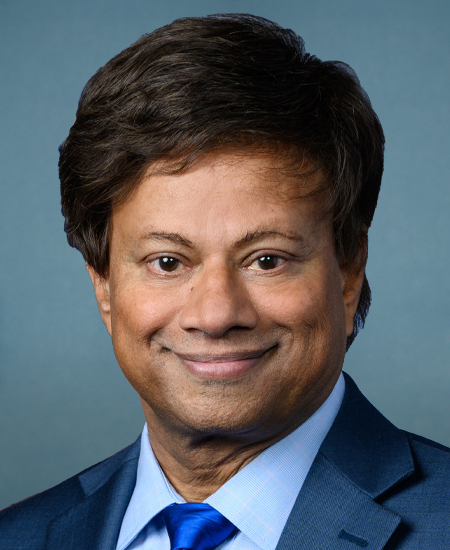
Rep. Shri Thanedar
Sponsored bills
Maddy summaryThe Ending PUSHOUT Act of 2025 aims to address discriminatory school discipline practices that disproportionately push students of color, particularly Black, Brown, and Indigenous girls, out of school. It requires schools to collect and report detailed demographic data on discipline practices, including race, gender identity, disability status, and other factors. The bill provides grants to schools to implement trauma-informed alternatives to exclusionary discipline like suspensions and expulsions, while prohibiting certain practices such as out-of-school suspension for young students for minor offenses like grooming policy violations. It also establishes a joint task force with student, parent, and expert representation to study and recommend solutions to end school pushout of girls of color.
Maddy summaryThis bill prohibits federal funding for school police officers and establishes a $5 billion grant program to help schools replace law enforcement with mental health professionals like counselors, social workers, and psychologists. It requires schools to eliminate police contracts before receiving funds and mandates that grant money be used for trauma-informed services, restorative justice programs, and evidence-based mental health support instead of punitive discipline. The bill directly affects schools with police presence but insufficient mental health staff, particularly those serving Black, Latino, Native American, and other marginalized students who face racial disparities in school discipline. It aims to reduce the school-to-prison pipeline by shifting resources from law enforcement to supportive services that address students' needs. The legislation includes reporting requirements for schools to track disciplinary practices and demographic data to monitor progress in reducing disparities.
Maddy summaryThis bill establishes federal minimum standards for collective bargaining rights for public employees and supervisors. The Federal Labor Relations Authority would determine if state laws provide these rights, and if not, would establish them for affected employees. The bill guarantees public employees the right to form unions, bargain collectively, and engage in concerted activities, while requiring public employers to recognize unions and put agreements in writing. It also prohibits strikes or lockouts that would disrupt emergency services. This would apply to public employees in states that don't meet the federal standards for collective bargaining rights.
Maddy summaryThe Affordable Housing Credit Improvement Act of 2025 would reform the Low-Income Housing Credit program, which provides tax credits to developers of affordable housing. It would increase state allocations based on population with annual cost-of-living adjustments, modify tenant eligibility rules to allow higher income limits for some residents, and add protections for domestic violence victims in housing. The bill would simplify rules for rural and Native American housing projects, clarify credit eligibility requirements, and require greater transparency in program administration. These changes would directly affect developers, property owners, and low-income tenants in housing projects that receive LIHC tax credits.
Maddy summaryHR 2729, the "Carnivals are Real Entertainment Act," creates a new temporary work visa category for carnival and circus workers. It directly affects mobile entertainment providers (like traveling carnivals, circuses, and affiliated food/game concession services) and their workers who perform essential tasks such as transporting, assembling, operating, and maintaining rides and equipment at seasonal fairs and festivals. The bill amends immigration law to define "mobile entertainment workers" as those entering temporarily for functions integral to these operations, subject to labor program requirements similar to other temporary work visas. It requires the Departments of Homeland Security and Labor to issue implementing rules within one year of enactment.
Maddy summaryHRES 297 is a non-binding resolution expressing the House of Representatives' support for fair compensation, benefits, and working conditions for paraprofessionals (like instructional assistants) and education support staff (including bus drivers, cafeteria workers, and clerical staff) in schools. It specifically calls for livable wages, job security, access to affordable health care, paid leave, and meaningful input in school policies for these workers. As a resolution, it does not create new laws or mandate changes but serves as a symbolic statement highlighting these workers' needs. The resolution directly addresses the concerns of over 3 million school support staff facing issues like underpayment, lack of benefits, and job instability.
Maddy summaryHRES 298 is a non-binding House resolution expressing support for designating April 7, 2025, as "World Health Day" in alignment with the World Health Organization's (WHO) established observance. It recognizes the importance of prioritizing public health nationally and globally, highlighting concerns like declining life expectancy, maternal and infant mortality, and healthcare access disparities affecting children, seniors, and marginalized communities. The resolution does not create new laws or allocate funds but acknowledges the need for equitable healthcare access and interagency collaboration. It formally supports the WHO's theme "Healthy Beginnings, Hopeful Futures" for its 2025 campaign on maternal and newborn health.
Maddy summaryHR 2698, the Bolstering Security Against Ghost Guns Act, mandates federal agencies to develop coordinated strategies addressing threats from "ghost guns" (privately made firearms). It requires the Department of Homeland Security to create a department-wide strategy within one year, including cross-agency collaboration and partner coordination. The bill also directs the Transportation Security Administration to report annually on ghost gun violations at checkpoints, U.S. Immigration and Customs Enforcement to analyze cross-border firearm smuggling patterns, and the Office of Intelligence and Analysis to produce threat assessments on terrorism-linked ghost gun use. These provisions apply directly to DHS components, the Secret Service, TSA, and ICE, focusing on data sharing, threat reporting, and prevention efforts without imposing new restrictions on firearm ownership.
Maddy summaryThe No Tax Breaks for Union Busting Act would deny tax deductions for employers who spend money to influence employees' decisions about union activities, such as union elections or collective bargaining. It defines "labor organization activities" broadly to include union elections, labor disputes, and collective actions. The bill requires employers to report such spending on tax returns and prevents them from deducting these expenses from taxable income. This would apply to employers using tactics like captive audience meetings, outside consultants, or other efforts to sway workers' union decisions. The policy aims to remove tax incentives for employers to interfere with workers' rights under labor law.