

Maddy summaryThis bill amends the WIC program to replace "drug abuse" with "substance use disorder" throughout its provisions, directly affecting WIC participants who may have substance use disorder. Key mechanisms include creating new nutrition education materials for pregnant individuals with substance use disorder and infants affected by prenatal exposure, establishing an online clearinghouse for these resources, and authorizing $1 million for fiscal year 2026. The changes aim to provide evidence-based, non-judgmental support through updated program materials and outreach. The bill specifically targets WIC participants impacted by substance use disorder, not broader population changes.
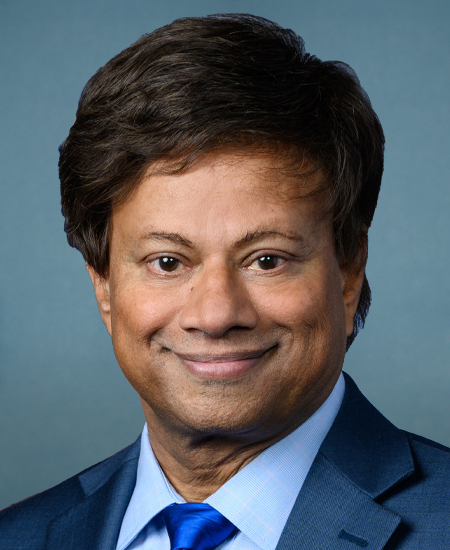
Rep. Shri Thanedar
Sponsored bills
Maddy summaryThis bill reinstates the federal government's authority to provide Direct Stafford Loans to graduate and professional students, preventing them from losing access to these loans after 2012. It temporarily extends this loan program through June 30, 2025, by modifying the Higher Education Act to remove a prior termination clause. The key provision allows graduate students to continue borrowing for education costs during this temporary period. This directly affects graduate and professional students who rely on these loans to cover tuition and expenses.
Maddy summaryHR 787, the Plain Language in Contracting Act, requires federal agencies to write contracting notices for small businesses in clear, concise language that follows existing federal plain language guidelines. It mandates that these notices include key words to help small businesses easily identify and understand opportunities on the government's single point of entry for contracts (as defined in 41 U.S.C. § 1708). The Small Business Administration must issue implementing rules within 90 days of the bill's enactment. This law directly affects small businesses seeking government contracts and federal agencies publishing contracting notices, aiming to make the process more accessible.
Maddy summaryThis resolution (HRES 457) is a symbolic measure expressing congressional support for designating June 6, 2025, as "National Gun Violence Awareness Day" and June 2025 as "National Gun Violence Awareness Month." It does not create new laws or policies but encourages public awareness through specific actions: wearing orange on June 6, focusing on gun safety during summer months, and holding community discussions. The resolution references statistics on gun violence deaths and honors Hadiya Pendleton, a teen victim killed in 2013. It directly affects the public by calling for voluntary observance and community engagement, not government mandates.
Maddy summaryHR 3694, the VALID Act of 2025, requires lenders to include specific information about VA loans in mortgage disclosures. It amends the National Housing Act to mandate that disclosures state the loan-to-value ratio and clarify that VA loans are available under Chapter 37 of Title 38 (veterans' benefits law), assuming prevailing interest rates. The bill also requires the Federal Housing Finance Agency to add a military service question to the Uniform Residential Loan Application form, placing it above the signature line within six months of enactment. This directly affects veterans and active-duty service members applying for VA-guaranteed mortgages, as well as the lenders processing those applications.
Maddy summaryThis bill updates federal housing law to explicitly prohibit discrimination based on sexual orientation and gender identity. It amends the Fair Housing Act to include these characteristics as protected classes alongside race, color, religion, sex, and other existing categories. The law now covers discrimination against individuals due to their own sexual orientation or gender identity, or because of their association with someone who has these characteristics. This applies to all housing providers, including landlords, real estate agents, and mortgage lenders, making it illegal to deny housing or services based on these factors.
Maddy summaryThe JUST Act of 2025 strengthens civil rights enforcement at the U.S. Department of Agriculture (USDA) by requiring corrective actions for employees who engage in discrimination, retaliation, or harassment - such as failing to provide required application receipts or delaying program services. It establishes a new Assistant Secretary for Civil Rights to oversee compliance, creates an independent Civil Rights Ombudsman office to help program participants navigate complaints, and grants the Assistant Secretary authority to directly grant equitable relief (like restoring loan eligibility) without prior approval from other USDA officials. The bill also shifts the burden of proof in appeals to require USDA to justify its decisions with strong evidence, ensuring fairer outcomes for applicants and participants in USDA programs.
Maddy summaryThe FBI Animal Cruelty Taskforce Act of 2025 establishes a dedicated FBI unit to investigate federal animal cruelty crimes, specifically targeting dogfighting, cockfighting, and "crush videos." This taskforce will create training materials for local law enforcement to help them detect and investigate these offenses. It also requires the taskforce to coordinate with agencies like the Department of Agriculture and U.S. Customs, and to submit annual reports to Congress detailing filed charges, convictions, and unresolved investigations. The bill directly affects local police departments through new training resources and federal agencies through mandated coordination and reporting.
Maddy summaryHR 3623, the Horse Transportation Safety Act of 2025, prohibits transporting horses between states in motor vehicles with two or more stacked levels. This directly affects horse transporters, including owners and carriers moving horses across state lines. The bill defines "motor vehicle" to exclude rail vehicles but requires compliance with the multi-level ban, imposing civil penalties of $100-$500 per horse transported in violation. Violations are enforced through separate penalties for each horse transported illegally, in addition to other applicable laws.
Maddy summaryHR 3661, the Extreme Weather and Heat Response Modernization Act, requires FEMA to review and update how it defines "incident periods" (timeframes for disaster response) for extreme weather events. Within one year, FEMA must form an advisory panel with diverse emergency management representatives to assess current procedures, particularly for slow-onset, compound, or cascading disasters, and submit findings to Congress. The bill also mandates FEMA to issue new guidance on community cooling centers, resilience centers, and extreme heat/cold mitigation projects within a year, and conduct a study on impacts to vulnerable communities, infrastructure, and emergency alerts. These changes directly affect FEMA, state/local emergency managers, and communities facing extreme heat or cold events by modernizing response protocols and funding eligibility.