

Maddy summaryHR 4627 amends the Foreign Assistance Act of 1961 to update U.S. foreign aid programs combating HIV/AIDS. It specifically adds funding for HIV pre-exposure prophylaxis (PrEP) medications as a covered activity and designates all HIV prevention efforts - including those targeting at-risk populations identified by the World Health Organization - as "core life-saving humanitarian assistance." This change ensures such prevention activities receive priority funding under U.S. foreign aid programs. The bill directly affects how U.S. government agencies allocate resources for global HIV/AIDS prevention initiatives.
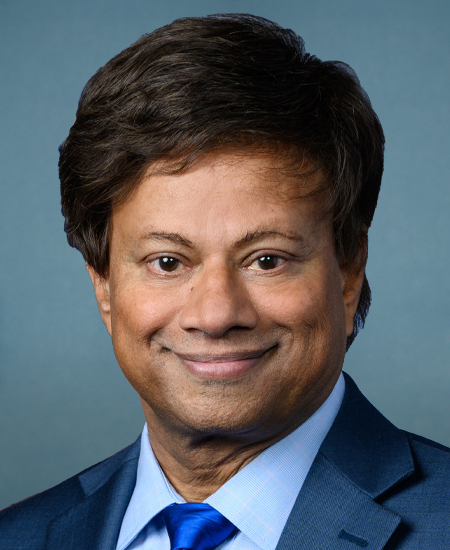
Rep. Shri Thanedar
Sponsored bills
Maddy summaryThis bill amends the National Labor Relations Act to recognize college athletes as employees eligible for collective bargaining rights. It directly affects athletes receiving athletic scholarships (grant-in-aid) who perform services for their institution, including those at public and private universities. Key provisions establish that athletes meeting specific criteria (receiving compensation for athletic participation) are employees, allow multiemployer bargaining units across athletic conferences, and prohibit waivers of these rights in scholarship agreements. The bill explicitly states it will not change tax treatment of athletic compensation or affect eligibility for federal financial aid.
Maddy summaryHR 4717 creates a refundable tax credit of up to 10% of a home's purchase price (capped at $15,000) for first-time homebuyers purchasing a principal residence in the United States. The credit is subject to limitations based on modified adjusted gross income (phased out if income exceeds 150% of the area median income) and home price relative to area median purchase prices in the buyer's location. Homebuyers must meet age requirements (at least 18 years old), not have owned a home in the past three years, and purchase with a federally backed mortgage. The credit is subject to a four-year recapture period if the home is sold within that timeframe, and taxpayers may transfer the credit to their mortgage lender as a down payment or closing cost assistance.
Maddy summaryHR 4685, the ICBM Act, pauses the $141 billion Sentinel intercontinental ballistic missile program and extends the Minuteman III missile system's operational life until 2050. It redirects all remaining funds for the Sentinel program and its associated W87-1 warhead modification to the Department of Education for K-12 programs under the Elementary and Secondary Education Act. The bill also requires an independent National Academy of Sciences study to compare costs and technical feasibility of extending Minuteman III versus proceeding with Sentinel. This legislation directly affects U.S. defense spending priorities and redirects billions in taxpayer funds from nuclear modernization to education.
Maddy summaryThis bill requires a 3-business-day waiting period before someone can receive a handgun from another person who isn't a licensed gun seller. It applies to most private handgun transfers but includes exceptions for law enforcement, family loans (like between spouses or parents and children), temporary transfers to prevent imminent harm, and transfers for shooting or hunting under specific conditions. The waiting period begins when the recipient first offers to take possession of the gun. The law would take effect 90 days after enactment.
Maddy summaryThis bill increases federal Medicaid funding for states that expand spending on behavioral health services (mental health and substance use treatment). It creates a new 90% federal reimbursement rate for the *increase* in quarterly state spending on these services compared to the 2019 baseline, provided states use the funds to supplement existing state funding and improve service delivery (e.g., raising provider payment rates). States must report annually to Congress on payment rates, rationale, and service utilization for these programs. The policy directly affects all 50 states administering Medicaid and the providers delivering behavioral health services within those programs. The changes take effect January 1, 2025, following enactment.
Maddy summaryThis bill requires the Department of Homeland Security (DHS) to create a system tracking all detentions or removals of U.S. citizens and lawful permanent residents (LPRs) during immigration enforcement. DHS must report these cases quarterly to Congress, including instances where minors were removed alongside undocumented parents. The system must also include cases involving citizens or LPRs detained by other agencies and transferred to DHS. A separate process for individuals to prove citizenship or LPR status during detention must be established within 180 days.
Maddy summaryThis bill adds "spotted lanternfly control" as a priority research area under federal agricultural funding, authorizing grants to develop and share tools for combating the invasive spotted lanternfly pest (Lycorma delicatula). It directly affects farmers, agricultural communities, and state departments of agriculture in states like Pennsylvania where the pest causes significant crop damage. The key provision amends existing law to allow research grants focused on creating effective treatments and management strategies for the pest. The bill also extends the funding period for all high-priority research initiatives through 2030.
Maddy summaryThe RAP Act of 2025 amends federal evidence rules to generally prohibit the use of a defendant's creative or artistic expression (such as music, poetry, or visual art) as evidence in criminal or civil trials. It directly affects defendants whose artistic works might otherwise be presented against them, making such evidence inadmissible unless the government proves specific conditions by "clear and convincing evidence." These conditions require showing the expression was intended literally, directly relates to the specific facts of the case, is uniquely relevant, and has distinct probative value not available through other admissible evidence. If admitted under the exception, courts must redact the evidence and provide special jury instructions. The law aims to protect artistic expression from being misused in legal proceedings.
Maddy summaryHR 4710, the No Surprises Act Enforcement Act, increases penalties for health insurance plans and issuers that violate balance billing protections, which prevent surprise medical bills. The bill raises fines from $100 to $10,000 per violation for specific balance billing rule violations and adds a new penalty of three times the difference between initial payment and out-of-network rates for late payments after Independent Dispute Resolution decisions. It requires health plans and nonparticipating providers to make timely payments within 30 days of a payment determination, with interest accruing on late payments. The bill also establishes new transparency reporting requirements for the Secretary to submit regular reports to Congress about audits, enforcement actions, and penalties. These provisions directly affect health insurance issuers, group health plans, and nonparticipating healthcare providers.