

Maddy summaryThe Ethics in Energy Act of 2025 prohibits large electric and natural gas utilities from charging customers (ratepayers) for expenses related to political influence activities. It directly affects major covered utilities - defined as electric companies with high annual sales volumes or major natural gas companies - and their customers. Key provisions require these utilities to publicly report all political-related expenses (including lobbying, PR campaigns, or trade association dues) and prevent them from recovering such costs through customer bills. The Federal Energy Regulatory Commission must create rules within 18 months to enforce this, impose penalties (up to triple the expense amount for large violations), and distribute half of collected penalties as customer rebates.
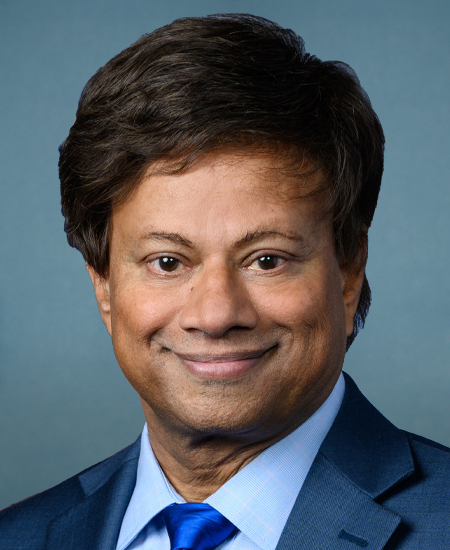
Rep. Shri Thanedar
Sponsored bills
Fix Our Flooded Basements Act of 2025 This bill expands the disaster assistance provided to individuals and households for repairs to and property in flood-damaged basements. It also expands eligibility and coverage for certain group flood insurance. Under current law, the Individual Assistance (IA) program of the Federal Emergency Management Agency (FEMA) limits home repair assistance for flood-damaged basements to damage affecting the safety, sanitation, or functionality of the home (e.g., structural damage, hazardous conditions). The bill allows home repair assistance for disaster-caused mold, mildew, and moisture damage in basements regardless of whether the damage affects safety, sanitation, or functionality. Additionally, flood-damaged basements are eligible for home repair assistance even when the basement is not required for occupying the dwelling. Also, currently, IA assistance for flood-damaged personal property in basements is limited to washers, dryers, and property essential for occupying the dwelling. The bill expands IA personal property assistance to more broadly cover property damaged by disaster-caused flooding in basements. The scope of such assistance must at least equal the coverage for such damage by a standard policy under the National Flood Insurance Program (e.g., covering air conditioning units and freezers in basements). Additionally, FEMA must expand the eligibility and coverage of the group flood insurance it provides to IA recipients, including increasing the maximum coverage and expanding coverage for basements. The bill also excludes from the maximum for IA housing assistance expenses for (1) hazard mitigation measures in flood-damaged basements, and (2) premiums for group flood insurance policies.
Maddy summaryHRES 615 is a ceremonial resolution celebrating the 324th anniversary of Detroit's founding (July 24, 1701) and recognizing the city's cultural and historical contributions to the United States. It highlights Detroit's role as the Midwest's oldest major city, its significance in the Underground Railroad, automotive innovation (birthplace of the Model T), Motown music, labor movements, and other cultural milestones. The resolution has no policy impact or effect on specific groups; it is purely symbolic, expressing congressional recognition through three stated actions: celebrating the anniversary, acknowledging Detroit's cultural contributions, and honoring its residents. As a procedural resolution, it does not create new laws or alter existing policies.
Maddy summaryHR 4763, the PTO Act, requires most employers to provide employees with at least 1 hour of paid annual leave for every 25 hours worked, with a maximum of 80 hours per year. It applies to private-sector workers and certain government employees, protecting their right to use paid leave for any purpose without disclosing the reason. The bill mandates employers to maintain health benefits during leave, allow carryover of up to 40 hours of unused leave, and pay out unused leave upon separation. It also prohibits employers from discriminating against employees for using paid leave or requiring them to find replacements while on leave. The law includes enforcement mechanisms, allowing employees to file complaints with the Department of Labor or pursue private lawsuits.
Maddy summaryHR 4767 establishes two key programs to expand international educational exchanges. It creates a scholarship program allowing international students, scholars, and experts to study at U.S. community colleges and vocational institutions for up to one academic year in priority sectors like agriculture, engineering, health, and environmental resilience. The bill also funds a capacity-building program to help these U.S. institutions develop stronger study abroad offerings through grants, training, and resources for faculty and underrepresented students. These provisions directly affect eligible U.S. junior colleges and vocational schools by increasing their opportunities to partner with international participants and expand global education programs.
Maddy summaryHR 4699, the BIKE Act of 2025, requires federal grant funding to support bicycle safety education programs for elementary and secondary school students. It mandates the Secretary of Transportation to revise Highway Safety Program Guideline No. 14 to include specific provisions for teaching bicycling skills, traffic rules, road navigation, safety precautions, and helmet use. The revised guidelines must be developed with input from educators and disseminated to state education agencies for integration into school curricula. This bill directly affects public school students and school districts through new safety education requirements and federal funding opportunities.
Maddy summaryHCONRES 46 is a non-binding congressional resolution expressing support for climate restoration. It declares Congress' commitment to restoring atmospheric CO2 levels to below 300 ppm (pre-industrial levels) and identifies climate restoration alongside achieving net-zero emissions as key climate policy priorities. The resolution specifically calls on the President, Secretary of State, and U.S. Ambassador to the UN to take actions toward restoring the climate and stabilizing greenhouse gas concentrations at preindustrial levels. It does not create new laws or funding, but formally recognizes an obligation to future generations to reverse climate change impacts. The resolution directly affects U.S. climate policy direction and international climate diplomacy efforts.
Maddy summaryHJRES 111 is a joint resolution seeking congressional disapproval of a U.S. Fish and Wildlife Service rule on barred owl management. The rule, published in September 2024, outlined strategies to reduce barred owl populations to protect the endangered spotted owl. Under the Congressional Review Act, this resolution would nullify the rule, preventing its implementation. If enacted, the rule would have no legal effect, and the agency could not enforce the barred owl management strategy.
Maddy summaryHRES 603 is a symbolic resolution (not a law) that reaffirms core constitutional principles like separation of powers, judicial independence, and Congress's authority over funding. It specifically condemns public officials who ignore court orders, undermine congressional oversight, or attempt to consolidate power across branches of government. The resolution emphasizes that congressional appropriations are binding law, not suggestions, and urges all officials to uphold the constitutional order. It does not create new legal requirements but serves as a formal statement of these principles.
Maddy summaryThis bill would prohibit the detention of pregnant women, lactating women, and postpartum mothers (within one year of childbirth) in immigration custody, requiring their immediate release except in rare circumstances involving public safety threats. It bans the use of physical restraints on these individuals during pregnancy, labor, delivery, and postpartum recovery, with only extremely limited exceptions. The bill mandates that facilities provide comprehensive reproductive health care including prenatal care, labor and delivery services, postpartum care, and access to abortion services. It requires facilities to maintain medical records, obtain informed consent for medical procedures, and conduct weekly reviews of any detained individuals under exceptional circumstances. The bill also establishes reporting requirements for facilities and creates transparency through public reporting of detention practices.