

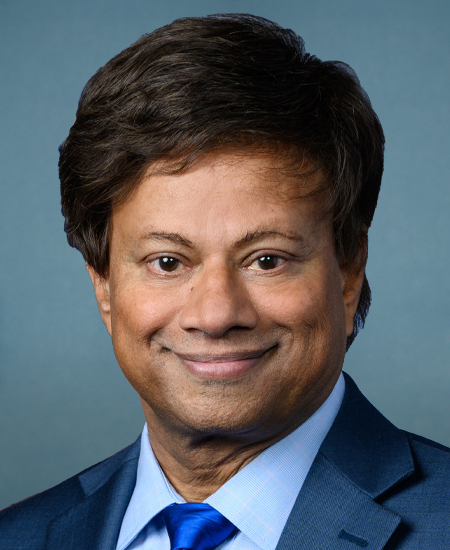
Photo of Shri Thanedar
D United States House · District 13 · Michigan

Rep. Shri Thanedar

Compare
Total votes
1,879
all sessions
Attendance
99%
12 missed
Near the chamber average
With party
97%
of cast votes
Near the chamber average
Bipartisan score
2%
crosses aisle rarely
Near the chamber average
Sponsored
1,693
bills & resolutions
Higher than 98% of chamber peers
Committees
4
assignments
1,693 bills and resolutions

Sponsored bills

Total
1,693
Primary
69
Co-sponsor
1,624
This page
1,693
matching current filters
Co-sponsor HR 8132
In committee · United States House · Co-sponsor
Balancing Incentives Act of 2024

Maddy summaryHR 8132, the Balancing Incentives Act of 2024, requires patent owners to explicitly consent before certain patent challenges can be filed. Specifically, it amends patent law to add a new requirement that the patent owner must consent to the filing of petitions for inter partes review or post-grant review under Sections 312(a) and 322(a) of Title 35. This change directly affects patent owners and entities seeking to challenge patents through these review processes. The bill makes no substantive changes to patent law but modifies the procedural step for initiating these reviews.

In committee Apr 26, 2024 1 co-sponsor
Co-sponsor HR 8103
In committee · United States House · Co-sponsor
Department of Homeland Security Office for Civil Rights and Civil Liberties Authorization Act

Maddy summaryHR 8103 establishes a new Office for Civil Rights and Civil Liberties within the Department of Homeland Security (DHS), creating a dedicated "Officer for Civil Rights and Civil Liberties" position that reports directly to the DHS Secretary. This office oversees compliance with civil rights and civil liberties standards across all DHS policies, programs, and activities, reviews complaints of abuses (like profiling), and integrates protections into decision-making. Key mechanisms include requiring DHS components to consult the Officer before policy changes, mandating investigations of complaints within 30 days, and requiring annual public reports to Congress on civil rights implementation. The bill directly affects DHS employees and the public impacted by DHS operations, ensuring accountability through structured oversight and transparency.

In committee Apr 20, 2024 1 co-sponsor
Co-sponsor HR 8061
In committee · United States House · Co-sponsor
Crime Victims Fund Stabilization Act of 2024

Maddy summaryHR 8061, the Crime Victims Fund Stabilization Act of 2024, ensures stable funding for the Crime Victims Fund by directing certain False Claims Act collections into it from 2024 through 2029. Specifically, it adds a provision requiring that amounts collected under the False Claims Act (excluding whistleblower rewards and government reimbursement for damages) be deposited into the fund during this period. This directly affects crime victims who rely on the fund for services like counseling and emergency aid, as it prevents potential shortfalls in funding. The bill makes a concrete policy change by redirecting specific federal civil penalties into the fund, rather than altering the fund's existing purposes or eligibility rules.

In committee Apr 18, 2024 1 co-sponsor
Co-sponsor HR 3303
In committee · United States House · Co-sponsor
Maternal Health for Veterans Act

Maddy summaryHR 3303, the Maternal Health for Veterans Act, requires the Department of Veterans Affairs (VA) to annually report on maternity care coordination programs and maternal health outcomes for veterans receiving care through VA facilities or VA-contracted providers. The bill mandates the VA to collect data on maternal outcomes - including disparities affecting high-risk demographic groups - and submit recommendations to Congress by September 2028. It authorizes $15 million annually (2024-2028) for VA maternity care coordination programs, supplementing existing funding without reducing current resources. The law directly affects veterans using VA maternity services, aiming to improve care through data-driven strategies.

In committee Apr 16, 2024 1 co-sponsor
Co-sponsor HRES 1148
In committee · United States House · Co-sponsor
Condemning the Iranian regime's terrorism, regional proxy war, internal suppression, and for other purposes.

Maddy summaryHRES 1148 is a resolution passed by the U.S. House of Representatives that condemns the Iranian government for supporting terrorism, regional proxy conflicts, and internal suppression of dissent - including its crackdown on protests following Mahsa Amini's death in 2022. It specifically calls for maintaining sanctions against Iran, supporting the Iranian Resistance's Ten-Point Plan (which advocates for a democratic, secular, nonnuclear Iran), and protecting Iranian political refugees in Albania. The resolution also affirms the Iranian people's right to self-determination under international law and urges the U.S. to recognize their struggle for freedom. As a non-binding resolution, it does not create new laws but formally expresses congressional stance.

In committee Apr 15, 2024 1 co-sponsor
Co-sponsor HR 8013
In committee · United States House · Co-sponsor
Gig Is Up Act

Maddy summaryHR 8013, the Gig Is Up Act, requires large employers (those with $100 million+ in annual gross receipts and 10,000+ independent contractors) to treat payments to certain gig workers as wages for payroll tax purposes. This means these employers must withhold Social Security and Medicare taxes at double the standard rate (instead of the usual 7.65%), similar to how they handle employee wages. The change applies to payments made after December 31, 2024, and directly affects major gig platforms and their workers who currently pay self-employment taxes. The bill does not reclassify workers as employees but alters how their payments are taxed under the Social Security system.

In committee Apr 15, 2024 1 co-sponsor
Co-sponsor HR 7998
In committee · United States House · Co-sponsor
Combating Hate Across Campus

Maddy summaryThe Combating Hate Across Campus Act (HR 7998) requires colleges and universities to collect and report campus hate crime statistics with more detailed demographic breakdowns. It amends the Higher Education Act to mandate that institutions disaggregate hate crime data by the specific identity of the targeted individual or group (such as race, religion, or sexual orientation), using the FBI's most recent hate crime data collection guidelines. This change ensures reports provide precise information about the nature and scope of hate incidents on campus. The requirement applies to all institutions of higher education receiving federal student aid under the Higher Education Act.

In committee Apr 15, 2024 1 co-sponsor
Primary HRES 1131
In committee · United States House · Lead sponsor
Celebrating Hindu Americans, and condemning attacks on Hindu places of worship, Hinduphobia, and anti-Hindu bigotry, and for other purposes.

Maddy summaryThis resolution (HRES 1131) is a symbolic House measure celebrating Hindu Americans and condemning anti-Hindu hate. It recognizes Hinduism’s global significance and Hindu Americans’ contributions to U.S. society, including cultural, economic, and spiritual impacts like yoga and Ayurveda. The resolution specifically condemns Hinduphobia, anti-Hindu bigotry, hate crimes targeting places of worship (mandirs), and discrimination faced by Hindu Americans, referencing rising FBI-reported hate crimes. As a non-binding resolution, it does not create new laws or allocate funds but aims to affirm support for Hindu Americans through public declaration.

In committee Apr 10, 2024 0 co-sponsors
Co-sponsor HRES 1121
In committee · United States House · Co-sponsor
Recognizing the 158th anniversary of the Civil Rights Act of 1866.

This resolution recognizes the anniversary of the Civil Rights Act of 1866 and its impact on establishing that all Americans are protected equally under the law.

In committee Apr 9, 2024 1 co-sponsor
Co-sponsor HR 7894
In committee · United States House · Co-sponsor
STAGE Act

Maddy summaryThe STAGE Act establishes a federal grant program to support professional nonprofit theaters. Eligible theaters (nonprofits producing live performances with fair wages, 3+ years of programming, and financial need or community focus) can receive grants covering payroll, facility repairs (prioritizing accessibility), marketing, and workforce training. Grants max out at $16 million per entity or 20% of its prior year's expenses, with $1 billion annually allocated for 2024-2028. The bill also mandates a federal study on sustaining the nonprofit arts sector, including input from artists and community stakeholders.

In committee Apr 9, 2024 1 co-sponsor
Showing 1,271 to 1,280 of 1,693 bills