

Maddy summaryThis bill would require federal firearms licensees to prohibit sales of specific high-capacity rifles and shotguns to people under 21. It targets semiautomatic centerfire rifles and shotguns capable of holding more than 5 rounds in their magazines, raising the age limit from 18 to 21 for these weapons. Exceptions apply for active military members and certain government employees authorized to carry firearms. The law directly affects gun retailers and individuals under 21 seeking to purchase these specific firearms. It modifies existing federal gun sale rules without changing age requirements for other firearms.
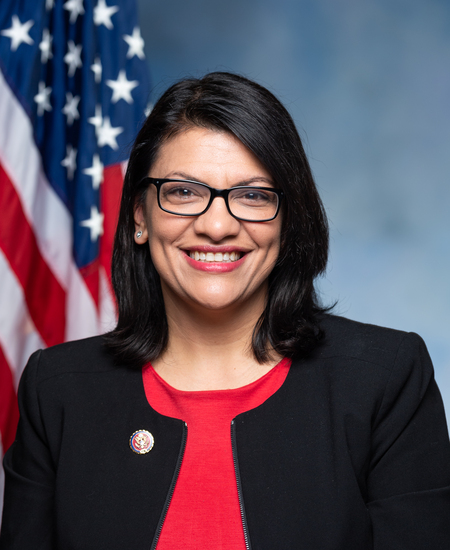
Rep. Rashida Tlaib
Sponsored bills
Maddy summaryHR 2366, the American Families United Act, amends immigration law to expand discretion for the Attorney General and Secretary of Homeland Security regarding family-related cases. It allows them to halt removal proceedings or grant relief for spouses and children of U.S. citizens if removal would cause "hardship" (with family separation presumed to constitute hardship), including special provisions for widows/orphans of deceased citizens. The bill also permits waiving certain inadmissibility grounds and excludes cases involving serious violations like terrorism or criminal offenses. This policy change directly affects noncitizens facing removal proceedings who have U.S. citizen family members, without creating new benefits but modifying existing discretionary authority.
Maddy summaryHCONRES 21 is a symbolic House resolution recognizing the persistent gender wage gap in the U.S., where women earn significantly less than men for comparable work. It cites specific data showing women overall earn 75 cents and women of color earn even less (e.g., 58 cents for Latinas) per dollar earned by White, non-Hispanic men. The resolution does not create new laws or policies but formally acknowledges the economic impact of this disparity, including annual lost wages exceeding $994 million for full-time women workers. It also highlights designated Equal Pay Days for different demographic groups to underscore the varying timelines to close the gap.
Maddy summaryThe WRCR Act of 2025 expands the Earned Income Tax Credit (EITC) to include qualifying students who meet specific criteria, such as receiving a Federal Pell Grant or having household income below 300% of the poverty line. It lowers the age requirement for eligibility from 25 to 18 and creates a special rule treating certain care-giving and learning activities as "compensated work" for EITC purposes. The bill increases credit percentages for certain taxpayers, modifies phaseout amounts to $4,000 (single filers) and $30,000 (joint filers), and establishes an advance payment system allowing monthly EITC payments up to 75% of the estimated credit. These changes directly affect low-income workers, students, and families with children who qualify for the EITC, with the advance payments beginning in 2026 for taxable years after 2024.
Maddy summaryThis bill adds Medicare coverage for home-based treatment of Alpha-1 Antitrypsin Deficiency Disorder (a rare genetic condition causing lung and liver damage). It specifically covers "augmentation therapy" (replacement protein therapy) delivered at home by qualified suppliers to Medicare Part A and B enrollees with this diagnosis who aren't in Medicare Advantage plans. The bill establishes payment for intravenous kits and up to 2 hours of nursing services per session, set at 80% of the lesser of actual cost or a defined rate. It amends Medicare rules to include this treatment under coverage, effective January 2027.
Maddy summaryThe Children’s Health Protection Act of 2025 establishes a new Office of Children’s Health Protection within the Environmental Protection Agency (EPA), led by a Director appointed by the EPA Administrator. The Office will identify environmental health risks disproportionately affecting children, coordinate federal programs to address these risks, and develop resources for schools to implement environmental health programs. It will also work with a permanent advisory committee to advise on safe chemicals management, evaluate environmental contaminants linked to childhood disease, and support healthcare providers through pediatric environmental health specialty units. The bill authorizes $7.8 million annually for the Office and $13.2 million total for the program through 2030.
Maddy summaryThe Paycheck Fairness Act strengthens equal pay protections by expanding the definition of "sex" to include pregnancy, childbirth, sexual orientation, gender identity, and sex characteristics. It modifies employer defenses for pay disparities to require proof that any pay difference is job-related, not based on sex, and accounts for the entire pay gap. The bill prohibits employers from asking about salary history, enhances penalties for violations, and requires employers with 100+ employees to collect and report detailed pay data by race, sex, and job category. It also establishes training programs for employers on eliminating pay bias and creates a National Equal Pay Enforcement Task Force to coordinate enforcement efforts. This legislation directly affects employers, particularly those with 100+ employees, and aims to address pay disparities impacting women, people of color, and other underrepresented groups.
Maddy summaryH.J. Res. 80 would declare the Equal Rights Amendment (ERA) part of the U.S. Constitution, asserting it has been ratified by 38 states (three-fourths of the states) despite the original 1972 deadline. If passed, this resolution would formally establish the ERA as a constitutional amendment, requiring all federal and state laws to align with its gender equality protections. The bill does not create new laws but confirms the ERA's status as part of the Constitution, affecting how laws are interpreted and enforced. It is a procedural step to resolve the legal dispute over the ERA's validity after decades of debate.
Maddy summaryHRES 238 is a non-binding House resolution expressing the House's position that every person has the basic right to emergency health care, including abortion care during medical emergencies. It does not create new laws or alter existing regulations but formally states the House's view that abortion restrictions in emergencies endanger patients' health and lives. The resolution specifically highlights how current abortion bans put pregnant people at risk during life-threatening conditions like hemorrhage or infection, disproportionately impacting Black, Indigenous, people of color, immigrants, and low-income individuals. It serves as a symbolic statement opposing policies that restrict emergency reproductive care access.
Maddy summaryThis bill creates a dedicated Inspector General (IG) position specifically for the Office of Management and Budget (OMB). It clarifies that the OMB IG's oversight authority is limited to matters explicitly assigned by law, preventing broader jurisdiction. The President must appoint this IG within 120 days of the bill's enactment. The bill directly affects OMB's internal oversight structure and the new IG's defined role, with no direct impact on the public or other agencies.