

Maddy summaryThe ABC Act (HR 2491) requires the Centers for Medicare & Medicaid Services and the Social Security Administration to review and simplify eligibility processes, forms, and communications for Medicare, Medicaid, CHIP, and Social Security programs. It specifically aims to reduce duplicate paperwork for family caregivers - defined as individuals supporting people with disabilities or health needs - and improve accessibility through features like ADA-compliant websites, translation services, and reduced call wait times. The agencies must gather input from caregivers and organizations, then implement changes to streamline interactions. Within two years, they must report findings and proposed actions to Congress, with follow-up reports every two years. This procedural bill focuses on administrative improvements, not new benefits.
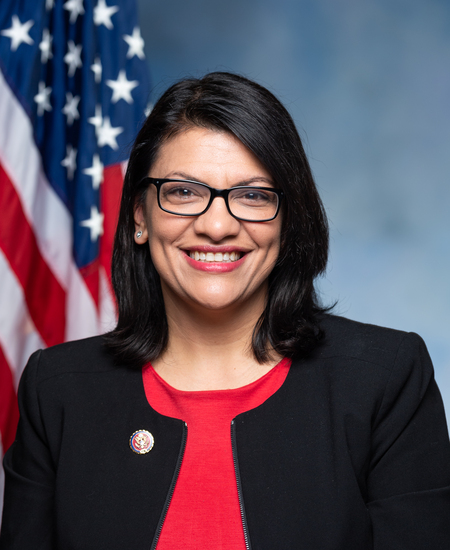
Rep. Rashida Tlaib
Sponsored bills
Maddy summaryHR 1756, the "Stop Politicians Profiting from War Act of 2025," prohibits Members of Congress, their spouses, and dependent children from owning or trading stocks, bonds, or other investments tied to defense contractors with U.S. Department of Defense contracts. It requires all such holdings to be divested within 120 days (or 180 days for complex funds) of enacting the law or when taking office, banning "blind trusts" as a compliance method. Exceptions include diversified investment funds meeting specific criteria, Alaska Native Claims Settlement stock, U.S. Treasury securities, and government retirement plans. Violations could result in civil penalties up to $50,000 per offense.
Save America's Forgotten Equines Act of 2025 or the SAFE Act of 2025 This bill permanently prohibits the slaughter of equines (e.g., horses and mules) for human consumption. (Current law prohibits the slaughter of dogs and cats for human consumption. This bill extends the prohibition to equines.) Specifically, this bill prohibits a person from knowingly (1) slaughtering an equine for human consumption; or (2) shipping, transporting, possessing, purchasing, selling, or donating an equine to be slaughtered for human consumption or equine parts for human consumption. The bill subjects a violator to a fine. The bill applies to conduct in or affecting interstate or foreign commerce or within the special maritime and territorial jurisdiction of the United States. However, it does not apply to an activity carried out by an Indian for a religious ceremony. As background, in recent years, the appropriations acts have prohibited the Department of Agriculture (USDA) from using federal funds to inspect horses before they are slaughtered for human consumption. Therefore, there are currently no USDA-inspected horse slaughter facilities in the United States.
Maddy summaryThis resolution (HRES 263) is a symbolic gesture recognizing the Islamic holy month of Ramadan and extending best wishes for Eid al-Fitr. It commends Muslims worldwide for observing Ramadan through fasting, spiritual renewal, and charitable practices, while acknowledging the contributions of American Muslims to society. The resolution does not create new laws or policies but expresses solidarity with Muslim communities in the U.S. and globally. It directly affects no specific group through legislative action, as it is a non-binding statement of support. The resolution was introduced in the House on March 27, 2025, by Representatives Dingell, Tlaib, and Carson.
Maddy summaryHouse Resolution HRES 267 formally recognizes the 10th anniversary of Educators Rising (rebranded in 2015) and its work preparing high school students for teaching careers. The resolution commends the program for addressing teacher shortages through local "Grow Your Own" initiatives that connect students to teaching pathways. It highlights Educators Rising’s national reach (1,400+ chapters) and role in fostering educator diversity, but contains no new policies, funding, or direct impacts on individuals or schools. As a symbolic resolution, it does not create legal obligations or alter existing programs.
Maddy summaryThis bill requires lenders in federally backed manufactured home community loan programs to include specific tenant protections in lease agreements. It mandates 1-year lease terms with renewal options, 60-day written notice for rent increases (with extended notice for larger hikes), grace periods for payments, and rights for homeowners to sell their homes in place without relocation. Violations trigger penalties like refunding rent with interest or paying damages to affected tenants, while a new Commission will propose stronger future protections. The law applies specifically to communities receiving federal loans under programs like HUD’s manufactured home park financing.
Maddy summaryHR 2475 establishes a 3-year pilot program providing direct cash payments and supportive services to homeless youth and young adults aged 18-30 living in low-income geographic areas. The program would randomly select up to 105,000 participants to receive monthly payments of at least $1,400 or the adjusted fair market rent for a 2-bedroom apartment, along with housing navigation, financial coaching, and workforce development services. Participants must consent to sharing tax information but the program is designed not to affect eligibility for other benefits or public charge status. The program includes a study to evaluate its impact on housing outcomes, economic mobility, and health for participants, with the goal of determining if direct cash payments could help reduce homelessness among young people.
Maddy summaryHR 2469, the Abortion DOULAS Act, mandates a study by the Secretary of Health and Human Services on abortion doula care - non-clinical support provided by trained professionals before, during, and after abortions. The study will collect data from patients, doulas, and providers to assess benefits, barriers (like cost and limited Medicaid coverage), and accessibility, especially for marginalized communities. It requires a report to Congress within 18 months, including recommendations for integrating abortion doula care into state Medicaid programs. The bill directly affects patients seeking abortion care, abortion doulas, and state Medicaid systems by focusing on evidence-based policy development. It does not alter current coverage but aims to inform future policy changes.
Maddy summaryThe COST of Relocations Act (HR 2470) requires federal agencies to conduct a detailed benefit-cost analysis before relocating more than 5% or 100 employees (whichever is smaller) outside their current commuting area. Agencies must submit an unredacted report to their Inspector General, covering expected outcomes, stakeholder impacts, risk assessments, and how the move affects the agency's mission. The Inspector General then reviews the report and submits findings to Congress within 90 days, including an assessment of whether the relocation complies with existing OMB guidance. This law applies specifically to significant relocations of federal operations, ensuring transparency without overriding other legal requirements for such moves.
Maddy summaryThis bill creates an entitlement program guaranteeing housing vouchers to young adults aged 18-30 experiencing homelessness, directly addressing systemic barriers that currently prevent them from accessing housing assistance. It requires public housing agencies to provide voluntary support services (like job training and housing navigation) while prohibiting discrimination based on credit history, immigration status, or other protected factors. Funded starting in fiscal year 2027, the program targets vulnerable youth disproportionately affected by homelessness, including Black, Indigenous, and LGBTQ+ communities. By expanding access to housing choice vouchers and reducing wait times from 132-140 days, it aims to improve housing stability and reduce homelessness for this population.