Court Legal Access and Student Support Act of 2021 or the CLASS Act of 2021 This bill prohibits institutions of higher education (IHEs) that participate in federal student-aid programs from restricting students' ability to pursue claims against IHEs in court. In addition, the bill makes mandatory arbitration agreements inapplicable to enrollment agreements between students and IHEs.
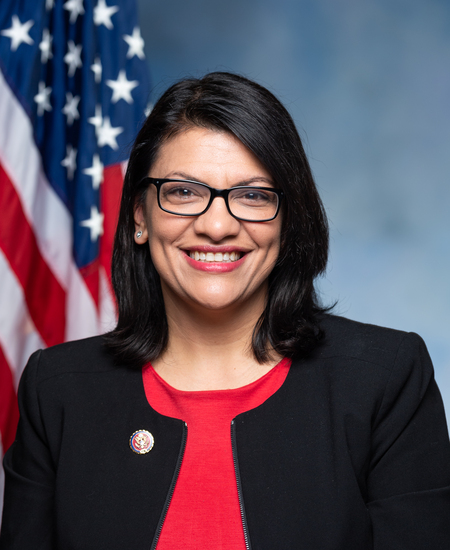
Rep. Rashida Tlaib
Sponsored bills
Bringing an End to Harassment by Enhancing Accountability and Rejecting Discrimination in the Workplace Act or the BE HEARD in the Workplace Act This bill expands protections against discrimination and harassment in the workplace and raises the minimum wage for tipped employees. Specifically, the bill (1) makes it an unlawful employment practice to discriminate against an individual in the workplace based on sexual orientation, gender identity, pregnancy, childbirth, a medical condition related to pregnancy or childbirth, or a sex stereotype; and (2) provides a statutory definition for what constitutes workplace harassment. Further, these protections apply to all workplaces, regardless of size, and to all workers, including independent contractors, interns, volunteers, and trainees. The bill prohibits employers from entering into contracts or agreements with workers that contain certain nondisparagement or nondisclosure clauses and prohibits certain predispute arbitration agreements and postdispute agreements. It also establishes grant programs to (1) prevent and respond to workplace discrimination and harassment, (2) provide legal assistance for low-income workers, and (3) establish a system of legal advocacy in states to protect the rights of workers. The bill further provides employees the right to retain their tips and it increases, in specified annual increments, the minimum wage for tipped employees to match the federal minimum wage for nontipped employees. Additionally, the bill requires the Equal Employment Opportunity Commission to provide specified training and resource materials, establish and convene a harassment prevention task force, and establish an Office of Education and Outreach with regard to prohibited discrimination and harassment in employment. The bill also requires specified studies, reports, and research on prohibited workplace harassment.
Private Prison Information Act of 2021 This bill specifies that a record related to a nonfederal prison, correctional, or detention facility must be considered a federal agency record for purposes of the Freedom of Information Act (FOIA). A nonfederal prison, correctional, or detention facility must disclose information under FOIA unless the information is exempt from disclosure or the disclosure is prohibited by law. The term nonfederal prison, correctional, or detention facility means (1) a private prison, correctional, or detention facility; or (2) a state or local prison, jail, or other correctional or detention facility.
Customer Non-Discrimination Act This bill prohibits discrimination based on sex, sexual orientation, and gender identity with respect to public accommodations and facilities. Specifically, the bill defines and includes sex, sexual orientation, and gender identity among the prohibited categories of discrimination or segregation. The bill expands the definition of public accommodations to include places or establishments that provide (1) exhibitions, recreation, exercise, amusement, gatherings, or displays; (2) goods, services, or programs; and (3) transportation services. Protections against discrimination based on race, color, religion, sex, sexual orientation, gender identity, or national origin shall include protections against discrimination based on (1) an association with another person who is a member of such a protected class; or (2) a perception or belief, even if inaccurate, that an individual is a member of such a protected class. The bill prohibits the Religious Freedom Restoration Act of 1993 from providing a claim, defense, or basis for challenging such protections. The bill prohibits an individual from being denied access to a shared facility, including a restroom, a locker room, and a dressing room, that is in accordance with the individual's gender identity. The bill also prohibits the provision of less favorable treatment with respect to pregnancy, childbirth or related medical conditions as compared to other physical conditions.

Cameroon TPS Act of 2021 This bill permits nationals of Cameroon to qualify for temporary protected status, which prevents their removal from the United States and allows them to obtain employment and travel authorization. Such status shall be available to qualifying nationals of Cameroon for 18 months starting from this bill's enactment.
Fostering Overseas Rule of law and Environmentally Sound Trade Act of 2021 or the FOREST Act of 2021 This bill restricts certain commodities produced on illegally deforested land from accessing the U.S. market. Specifically, the bill prohibits the importation of any product made wholly or in part of a covered commodity produced from illegally deforested land. The bill outlines requirements for import declarations of covered commodities. The U.S. Trade Representative (USTR) must, within 30 days, publish (1) an initial list of covered commodities that consists of palm oil, soybeans, cocoa, cattle, rubber, and wood pulp; and (2) an initial list of covered products that are defined by the bill in accordance with the Harmonized Tariff Schedule. These lists must be updated at least on an annual basis. Further, the USTR must identify foreign countries without adequate and effective protection against illegal deforestation caused by the production of commodities that are likely to enter the United States. The USTR must develop an action plan that includes benchmarks for each identified country. Additionally, the bill creates an interagency working group to provide advice and recommendations to the USTR, U.S. Customs and Border Protection, and other relevant agencies. The bill provides funding to assist foreign governments in combating illegal deforestation. The bill also includes illegal deforestation as a specified unlawful activity under a federal financial crime statute. The bill establishes a federal procurement preference for commodities that are not produced from land subject to deforestation.
Lifting Immigrant Families Through Benefits Access Restoration Act of 2021 or the LIFT the BAR Act of 2021 This bill repeals certain limits on the eligibility of noncitizens who lawfully reside in the United States for federal means-tested programs, including Medicaid, the Children's Health Insurance Program (CHIP), programs funded through Temporary Assistance for Needy Families (TANF) grants, Supplemental Security Income (SSI), and certain nutrition and housing programs.
Welcoming Evacuees Coming from Overseas to Mitigate Effects of Displacement Act of 2021 or the WELCOMED Act of 2021 This bill makes certain individuals from Afghanistan eligible for any benefit that is available to a refugee, such as resettlement assistance. Specifically, this bill shall apply to a national of Afghanistan (or an individual with no nationality who last habitually resided in Afghanistan) who is temporarily paroled into the United States for urgent humanitarian reasons or significant public benefit during the four-year period beginning on July 1, 2021.
Supreme Court Term Limits and Regular Appointments Act of 2021 This bill establishes staggered, 18-year terms for Supreme Court Justices and limits the Senate's advice and consent authority in relation to the appointment of Justices. Specifically, the bill requires the President to appoint a Supreme Court Justice every two years. If the appointment of a Justice would result in more than nine Justices on the Court, then the nine most junior Justices shall make up the panel of Justices exercising judicial power in cases and controversies. Further, any Justice who has served a total of 18 years is deemed retired from regular service and may continue to serve as a Senior Justice. Senior Justices may continue to perform judicial duties assigned to them by the Chief Justice. However, no Justice appointed before the date of enactment shall be counted towards such panel, nor shall they be required to retire from regular active service. In the event of a vacancy on the Court, the Chief Justice must assign the Justice most recently designated as a Senior Justice to serve on the Court until the appointment of a new Justice. Additionally, the Senate's advice and consent authority is waived if the Senate does not act within 120 days of a Justice's nomination.
Supreme Court Ethics Act This bill establishes a new statutory requirement for the Judicial Conference of the United States to issue a judicial code of conduct for judges and justices of U.S. courts, including Justices of the Supreme Court. Currently, the Judicial Conference issues a code of conduct for judges of U.S. courts (but not for Justices of the Supreme Court).